Nukewatch

Working for a nuclear-free future since 1979

  • Issues
    • Direct Action
    • Environmental Justice
    • Nuclear Power
      • Chernobyl
      • Fukushima
    • Nuclear Weapons
    • On The Bright Side
    • Radiation Exposure
    • Radioactive Waste
    • Renewable Energy
    • Uranium Mining
    • US Bombs Out of Germany
  • Quarterly Newsletter
    • Quarterly Newsletter
    • Newsletter Archives
  • Resources
    • Nuclear Heartland Book
    • Fact Sheets
    • Reports, Studies & Publications
      • The New Nuclear Weapons: $1.74 Trillion for H-bomb Profiteers and Fake Cleanups
      • Nuclear Power: Dead In the Water It Poisoned
      • Thorium Fuel’s Advantages as Mythical as Thor
      • Greenpeace on Fukushima 2016
      • Drinking Water at Risk: Toxic Military Wastes Haunt Lake Superior
    • Nukewatch in the News
    • Links
    • Videos
  • About
    • About Nukewatch
    • Contact Us
  • Get Involved
    • Action Alerts!
    • Calendar
  • Donate

July 23, 2024 by Nukewatch Leave a Comment

Iran Reduces Enriched Uranium Stockpile

By Lindsay Potter

The International Atomic Energy Agency has reported that Iran has reduced its highly enriched stockpile of near-weapons-grade, or 60%-enriched uranium, in the last quarter. Iran achieved this reduction by deliberately mixing enriched uranium with “low-grade 2% material,” the Wall Street Journal reported, marking the third time Iran has taken such a step. Iran continues to assert its nuclear program is strictly for civilian use. The move is largely interpreted as a step by Iran towards de-escalation, especially over tensions with the United States. However, the U.S. has accused Iran of preventing IAEA inspectors from carrying out their work by failing to comply, provide information, or barring inspectors from the country. After the U.S. unilaterally withdrew from the Iran nuclear deal, the Joint Comprehensive Plan of Action, in 2018, Iran began to enrich uranium. Iran is the only country to enrich uranium to such a level of purity without also constructing a nuclear weapon, but has the right to do so for civilian purposes under the Nonproliferation Treaty. The U.S. continues to badger Iran at the IAEA for non-compliance and to insist that the IAEA probe deeper into Iran’s activities. Whether or not Iran’s efforts are so small as to only be symbolic, the U.S. continues to levy threats rather than hint at the possibility of mutual de-escalation.

— Reuters, March 7; Wall Street Journal, Feb. 26, 2024
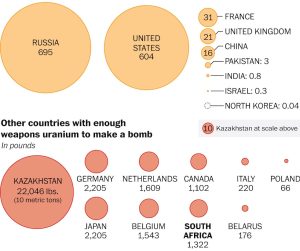
Photo: Washington Post

Filed Under: Newsletter Archives, Nuclear Weapons, Quarterly Newsletter

July 23, 2024 by Nukewatch Leave a Comment

NATO’s Biggest European Base, Next to Ukraine

By Lindsay Potter
radu-tudor.ro

NATO will build its biggest European base in Romania, next to Ukraine, thumbing its nose at Russia’s repeated warnings against NATO’s eastward expansion and the primary role NATO’s provocations played in Russia’s explanations for its ongoing military invasion of Ukraine. Euronews.com reports the base will be “the size of a small town.” The base will be close to the Black Sea, by the city of Constanta and 130km from the border with Ukraine. The project will build on the Mihail Kogalniceanu Romanian Air Force 57th Air Base and will plan to host 10,000 NATO soldiers and their families. Once complete, it should occupy 7,416 acres with a perimeter of 19 miles. All told, the build-out will cost Bucharest $2.7 billion. Currently, 5,000 NATO soldiers, mostly U.S., are based there.

Russian Senator Andrei Klimov said the base represents a “threat to Bucharest.” He adds, “The NATO suicide club drags ordinary civilians into such adventures. There won’t be any benefit for Romania from this … [the] closer it is to Russia’s borders, the more likely it is to be among the first targets for retaliatory strikes.”

— Defense Post, March 21; Kyiv Post, March 18, 2024

Filed Under: Newsletter Archives, Quarterly Newsletter, War

July 23, 2024 by Nukewatch Leave a Comment

New Report on Massive Global Nuke Spending

On June 17, the International Coalition to Abolish Nuclear Weapons released its fifth annual report on nuclear weapons spending, “Surge: 2023 Global Nuclear Weapons Spending.” Here’s what you need to know:

baselpeaceoffice.org

Country spending in 2023:

• China $11,850,032,735- $376/second
• France $6,060,606,061 – $192/ second
• India $2,657,874,340 – $84/second
• Israel $1,090,804,771 – $35/second
• North Korea $856,333,333 – $27/second
• Pakistan $1,011,005,630 – $32/ second
• Russia $8,308,544,638 – $263/second
• UK $8,058,218,532 – $256/ second
• US $51,500,000,000 – $1,633/second

The grand total of $91,393,420,041 amounts to $2,898/second spent on nuclear weapons in 2023.

The total is $10.8 billion more than in 2022. The United States spent more than all of the other nuclear-armed states combined and showed the biggest one-year increase ($51.5 billion).
The report also shows that total nuclear weapons spending in the last five years was more than $387 billion, more than what the World Food Programme estimates it would take to end world hunger.

Of that, companies got about 30% of all spending, and turned around to hire at least 450 lobbyists as well as provide financing for major think tanks to influence the nuclear debate.

— icanw.org/surge_2023_global_nuclear_weapons_spending

Filed Under: Military Spending, Newsletter Archives, Nuclear Weapons, Quarterly Newsletter

July 23, 2024 by Nukewatch Leave a Comment

Biden Approves Extension of Price-Anderson Act

On March 23, 2024, out of the public view and without a single hearing, both chambers of Congress passed legislation and the White House signed into law, the renewal of the Price-Anderson Act (PAA) that extends and expands the nuclear industry’s limited liability protection to the next severe accident by forty years until December 31, 2065. The PAA financially shields the nuclear industry that otherwise would never have built its first reactor.

While the [estimated] cost of nuclear accidents at Chornobyl and Fukushima have exceeded hundreds of billions of dollars, the current PAA limits the

theragblog.com

U.S. industry’s collective liability to just over $16 billion per accident — leaving federal taxpayers liable for the remaining compensation costs. Let’s remember, the U.S. government has yet to provide compensation to downwind U.S. citizens, still sickened and dying of cancer caused by the first atomic bomb “test” (Trinity) on July 16, 1945.

The PAA renewal is the most dramatic demonstration that the nuclear industry and its deluded champions have “no confidence” in their own cynical promotional rhetoric.

— Excerpted from Beyond Nuclear, March 27, 2024

Filed Under: Environment, Environmental Justice, Newsletter Archives, Nuclear Power, Quarterly Newsletter

July 23, 2024 by Nukewatch Leave a Comment

“Gigantic Subsea Nuclear Graveyard”

By Lindsay Potter
telegraph.co.uk

The United Kingdom is considering an unprecedented deep-sea Geological Disposal Facility (GDF) under the sea floor for high-level radioactive waste, currently estimated to cost $83 billion and take 150 years to build — making it the “biggest, longest-lasting, and most expensive infrastructure project ever undertaken in the U.K.,” according to the London Telegraph. The GDF would be a 3,500-foot-deep shaft with multiple tunnels to be filled and then sealed with cement. The London Telegraph reports that the shaft would connect to “huge vaults … excavated in the impermeable clays … scientists hope could provide a last resting place for Britain’s nuclear legacy.” The proposed sites are off the coast of Lincolnshire or off the coast of Cumbria, both areas dependent on tourism.

Professor of Energy Policy at Greenwich University Dr. Steven Thomas said, “these [cost] estimates are no more than a wild guess.” For now, contractor Nuclear Waste Services Co. (NWS) anticipates storing 26 million cubic feet of waste — 750,000 cubic feet are currently awaiting burial and the rest is estimated waste to be accumulated by the U.K.’s next generation of nuclear reactors. The waste includes 110,000 tons of uranium and 120 tons of plutonium. Uranium-238 takes 4.5 billion years for half to decay. Neil Hyatt, NWS’s chief scientific advisor, points out the waste will be deadly likely beyond the end of our civilization. “We’re talking about a piece of infrastructure that’s going to go with us on a journey into the future, for as far forward [in time] as homo sapiens has existed,” he said. Claire Corkhill, professor of radioactive waste management at Bristol University, who is also a member of the Government’s advisory Committee on Radioactive Waste Management, said, “We owe it to future generations to ensure that we have a solution for the radioactive waste generated from new nuclear power stations before we start producing it.”

— Le Show, May 12; electricityinfo.org, May 6; London Telegraph, May 5, 2024

Filed Under: Environment, Environmental Justice, Newsletter Archives, Nuclear Power, Quarterly Newsletter, Radioactive Waste

  • « Previous Page
  • 1
  • …
  • 39
  • 40
  • 41
  • 42
  • 43
  • …
  • 266
  • Next Page »

Stay Connected

  • Facebook
  • Twitter

Subscribe

Donate

Categories

  • B61 Bombs in Europe
  • Chernobyl
  • Counterfeit Reactor Parts
  • Depleted Uranium
  • Direct Action
  • Environment
  • Environmental Justice
  • Fukushima
  • Lake Superior Barrels
  • Military Spending
  • Newsletter Archives
  • North Korea
  • Nuclear Power
  • Nuclear Weapons
  • Office News
  • On The Bright Side
  • Photo Gallery
  • Protect the Water Close Xcel's Monticello Reactor
  • Quarterly Newsletter
  • Radiation Exposure
  • Radioactive Waste
  • Renewable Energy
  • Social Issues
  • Sulfide Mining
  • Through the Prism of Nonviolence
  • Uncategorized
  • Uranium Mining
  • US Bombs Out of Germany
  • War
  • Weekly Column

Contact Us

(715) 472-4185
nukewatch1@lakeland.ws

Address:
740A Round Lake Road
Luck, Wisconsin 54853
USA

Donate To Nukewatch

News & Information on Nuclear Weapons,
Power, Waste & Nonviolent Resistance

Stay Connected

  • Facebook
  • Twitter

© 2026 · Nukewatch