Nukewatch

Working for a nuclear-free future since 1979

  • Issues
    • Direct Action
    • Environmental Justice
    • Nuclear Power
      • Chernobyl
      • Fukushima
    • Nuclear Weapons
    • On The Bright Side
    • Radiation Exposure
    • Radioactive Waste
    • Renewable Energy
    • Uranium Mining
    • US Bombs Out of Germany
  • Quarterly Newsletter
    • Quarterly Newsletter
    • Newsletter Archives
  • Resources
    • Nuclear Heartland Book
    • Fact Sheets
    • Reports, Studies & Publications
      • The New Nuclear Weapons: $1.74 Trillion for H-bomb Profiteers and Fake Cleanups
      • Nuclear Power: Dead In the Water It Poisoned
      • Thorium Fuel’s Advantages as Mythical as Thor
      • Greenpeace on Fukushima 2016
      • Drinking Water at Risk: Toxic Military Wastes Haunt Lake Superior
    • Nukewatch in the News
    • Links
    • Videos
  • About
    • About Nukewatch
    • Contact Us
  • Get Involved
    • Action Alerts!
    • Calendar
  • Donate

June 21, 2026 by Nukewatch Leave a Comment

Proximity to Nuclear Reactors Associated with Increased Cancer Deaths

By Maya Brownstein

BOSTON, Mass. — U.S. counties located closer to operational nuclear power plants (NPPs) have higher rates of cancer mortality than those located farther away, according to a new study led by the Harvard T.H. Chan School of Public Health.

The study is the first of the 21st century to analyze proximity to NPPs and cancer mortality across all NPPs and every U.S. county. The researchers emphasized that the findings are not enough to establish causality but do highlight the need for further research into nuclear power’s health impacts.

The study was published Feb. 23, 2026, in the journal Nature Communications.Where Is the Largest Nuclear Power Plant in the U.S.? Top 20 for 2025 ...
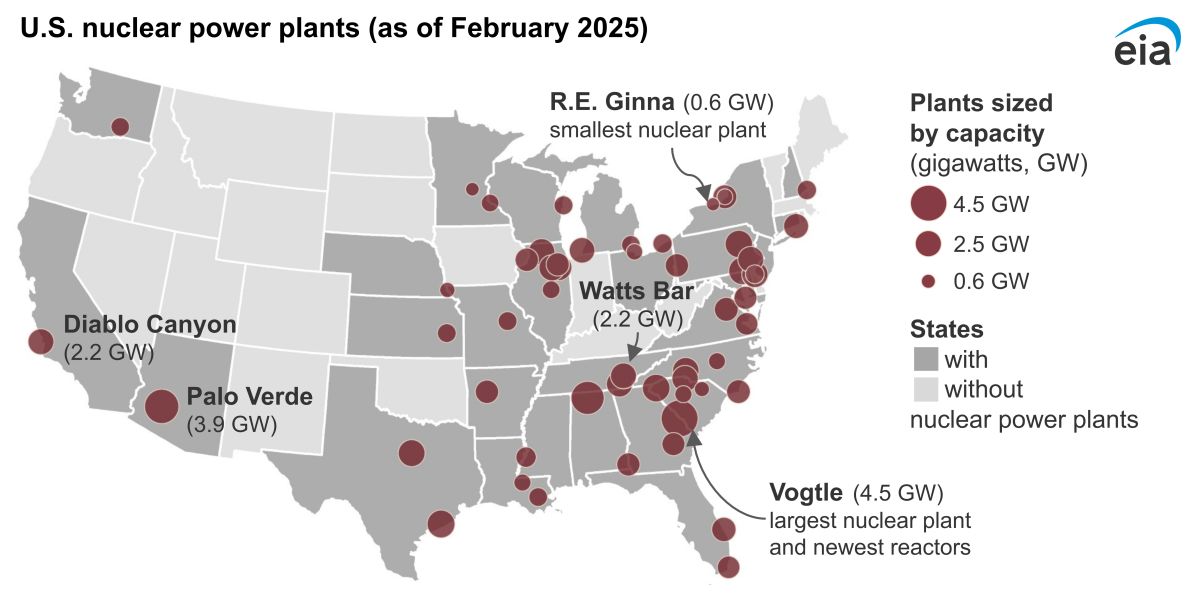
Numerous studies on the potential link between NPPs and cancer have been conducted around the world, with conflicting results. In the U.S., these studies have been rare and limited in their scope, focused on a single NPP and its surrounding community.

To expand the evidence base, the researchers conducted a national assessment of NPPs and cancer mortality between 2000 and 2018 using “continuous proximity.” They used advanced statistical modeling that captured the cumulative impact of all nearby NPPs, rather than just one. The locations and dates of operation of U.S. NPPs — as well as some nearby in Canada — were obtained from the U.S. Energy Information Administration, and county-level data on cancer mortality was obtained from the Centers for Disease Control and Prevention. The researchers controlled for potential confounders [that might effect data] in each county, including educational attainment, median household income, racial composition, average temperature and relative humidity, smoking prevalence, BMI [body mass index], and proximity to the nearest hospital.

The study found that U.S. counties located closer to nuclear power plants experienced higher cancer mortality rates, even after accounting for socioeconomic, environmental, and health care factors. The researchers estimated that over the course of the study period, roughly 115,000 cancer deaths across the U.S. (or about 6,400 deaths per year) were attributable to proximity to NPPs. The association was strongest among older adults.

“Our study suggests that living near a NPP may carry a measurable cancer risk — one that lessens with distance,” said senior author Petros Koutrakis, Professor of Environmental Health and Human Habitation. “We recommend that more studies be done that address the issue of NPPs and health impacts, particularly at a time when nuclear power is being promoted as a clean solution to climate change.”

The researchers noted that the results are consistent with the results of a similar study they conducted in Massachusetts, which identified elevated cancer incidence among populations living closer to NPPs.

They also noted some limitations to the study, including that it did not incorporate direct radiation measurements and instead assumed equal impact by [emissions from] all NPPs.

— Maya Brownstein is the Media Relations Manager in the Office of Communications, Chan School of Public Health.

— Link to Harvard report is here: https://www.nature.com/articles/s41467-026-69285-4

Filed Under: Environment, Newsletter Archives, Nuclear Power, Quarterly Newsletter, Radiation Exposure

June 21, 2026 by Nukewatch Leave a Comment

Monticello Reactor Leaks Oil to Mississippi while Shut Down for Repairs

The 55-year-old Monticello nuclear reactor owned by Xcel Energy was unexpectedly shut down February 20, 2026 to “perform maintenance” and to “determine appropriate repairs,” according to The Monticello Times. The reactor was restarted on April 3 after being offline 43 days.

No Minneapolis, regional, or national news service made mention of the reactor outage in spite of the “over 1 million users” that rely on its electricity (according to Xcel’s website). The reasons for the outage were not made public by the company, which did not name the equipment or sorts of systems that need repair.

The Nuclear Regulatory Commission also made no announcement of the shutdown, and its regional Public Affairs Officer Victoria Mitlyng wrote in an email to Nukewatch February 26, “The shutdown at Monticello was a planned maintenance shutdwon (sic) and did not require formal notifications. It’s a routine practice for nuclear plants.” The lack of a public NRC notification may explain why news services made no mention of the shutdown.

According to Xcel spokesperson Theo Keith, who spoke to The Monticello Times, the shutdown “is not related to the tritium leak” from the reactor and made public in 2023. Tritium is the radioactive form of hydrogen, and Mr. Keith’s reference is to the leak of 829,000 gallons of highly radioactive coolant that contaminated groundwater under the reactor site, some of which eventually reached the Mississippi River, a drinking water source for Minneapolis, St. Paul, and millions more downstream.

Xcel explained to the press that the regional electrical power grid draws from multiple generators across the Midwest, and that the mix of providers allows uninterrupted service even when individual systems are taken offline.

Myths Busted by Monticello Reactor Shutdown

Monticello’s unplanned 43-day shutdown debunks two myths endlessly repeated in nuclear propaganda: that it produces electricity 24/7, 365 days a year; and that nuclear’s electricity generation is needed.

First, the myth that nuclear power provides uninterrupted electric generation is boasted about on the Nuclear Energy Institute’s website, where its page-1 slogan is: “Only nuclear has the power to deliver 24/7/365.” But as the NRC’s Mitlyng emailed Nukewatch, “It’s a routine practice” for nuclear reactors to shut down. They are taken offline regularly and repeatedly by emergencies, by unexpected repair work, by refueling outages, and by emergencies and accidents that plague the industry. Historically, major nuclear reactor accidents occur early on following their start up, and late in their operational lives. At 55, Monticello is the sixth oldest of 94 reactors in the United States.

Second, promoters of commercial nuclear reactors say their electricity “is needed to keep the lights on.” This is BS again, as Xcel told the press that it “does not anticipate any impact to electric service while the plant is offline.”

Imagine a nuclear-free Mississippi River watershed. Xcel’s Monticello reactor isn’t needed to keep the lights on, and it’s so old that it can’t operate without major equipment repairs severe enough to gut Xcel’s profit-taking for months at a time.

Filed Under: Environment, Newsletter Archives, Nuclear Power, Protect the Water Close Xcel's Monticello Reactor, Quarterly Newsletter

June 21, 2026 by Nukewatch Leave a Comment

What Ever Happened to My ‘World-Class’ Nuclear Regulator? U.S. Showcases Dangerous Nuclear Reactor Designs


By Kelly Lundeen

If you do an online search for “world-class nuclear regulator” your results are filled with references to the “independent” and “rigorous” U.S. Nuclear Regulatory Commission, but that is changing. Maybe you’ve read headlines: “NRC Approves Construction Permit for TerraPower,” the first commercial sodium-cooled fast reactor to ever reach this milestone. It is one of several risky reactor proposals that may finally get their day in the spotlight amidst a sweeping series of federal mandates calling for mass deregulation. Rules that would have kept “small,” “modular,” or “advanced” nuclear reactors safer are being wiped from the books. Proposals that were previously discarded as fantastical appear to be gaining traction in regulatory processes. And you’re left wondering — how did we get to this point?

It’s been almost one year since the nuclear industry was gifted with four executive orders. In a press conference, the president, the leaders of the Department of War and Department of Energy, and nuclear industry executives shared their plan to achieve “American energy dominance” with nuclear.

Unashamed, Secretary of Interior Doug Burgum explained that they simply plan “to turn the clock back on over 50 years of overregulation of an industry.” The executive orders continue the degradation of an already highly flawed licensing process that began under former president Biden with passage of the 2024 ADVANCE Act. Through a fast-tracked licensing process, about 20 new reactors are making some regulatory headway, or at least headlines.

See related image detail. Altman-backed Oklo nuclear facility ramps up as AI industry looks to ...
Plutonium may become the fuel for the Oklo Inc. reactor sketched here under a DOE reactor pilot program. The nuclear industry relies on public and politicians’ ignorance and fascination with technology to promote dangerous nuclear reactors. Photocredit: Oklo

Reactor Licensing: Speeding Up and Slowing Down

A March 4 NRC press release announced the TerraPower Natrium reactor construction permit approval, “following a streamlined mandatory hearing process,” and bragged that the “NRC staff finished their technical review of this new design in less than 18 months.” This allowed little time for public input or environmental review. Whether the process is slow or fast, regulators nearly always give their seal of approval to nuclear projects, but cutting the licensing process down to a fraction of its previous timeline saves the nuclear industry a lot of money. Under a proposed Department of Energy (DOE) licensing process, some new reactors will be entirely exempt from adhering to the National Environmental Policy Act, which requires environmental assessments. Opposing the proposal, almost 50 organizations submitted comments to the DOE, which will serve as the basis for a lawsuit.

The new set of reactors are not the large, water-cooled, commercial units that have been operating for decades, and received licenses after a lengthy process under the NRC. So-called small modular nuclear reactor (SMNR) designs are lining up for approval through new programs; either expedited under the NRC, or extra-expedited under the DOE or Department of War.

The Nuclear Reactor Pilot Program was created under one of the May 2025 executive orders. Through this program, the hope of nuclear proponents is that the Department of Energy will give the initial thumbs up for a test version of SMNR designs without much hassle. Then, under a required, accelerated new process, the NRC will be asked to rubber stamp the DOE’s initial approval.

One of the questionable proposals selected for this program is the hole-in-one Deep Fission 15-megawatt-electric (one megawatt is one million watts)reactor that would be buried one mile under Parsons, Kansas in a borehole that serves double duty as a waste storage site. It would be a pressurized water reactor using low-enriched uranium fuel. The sudden announcement of a groundbreaking ceremony in December produced a clamor of opposition by local residents. July 4, 2026 was the deadline set by Trump for a minimum of three of the eleven DOE reactor pilot projects to reach “criticality,” the stage in which a reactor has a stable, self-sustaining fission reaction. On March 25, KRPS radio announced that the goalpost for this design was downgraded from “criticality by July 4” to “drilling test wells,” without a specified end date.

Changing Coolant Does Not Make it Cool

Vital safety issues have been overlooked in the rush to produce electricity for the booming numbers of data centers under the guise of “national security.” These reactor designs would have coolants different than water, including gas, liquid sodium metal, and molten salt. Physicist and mathematician Dr. Gordon Edwards recently laid out the essentials of why exploring any of these designs is illogical in a February webinar “Debunking Nuclear ‘Hopium,’” just as other nuclear experts have done many times in the past.

Gas-cooled reactors have the same problem as any conventional water-cooled reactor. Meltdown is caused by loss of coolant, which can happen whether the coolant is water or gas. Liquid sodium metal burns spontaneously and explodes in a violent chemical reaction on contact with water. At the temperature required inside the reactors, sodium also burns upon contact with oxygen. Molten salt, on the other hand, explodes when exposed to air. Of the new test designs selected by the DOE and the Dept. of War, at least four are cooled with gas, four with liquid sodium, three with molten salt, two with light water and two with water, but nuclear energy doesn’t change much no matter the coolant used.

Changing Fuel Does Not Make it Cool

Nuclear fission has some fundamental problems whichever way you split the atom. The new test reactor projects would be fueled by low-enriched uranium, high assay low-enriched uranium (known as HALEU), or metallic uranium-zirconium, and only whispers have been heard about Oklo Inc.’s Pluto reactor, which would use (shhhhh) weapons-grade plutonium as fuel. Nuclear energy involves the creation of radioactive waste, the risk of accidents, the task of decommissioning, and the creation of weapons material that is a target for terrorists. None of these problems goes away by switching to “small” or “advanced” reactors.

A Nuclear Catastrophe is Catastrophic

The nuclear industry works very hard to convince the public that nuclear power is safe. One company went so far as to name itself the “Ultra Safe Nuclear Corporation,” but then it went bankrupt. Nano Nuclear Energy, Inc. bailed out Ultra Safe Nuclear Corporation and is reviving its project at the University of Illinois Urbana-Champaign to build a 15-megawatt helium gas-cooled “Kronos” research microreactor on campus.

Nano Nuclear Energy, Inc. submitted a construction permit application to the weakened NRC April 2, but has acquired $6.8 million from the state of Illinois.

CEO Jay Yu assured the public on Fox 32, “our technologies have no liquid coolant. They can’t melt down. Even if you shoot a rocket at our fuel, it just passively cools. It would never blow up.” This might be theoretically possible if the only type of nuclear accident is meltdown, defined as “heat damage causing significant change in the physical structure of the core and penetration of at least one barrier.” Dr. Edwards clarifies, “when the uranium atoms are split, you have all those fission products building up and they’re there…. You can’t wish them out of existence. Anything that releases that material into the environment is going to be catastrophic for the neighboring environment…. That’s what nuclear catastrophes are.”

Reactors Breaking Ground

The federal government is pushing for eleven new reactors to be handled through the Nuclear Reactor Pilot Program. Under new expedited rules created by the DOE for the program, there are four stages: a design safety agreement, a preliminary safety analysis (based on the design being partially built), a final design phase (with the completion of construction), and a readiness review prior to startup. The first three steps are to be completed in 45 days. However, of those eleven reactor projects selected in August 2025, only four have reached the second step in the DOE process as of early April. Two more designs have completed the first step and several have “broken ground,” but it’s always fun to play in the dirt with a shovel if the newspapers will come to take a picture, whether you dig a hole or not.

“Small” Does Not Mean Clean, Affordable, or Fast

“S” stands for “small” in SMNRs, however, that is not reflected in the amount of radioactive waste that will be produced. Results published in the Proceedings of the National Academies of Sciences in 2022 “reveal that water-, molten salt-, and sodium-cooled [SMNR] designs will increase the volume of nuclear waste … by factors of 2 to 30.”

The TerraPower Natrium reactor is already on track to be the most expensive electricity produced in history. The 2025 World Nuclear Industry Status Report explains the economics. “TerraPower frequently states that the projected cost of the Natrium project is $4 billion; however, in a July 2024 interview, the company’s co-founder, former Microsoft CEO Bill Gates, stated that its full development cost could be ‘close to $10 billion.’ With 345 megawatts of nuclear generation capacity, the cost would be $12,000-$29,000” per kilowatt.

The disadvantages of SMNRs are many, but the primary problem is the inherently dangerous nature of atomic fission. Reactor designs similar to those being proposed have been tested since the 1950s, and have caused serious accidents. Years of research and development are still required to get SMNRs past the testing phase.

The billions of dollars in federal and private investment in SMNR development is money stolen from market-proven renewable energy installation and battery technology innovation that don’t produce deadly long-lived wastes.

Through bipartisan support of deregulation and expedited licensing, the nuclear industry seeks to shut the public out of the licensing process. This was already the case for DOE and Dept. of War projects, but is now also expanding under the NRC.

Communities nation-wide are exercising their right to be involved and slowing, if not stopping, some reactor proposals. Public involvement needs to be swift in shortened application process times and will be most effective pressuring local or state agencies. Smaller nuclear reactors are not safer, cleaner, cheaper, or faster. That’s what renewables are for.

— Sources for this report are with the online version.

Filed Under: Newsletter Archives, Nuclear Power, Quarterly Newsletter

June 21, 2026 by Nukewatch Leave a Comment

No More ‘New START’ Nuclear Weapons Numbers Treaty May Have Been Worse than Useless

By Ray Acheson

Yoshito Matsushige - Alchetron, The Free Social Encyclopedia
The atomic bomb dropped on Hiroshima, Japan, August 6, 1945 by the United States destroyed 140,000 civilians. It had only a fraction of the explosive and incendiary force of “tactical” warheads being built by the United States as a part of the Obama Administration’s trade-off for Senate ratification of the 2010 New START treaty. Photo by newspaper photographer Yoshito Matsushige.

On Feb. 5, 2026, New Strategic Arms Reduction Treaty (New START), the last remaining nuclear arms control agreement between Russia and the United States, officially expired. In September 2025, the Russian government offered to continue implementing the Treaty for another year if the U.S. government agreed, but the Trump regime did not formally respond to that offer. Instead, his administration has insisted on nuclear arms control talks with China, which has a much smaller arsenal than either Russia or the United States and has so far refused to engage in such negotiations.

The expiration of New START means that Russia and the United States could increase their deployed warheads substantially within a matter of months. New START, agreed to in 2010, obligated Russia and the United States to reduce their operationally deployed, “strategic” nuclear warheads to:

• 700 deployed intercontinental and submarine-launched ballistic missiles and heavy bombers assigned to nuclear missions;
• 1,550 nuclear warheads deployed on those platforms; and
• 800 launchers (both deployed and non-deployed).

The Treaty also included mechanisms for compliance and verification, twice-yearly exchanges of data, ongoing mutual notification about the movement of strategic nuclear forces, short-notice, on-site inspections of missiles, warheads, and launchers covered by the Treaty, and a bilateral consultative commission and clear procedures to resolve questions or disputes.

The cost of New START, however, was very high

The Obama administration agreed to a massive [$1.7 trillion] nuclear weapon modernization program in exchange for ratification by the U.S. Senate. This modernization program continues today, with the U.S. government spending billions every year to “upgrade” its nuclear arsenal, delivery systems, and related facilities. Thus, as ICAN Australia [Int’l Campaign to Abolish Nuclear Weapons] notes, U.S. ratification of New START “has arguably done more harm by entrenching the United States’ possession of nuclear weapons and thwarting prospects for disarmament.” Fifteen years later, we still have the modernization program, but not the treaty for which it was bargained.

Russia has also been modernizing its nuclear arsenal over the past years, and has threatened to use nuclear weapons in the context of its war in Ukraine. In 2024, Russia spent about $8.1 billion on its nuclear weapon program, while the U.S. spent about $56.8 billion. The Trump regime has suggested it might restart explosive nuclear testing, and has engaged in several unlawful military actions over the past year, including in Iran and Venezuela. Both Russia and the U.S. are in violation of many international laws and have shown disdain for any attempt to restrain their violence. In this context, prospects for nuclear arms control, let alone disarmament, look grim.

However, it’s important to recognize that the failure of Russia and the United States to extend New START or negotiate a new arms control agreement does not mark the beginning of a new nuclear arms race. The arms race has been underway for many years already. While the expiration of New START marks another development along this path, it is a path both countries were already on. Furthermore, New START itself, while limiting certain deployments, did not lead to denuclearization. Instead, it led to further expansion of nuclear arsenals. Whatever comes next must be substantially different — it must advance disarmament, not arms control; it must lead to abolition, not retrenchment of the weapons and systems that have led us further to destruction.

The Treaty on the Prohibition of Nuclear Weapons (TPNW) was developed exactly for this purpose. Supported by the majority of countries in the world, the TPNW offers a clear path to the end of nuclear weapons and the dangerous game being played by states that are gambling with all our lives. As ICAN says, “The dire international security environment at present, rather than serving as an excuse for inaction, must spur urgent action on disarmament…. Joining the TPNW is an important step that all countries can take to press for disarmament in these dangerous times.”

Reaching Critical Will urges:

• Russia and the United States to stick to the limits of New START and continue or restart the other measures of New START while they engage in good faith negotiations to end the arms race and achieve nuclear disarmament, as they and other nuclear-armed states are obligated to do under the Non-Proliferation Treaty’s Article VI;

• All nuclear-armed states to join the TPNW and end their nuclear weapon programs — and in the meantime, to stop their nuclear weapon modernization programs, refrain from expanding or sharing their arsenals, and not develop and deploy “missile defense” or nuclear space systems; and

• All states to reverse course from violating and dismantling international law, to instead pursue security through disarmament and diplomacy.

— Ray Acheson is Director of WILPF’s disarmament program Reaching Critical Will, provides intersectional feminist analysis and advocacy at international disarmament forums, and is the author of Abolishing State Violence: A World Beyond Bombs, Borders, and Cages and Banning the Bomb, Smashing the Patriarchy.

Filed Under: Newsletter Archives, Nuclear Weapons, Quarterly Newsletter

June 21, 2026 by Nukewatch Leave a Comment

Cesium Contamination of Some Imported Consumer Goods Brings Criminal Charges

Last summer and fall dozens of reports warned of radioactive cesium-137 contamination of imported shrimp, cloves, tennis shoes, and zinc powder. The shrimp contamination led to the recall of frozen shrimp — shipped from Indonesia — by Walmart, Kroger, and dozens of other grocers across 31 U.S. states. The scandal led to international investigations seeking to find the source of the cesium as well as the ways the contamination was spread, how it doused consumer goods, and how it came to be exported around the world. Kroger stores alone recalled 77.5 tons, or 155,000 pounds, of the shrimp it sold between June 12, 2025 and Sept. 17, 2025. (For background on the story, see both the Fall and Winter 2025 Nukewatch Quarterly.)

Reporters and investigators chased leads in search of the source of the cesium contamination, which has now been traced to airborne particles from a smelting plant at PT Peter Metal Technology, a stainless-steel processing and scrap iron smelting company in the Modern Cikande Industrial Estate (MCIE), 35 miles west of Jakarta. (Indonesia’s capital Jakarta is now the world’s most populous city with 41.9 million people.)After nickel, Indonesia’s copper smelting industry is now attracting ...

PT Peter Metal Technology (PMT) is about two miles from the shrimp processing facility, PT Bahari Makmuri Sejati which exported the tons of recalled shrimp to the U.S. last summer. The U.S. imported some 84 million pounds of shrimp from Indonesia in 2025.

Bara Hasibuan, spokesperson for the Indonesian government’s “Cesium-137 Radionuclide Hazard Task Force” investigating the contamination, said Dec. 4, 2025, “The purchase of scrap materials mixed with used industrial equipment contained cesium-137, which was processed legally or illegally.…” Investigators now believe radioactive cesium dust was released into the environment after PMT inadvertently smelted scrap containing cesium-137.

At a Sep. 30, 2025 press conference Bara said, “Because it’s airborne, the contamination can be carried by wind.” Later, Steven Biegalski, PhD, Chair of the nuclear and radiological engineering and medical physics program at the Georgia Institute of Technology in Atlanta, told Consumer Reports, that the “easiest explanation” is that a medical or industrial device containing cesium-137 was inadvertently reprocessed as scrap metal. The cesium-137 could have become gaseous in the PMT smelter and then been released from the smokestack, he said. “That whole island likely had a cesium-137 plume go over it, leaving a trail of contamination,” he said. (Yes, that, and the smelter itself, the smokestack, and the surroundings. Several families were evacuated from the area after cesium contamination was identified.)

If Biegalski is correct, and the plume passed over Jakarta’s 41 million people and blew east across the “whole island,” then the government’s hazard task force was right to send inspectors to far-flung locations across Java. Two sites were a shrimp processing facility in Surabaya, 500 miles east of the smelter in MCIE; and two farms in Pati, in central Java, 310 miles east of the MCIE.

The contaminated cloves, which were intercepted before being sold in the U.S., came from a plantation in Lampung on Java’s neighboring island of Sumatra, 100 miles west of the MCIE and across the Sunda Strait. This contamination indicates that part of the cesium’s plume was blown west as well as east. “We can confirm that contamination has been found on plantations in Lampung,” Bara said in October according to ABC News.

Nevertheless, Bara claimed last December that the source of the cesium-137 plume, the PT Peter Metal Technology smelter, had been completely cleaned up. “The decontamination in the Cikande industrial area [known as MCIE], which was the source of contamination, has been completed,” he said, according to Tempo English.

Bara’s claim must be considered in light of Indonesia’s Minister of Environment and Forestry Hanif Faisol Nurofiq’s statement to the press Dec. 3, 2025. Hanif said that his Ministry “does not possess specific duties or functions related to radiological activities or managing radioactive waste.” Minister Hanif also heads the investigative cesium task force of which Bara is the spokesperson.

Minister Hanif also publicly “stressed the critical importance of effectively managing the … case to restore international confidence in the safety of Indonesian export products,” Tempo reported. The mission is clear: if the Ministry can’t restore a safe environment, it can try to restore a belief in safety.

One attempt to boost confidence early last December was the filing of criminal charges against Lin Jingzhang, a Chinese citizen and Director of PT Metal Peter Technology. Lin was charged with environmental crimes and faces 3 to 10 years in prison, and a fine of up to $480,000, according to the Indonesian news service Antara. —JL

Filed Under: Environment, Newsletter Archives, Quarterly Newsletter, Radiation Exposure

  • « Previous Page
  • 1
  • …
  • 4
  • 5
  • 6
  • 7
  • 8
  • …
  • 266
  • Next Page »

Stay Connected

  • Facebook
  • Twitter

Subscribe

Donate

Categories

  • B61 Bombs in Europe
  • Chernobyl
  • Counterfeit Reactor Parts
  • Depleted Uranium
  • Direct Action
  • Environment
  • Environmental Justice
  • Fukushima
  • Lake Superior Barrels
  • Military Spending
  • Newsletter Archives
  • North Korea
  • Nuclear Power
  • Nuclear Weapons
  • Office News
  • On The Bright Side
  • Photo Gallery
  • Protect the Water Close Xcel's Monticello Reactor
  • Quarterly Newsletter
  • Radiation Exposure
  • Radioactive Waste
  • Renewable Energy
  • Social Issues
  • Sulfide Mining
  • Through the Prism of Nonviolence
  • Uncategorized
  • Uranium Mining
  • US Bombs Out of Germany
  • War
  • Weekly Column

Contact Us

(715) 472-4185
nukewatch1@lakeland.ws

Address:
740A Round Lake Road
Luck, Wisconsin 54853
USA

Donate To Nukewatch

News & Information on Nuclear Weapons,
Power, Waste & Nonviolent Resistance

Stay Connected

  • Facebook
  • Twitter

© 2026 · Nukewatch