Nukewatch

Working for a nuclear-free future since 1979

  • Issues
    • Direct Action
    • Environmental Justice
    • Nuclear Power
      • Chernobyl
      • Fukushima
    • Nuclear Weapons
    • On The Bright Side
    • Radiation Exposure
    • Radioactive Waste
    • Renewable Energy
    • Uranium Mining
    • US Bombs Out of Germany
  • Quarterly Newsletter
    • Quarterly Newsletter
    • Newsletter Archives
  • Resources
    • Nuclear Heartland Book
    • Fact Sheets
    • Reports, Studies & Publications
      • The New Nuclear Weapons: $1.74 Trillion for H-bomb Profiteers and Fake Cleanups
      • Nuclear Power: Dead In the Water It Poisoned
      • Thorium Fuel’s Advantages as Mythical as Thor
      • Greenpeace on Fukushima 2016
      • Drinking Water at Risk: Toxic Military Wastes Haunt Lake Superior
    • Nukewatch in the News
    • Links
    • Videos
  • About
    • About Nukewatch
    • Contact Us
  • Get Involved
    • Action Alerts!
    • Calendar
  • Donate

April 18, 2024 by Nukewatch Leave a Comment

“The Only Sane Solution …”

By Brian Terrell

“We still hold that nonviolent resistance is the only sane solution,” Dorothy Day wrote in 1940, in a time of war much like our own, minus the daily escalating threat of nuclear annihilation that we face today. “We have to continue to make our voice heard until we are finally silenced — and even then, in jail, or concentration camp, to express ourselves.” In that spirit, Catholic Workers and other activists in Kansas City will be hosting the annual Spring Midwest Catholic Worker Resistance Retreat there April 12-15.

Each spring for more than 20 years, Catholic Workers and their fellow travelers have left their homes, houses of hospitality, and farms to lend support for a local campaign of nonviolent resistance somewhere in the Midwest.

The Kansas City “National Security Campus,” (KCNSC) “creating technology roadmaps to ensure we’re at the forefront of national security innovation” — along with the Lawrence Livermore National Laboratory, the Los Alamos National Laboratory, the Nevada National Security Site, the Pantex Plant, the Sandia National Laboratories, and the Y-12 National Security Complex — is a facility of the U.S. Department of Energy’s National Nuclear Security Administration (NNSA). With some 7,000 employees, the Kansas City “campus” produces more than 80% of the non-nuclear components in U.S. nuclear weapons.

In January 2022, officials at KCNSC announced the completion of the B61-12 “Life Extension Program’s” first production unit (FPU): “It is with great pride and excitement that we see the B61-12 achieve FPU,” said Eric Wollerman, president of Honeywell Federal Manufacturing & Technologies which manages and operates the “campus” complex, formerly known as the Kansas City Plant.

The new B61-12 H-bombs are on their way to replace the old B61 freefall gravity bombs at bases in five NATO countries as part of “nuclear sharing” arrangements. These new, “more flexible” thermonuclear bombs — with adjustable tail assemblies that allow them to be guided, and a built-in option to dial up to 50 kilotons (three times the destructive power of the Hiroshima bomb) or down to less than one kiloton — are the nuclear weapons closest to the borders of Russia. If or when the order is given, they will be “delivered” to their target areas by their host countries’ air forces.

New technologies like the B61-12 have inspired optimism in U.S. war planners that a nuclear war, once started, can be controlled and brought to decisive victory. Open talk about “using nuclear weapons could create conditions for decisive results and the restoration of strategic stability,” in the words of a June 2019 report by the U.S. Joint Chiefs of Staff, “and create conditions that affect how commanders will prevail in conflict ” has become commonplace. On Oct. 12, 2023, the Congressional Commission on the Strategic Posture of the United States published its report on the unsubstantiated dangers posed by China and Russia, suggesting that “the United States and its Allies and partners must be ready to deter and defeat both adversaries simultaneously.”

Responding to “the demands of a rapidly evolving security environment,” on October 27 the [Pentagon] announced that “a modern variant of the B61 nuclear gravity bomb, designated the B61-13” would be produced. [According to the Arms Control Association, the B61-13 would have a maximum explosive force of around 360-kilotons, “a massive increase when compared to the most recent 50-kiloton B61-12.”] The B61-13 “would be deliverable by modern aircraft … providing the president with additional options against certain harder and large-area military targets,” the Pentagon said. The doctrine of “mutually assured destruction” (MAD) — that a nuclear war could have no winners and would annihilate the combatant parties leaving much of the planet lifeless — was never a good plan for lasting peace. The existential fear that gripped the planet in the cold war years was “not a way of life at all, in any true sense,” President Eisenhower said in 1953, but “humanity hanging from a cross of iron.” MAD didn’t prevent endless conflicts and wars of proxy, but somehow, by sheer luck some say, a final nuclear weapons exchange did not happen in those years.

In the 1990s, there was some real progress toward disarmament and even now, the nations of the world are uniting in support of a total prohibition of nuclear weapons. Over the past three administrations, however, the United States has led the other nuclear powers in a new arms race. For elected officials and policy makers, talk of arms reduction has been replaced by “stockpile stewardship,” ensuring the nuclear threat for future generations. While quality of life declines globally and the world faces imminent climate collapse, the U.S. Department of Energy commits trillions of dollars for “life extension” of the B61-12 and other nuclear weapons systems.

Last August, United Nations Secretary-General António Guterres warned, “This year, we face an alarming rise in global mistrust and division. At a time in which nearly 13,000 nuclear weapons are stockpiled around the world — and countries are working to improve their accuracy, reach, and destructive power — this is a recipe for annihilation.”
This will be the second such retreat and action by Catholic Workers at the Kansas City National Security Campus. The first one in 2011 drew some 150 participants and culminated in fifty-three arrests on May 2 for blocking the construction of what was to become the nation’s first nuclear weapons production factory built in 33 years. Since then, Catholic Workers have regularly organized protests and resistance there, as they have at the weapons plant that preceded it, sponsored by PeaceWorks Kansas City.

Print by Sarah Fuller, sarahfullerart.com

Last August, Catholic Workers and others from around Europe and the U.S. joined protests hosted by the Jeanette Noel Catholic Worker in Amsterdam at Volkel air base in the Netherlands. The group participated in a series of other protests sponsored by the German coalition “Büchel is Everywhere!” at Germany’s Büchel air base. Both bases host U.S. air force squadrons that maintain their B61 bombs, ready to be loaded onto Dutch and German fighter jets at a moment’s notice.

“Fill the Jails!” was Dorothy Day’s urgent advice to Catholic Workers during the war on Vietnam. The Earth has not seen such perilous times as the “rapidly evolving security environment” that we are living through today. This spring’s retreat in Kansas City is a weekend of education, prayer, reflection, community-building, and training, followed on Monday, April 15, with nonviolent direct action to disrupt the deadly business as usual at the KCNS nuclear weapons factory. For more information contact Ann Suellentrop, 913-271-7925, annsuellen@gmail.com.

— Brian Terrell is a peace activist who has spent time in prison for protesting assassinations at U.S. military drone bases and lives at Strangers and Guests Catholic Worker farm in Maloy, Iowa.

Filed Under: B61 Bombs in Europe, Military Spending, Newsletter Archives, Nuclear Weapons, On The Bright Side, Quarterly Newsletter, Through the Prism of Nonviolence, War

April 18, 2024 by Nukewatch Leave a Comment

U.S. Nuclear Weapons May Soon Return to British Air Base

New U.S. hydrogen bombs may soon return to England, according to classified Pentagon documents obtained by London’s Daily Telegraph. The documents report a “nuclear mission” to get underway “immediately” at Lakenheath air force base. On February 5, Russia’s permanent representative to the United Nations Gennady Gatilov vowed, on state television, to respond if the U.S. enacts the transfer. Moscow has warned it would see the move as provocative, with Foreign Ministry spokeswoman Maria Zakharova saying last fall, “If this happens, it will be treated by us as an escalation, which will lead to the exact opposite of achieving the pressing task of removing all U.S. nuclear weapons from Europe,” the Tass news agency reported. During the Cold War, U.S. nuclear bombs and missiles were stationed in England. The last was removed in 2008. The 1970 Nonproliferation Treaty forbids such transfer of nuclear weapons to other countries.

— Newsweek, Feb. 5, https://www.newsweek.com/russia-gennady-gatilov-us-nuclear-weapons-britain-1866874; Defense Pose, Jan. 30 (https://www.thedefensepost.com/2024/01/30/us-nuclear-weapons-uk/); The Guardian (https://www.theguardian.com/uk-news/2024/jan/26/us-planning-to-station-nuclear-weapons-in-uk-amid-threat-from-russia-report), the Independent (https://www.independent.co.uk/news/uk/politics/us-nuclear-weapons-stationed-uk-b2485844.html), The Standard (https://www.standard.co.uk/news/uk/united-states-uk-nuclear-weapons-ukraine-war-raf-base-b1135208.html), and Stars and Stripes ( https://www.stripes.com/theaters/europe/2024-01-29/nuclear-weapons-lakenheath-12831280.html), Jan. 27, 2024


“The US Air Force base at Lakenheath has been added to the list of nuclear weapons storage sites being upgraded in Europe.” – Federation of American Scientists, fas.org.

Filed Under: B61 Bombs in Europe, Newsletter Archives, Nuclear Weapons, Quarterly Newsletter

January 18, 2024 by Nukewatch 1 Comment

B61-13: Biden Orders Yet Another New H-bomb

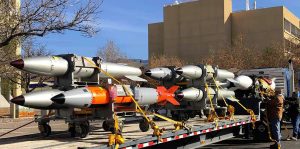
B61 H-bombs in tow. Sandia National Lab photo.
By John LaForge
On October 27, the Pentagon announced its intention to produce yet another modification of its B61 thermonuclear gravity bomb warhead design, to be called the B61-13. The plan needs congressional authorization which is nearly axiomatic when nuclear weapons spending is proposed.
The surprise decision “comes shortly after another new nuclear bomb — the B61-12 — began full-scale production last year and is currently entering the U.S. nuclear arsenal,” reported Hans Kristensen and Matt Korda for the Federation of American Scientists.[1] The military said it wanted 480 of the B61-12s, and that it would replace the B61-3s and -4s now stationed in Europe for use by fighter jet pilots from Germany, Italy, Belgium, the Netherlands, and Turkey.
The Pentagon’s press release says that the new B61-13 is not intended for the five European air forces, and that it will be stationed in the U.S. and used only on heavy bombers. However, Kristensen and Korda reported, “Nonetheless … the [jet] fighters that are destined to deliver the B61-12 will also be capable of delivering the B61-13.” They also report, “The B61-13 will have the same maximum yield as the B61-7 (360 kilotons), according to defense officials, a significant increase compared with the 50-kiloton B61-12 it is intended to supplement.” Such an enormous kiloton yield is 24 times the force of the Hiroshima bomb which killed 140,000 people.
Commenting on the dubious reasons put forward for buying more nuclear weapons (the U.S. has over 5,000), the two analysts wrote that “The case for the B61-13 is strange,” that the Pentagon’s justification “is hard to see,” that the “military mission” of the new bomb “is somewhat of a mystery,” and that, “The military doesn’t need an additional, more powerful gravity bomb.”
A Pentagon press release on the new H-bomb says only that its reasons for another bomb are “a changing security environment,” and the need to deter Russia and China. Since not much has changed in U.S.-Russia or U.S.-China relations in decades, and since the current U.S. nuclear arsenal packs catastrophic devastation beyond human imagination, the Biden administration’s and the Pentagon’s rationale for another nuclear weapon is simply asinine.
—  Federation of American Scientists, Oct. 27, 2023

Filed Under: B61 Bombs in Europe, Military Spending, Newsletter Archives, Nuclear Weapons, Quarterly Newsletter

January 18, 2024 by Nukewatch 1 Comment

European Court of Human Rights May Hear Appeals of Nuclear Weapons Protest Convictions

By John LaForge

German and U.S. nuclear weapons resisters continue their quixotic jousting match with the criminal justice system. Emphasis on the word criminal.

After dozens of “go-in” actions against the presence of U.S. nuclear weapons at Germany’s Büchel air base, and following scores of trial court convictions for “trespassing” at the NATO base, twenty individual appeals to Germany’s high-level Constitutional Court have now been rejected without comment. The high court has simply upheld the rulings of the Regional Court in Koblenz finding the resisters guilty. Koblenz judges have repeatedly found that secret arrangements between the U.S. and Germany have legalized the shipment to and deployment of U.S. nuclear bombs at Büchel.

Nuclear abolitionists, including Nukewatch’s John LaForge and many others, have argued that binding U.S. and German treaty law forbids any and all such transfer of nuclear weapons (known as nuclear proliferation), and consequently that nonviolent actions attempting to interfere with such violations are justifiable acts of “crime prevention.”

As of September, a total of six nuclear resisters have filed applications or appeals with the European Court of Human Rights, in Strasbourg, France, arguing that the convictions were in error. The ECHR, made up of 42 judges, one from every state party to the European Convention on Human Rights, has a rigid set of standards to be met to win a hearing, and defendants must first have exhausted all the means of redress in their state and federal courts.

A sleeping “Madame Justice” was “woken up” by protesters before Germany’s Constitutional Court.

In LaForge’s appeal to the ECHR, filed in May, the court has indicated some interest in the case, but has not yet formally decided to hear it. In June, the court wrote that one signature and one document were missing from the application. “Normally this would mean that your application would be rejected,” the court said. “However, in view of the particular circumstances of the case, you are requested, on an exceptional basis, to complete your file” and supply the needed information by August 7.

After receiving the required materials, the Legal Secretary wrote on October 9, “The court will deal with the case … as soon as the course of business permits.”

In late September, John joined German anti-nuclear bicyclists in a public protest ride between the two high courts. Beginning with a rally at the doors of the Constitutional Court in Karlsruhe, Germany, sixteen riders spent two days cycling to Strasbourg and the gates of the ECHR, just across the Rhine River border separating Germany and France.

In front of both court complexes, group members spoke of the increasing dangers and legal nihilism of nuclear sharing, and a small troupe performed a theatrical piece called “Wake Up Justice!” in which a sleepy, inattentive “Madame Justice,” portrayed by Lies Welker (pictured outside the Constitutional Court), was woken by the shouts and cries of citizens demanding that she do something about the threats to humanity posed by the nuclear war planners.

Filed Under: B61 Bombs in Europe, Direct Action, Newsletter Archives, Nuclear Weapons, Quarterly Newsletter, US Bombs Out of Germany

January 18, 2024 by Nukewatch Leave a Comment

Lawsuit Filed in Rome Against Stationing of U.S. Nuclear Weapons in Italy

By John LaForge

A formal complaint, submitted October 2, 2023 to Italy’s Public Prosecutor’s Office at the Court of Rome, demands a criminal investigation of the stationing of U.S. nuclear weapons on the national territory of Italy. The lawsuit also calls for the pursuit of all Italian persons who may be criminally responsible for the weapons’ importation and deployment. The complaint was signed by representatives of 22 organizations and says that the presence of U.S. nuclear weapons in Italy is certain, even though it has never been officially acknowledged by the government. The open secret of the transfer to Italy of the B61 H-bombs has been confirmed by numerous newspaper reports, scientific journals, leaked NATO documents, and the effective admission by the U.S. government that it has transferred nuclear weapons to Belgium, the Netherlands, Germany, Italy, and Turkey. U.S. B61 gravity bombs are reportedly now stationed at Italy’s air force bases at Ghedi and Aviano. The legal complaint recalls that Italy ratified the Treaty on the Nonproliferation of Nuclear Weapons (NPT) on April 24, 1975, and argues that the treaty’s Articles I and II prohibit the transfer of foreign nuclear weapons to Italy. The complaint also charges that the presence of U.S. nuclear weapons in Italian territory violates Italian federal law related to weapons and import licenses. — For a copy of the lawsuit, email us at nukewatch1@lakeland.ws.

Several nuclear weapons related upgrades underway at Ghedi Air Base in 2021, the year Italy hosted the annual NATO “Steadfast Noon” war games. Photo: Federation of American Scientists.

Filed Under: B61 Bombs in Europe, Newsletter Archives, Nuclear Weapons, Quarterly Newsletter

  • « Previous Page
  • 1
  • 2
  • 3
  • 4
  • 5
  • 6
  • …
  • 20
  • Next Page »

Stay Connected

  • Facebook
  • Twitter

Subscribe

Donate

Categories

  • B61 Bombs in Europe
  • Chernobyl
  • Counterfeit Reactor Parts
  • Depleted Uranium
  • Direct Action
  • Environment
  • Environmental Justice
  • Fukushima
  • Lake Superior Barrels
  • Military Spending
  • Newsletter Archives
  • North Korea
  • Nuclear Power
  • Nuclear Weapons
  • Office News
  • On The Bright Side
  • Photo Gallery
  • Protect the Water Close Xcel's Monticello Reactor
  • Quarterly Newsletter
  • Radiation Exposure
  • Radioactive Waste
  • Renewable Energy
  • Social Issues
  • Sulfide Mining
  • Through the Prism of Nonviolence
  • Uncategorized
  • Uranium Mining
  • US Bombs Out of Germany
  • War
  • Weekly Column

Contact Us

(715) 472-4185
nukewatch1@lakeland.ws

Address:
740A Round Lake Road
Luck, Wisconsin 54853
USA

Donate To Nukewatch

News & Information on Nuclear Weapons,
Power, Waste & Nonviolent Resistance

Stay Connected

  • Facebook
  • Twitter

© 2026 · Nukewatch