Nukewatch

Working for a nuclear-free future since 1979

  • Issues
    • Direct Action
    • Environmental Justice
    • Nuclear Power
      • Chernobyl
      • Fukushima
    • Nuclear Weapons
    • On The Bright Side
    • Radiation Exposure
    • Radioactive Waste
    • Renewable Energy
    • Uranium Mining
    • US Bombs Out of Germany
  • Quarterly Newsletter
    • Quarterly Newsletter
    • Newsletter Archives
  • Resources
    • Nuclear Heartland Book
    • Fact Sheets
    • Reports, Studies & Publications
      • The New Nuclear Weapons: $1.74 Trillion for H-bomb Profiteers and Fake Cleanups
      • Nuclear Power: Dead In the Water It Poisoned
      • Thorium Fuel’s Advantages as Mythical as Thor
      • Greenpeace on Fukushima 2016
      • Drinking Water at Risk: Toxic Military Wastes Haunt Lake Superior
    • Nukewatch in the News
    • Links
    • Videos
  • About
    • About Nukewatch
    • Contact Us
  • Get Involved
    • Action Alerts!
    • Calendar
  • Donate

January 18, 2024 by Nukewatch Leave a Comment

Nuclear Power: Uninsurable, Dangerous, Slow, too Expensive

Editor’s Note: Asked publicly June 23, 2023, “Should nuclear play a role in our country’s transition…?” presidential hopeful Robert F. Kennedy, Jr. answered with the following:

“I’m all for nuclear energy if it can be made safe and if it can be made economically competitive.

“Right now it’s not safe, and you shouldn’t take my word for it. You should take the word of the insurance industry which is the ultimate arbiter of risk in this country. The insurance companies will not insure nuclear power. And so the nuclear industry had to go to Congress, and in a sleazy legislative maneuver in the middle of the night, [it] passed the Price Anderson Act, which essentially immunizes the nuclear industry from accountability for its own accidents.

“My house in New York is 22 miles from the Indian Point Power Plant [and] I had a provision in my insurance policy that says this policy does not cover you for radiation damage from a nuclear power plant accident. All of the insurance policies in this country have something essentially like that. So you are bearing the burden of their risk and they don’t have to pay any attention to risk, because the country has immunized them.

“Is it economic? No. The last nuclear [reactor] built has a price-per gigawatt of $14 billion.

“For a solar plant, right now, the construction costs about $1.1 billion a gigawatt. A coal plant costs about $3.6 billion per-gigawatt. So, you know, a solar plant costs on

Photo:grilled.com

e-fourteenth (1/14) of what a nuke reactor costs.

“We can make energy by burning prime rib if we wanted, but it wouldn’t make any sense.

“And once you build a solar or wind plant, it’s free energy forever, because the electrons are hitting the Earth for free. All we’re doing is building a system to pick them [electrons] up and harvest them.

“Once you build a nuke plant you have to go do uranium mining, which is very, very expensive; you have to have regular outages [for refueling], you have to hire safety technicians that are ruinously expensive, and then you have to dispose of the waste, and take care of it for the next 30 thousand years, which is five times the length of recorded human history. So how can it possibly be economic?

“They told us when they first built these plants that nuclear energy would be “too cheap to meter.” It’s turned out to be the most prohibitively expensive way to boil a pot of water that’s ever been devised.

“And now [the industry is] saying, ‘Well don’t worry, we’ve got a new generation of nukes that solves a lot of these problems,’ and my answer to that is: ‘Show us. Show us that.’

“Number one, no nuclear [reactor] will be built anywhere in the world, no utility will build any, unless the public subsidizes essentially the entire cost of construction. That’s not competitive. Industry should pay for all of its costs, including the disposal of their waste — which is a lesson we were all supposed to have learned in kindergarten.

“I tell the public: If they can do it without public assistance, if they can be competitive in the marketplace, I’m all for them.”

— This is not an endorsement of Kennedy’s campaign as the Progressive Foundation/Nukewatch doesn’t make endorsements.
Filed Under: Newsletter Archives, Nuclear Power, Protect the Water Close Xcel's Monticello Reactor, Quarterly Newsletter, Renewable Energy

January 18, 2024 by Nukewatch Leave a Comment

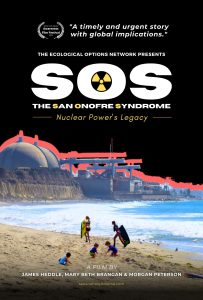
Documentary on Radioactive Waste Wins Prize


Photo:sanonofresyndrome.com/press-kit


By John LaForge

The new documentary film from producer/director Mary Beth Brangan, “SOS – The San Onofre Syndrome: Nuclear Power’s Legacy” [https://sanonofresyndrome.com/], has won the Awareness Film Festival’s Documentary Feature Grand Jury Award — beating the festival’s 100 other documentary entries. Brangan says that the film “chronicles a community’s victory over leaking reactors, only to confront a chilling reality — deadly radioactive waste stranded next to a rising sea. As temporary containers decay, a nationwide crisis emerges, and the race to avert catastrophe becomes a stark countdown against time.” Haled as “a timely and urgent story with global implications,” the film was recently accepted into the next International Uranium Festival to be screened in Rio de Janeiro, Berlin, and eighteen U.S. cities in 2024.

— SOS: info@sanonofresyndrome.com; https://sanonofresyndrome.com

Filed Under: Environment, Environmental Justice, Newsletter Archives, Nuclear Power, Quarterly Newsletter, Radiation Exposure, Radioactive Waste

January 18, 2024 by Nukewatch Leave a Comment

Owners Want Monticello Reactor to Run 80 Years

By John LaForge

The 52-year-old Monticello nuclear reactor on the Mississippi River in Minnesota, 38 miles northwest of Minneapolis, is owned by Xcel Energy and operated by Northern States Power.

Fired up in 1971, the General Electric Mark I boiling water reactor is identical to the three Fukushima-Daiichi reactors in Japan that suffered complete core meltdowns and four hydrogen explosions in March 2011, leading to the worst accidental radiation releases in history. (Fukushima is often called the second worst nuclear reactor disaster after Chernobyl, but releases of cesium-137 to the ocean from Fukushima far surpass those of Chernobyl.)

In January 2023, Xcel applied to the U.S. Nuclear Regulatory Commission (NRC) for a second extension to its operating license which, if granted, would allow the unit to run for 80 years. The first extension was granted in 2006, allowing the jalopy to generate radioactive waste until 2030, when it will be 60. Monticello’s second request, called a Subsequent License Renewal Application, or SLRA, is now in progress, and the NRC, like a rubber stamp, has granted nearly every license extension request it has ever entertained.

The process is complex. After the application is submitted, a License Renewal Process and Environmental Scoping meeting is held; then the NRC conducts an Environmental Review, followed by a Site Environmental Audit which was completed in August 2023. Then a Draft Supplemental Environmental Impact Statement is issued (scheduled for Feb. 24, 2024), at which point interested parties and the public have 90 days to submit comments on the relicensing proposal. A public meeting is then held to discuss the Draft SEIS, and then a Final SEIS is issued. Lastly, the NRC issues a decision. The over-worked citizenry can be excused for not keeping up with this voluminous bureaucratic charade, something the industry desperately counts on.

The risks of operating large power reactors long past their designed retirement date is illustrated by what’s called the “bathtub curve.” The curve is a schematic description of when, and how likely, major accidents with machinery can be expected due to long-lasting wear-and-tear. (See diagram)

The “bathtub curve” is a schematic description of when major accidents with complicated machinery can be expected. Most occur early on in a machine’s life, and then toward the end of it after years of wear-and-tear.

The curve shows that in the life of complicated machines like nuclear reactors, accidents often occur early on — due to extreme heat, heavy vibrations, untested electronics, valves, welds, and associated equipment. After the early mishaps and mistakes there is often a period of time when the number of unplanned events decreases, followed by a steady state of proper operation. Then, in later years, the effects of aging damage the reliability of parts and equipment, especially those subject to decades of intense heat, vibration, corrosion, and — in the case of nuclear reactors — neutron bombardment and its “embrittlement” of metal parts and structures.

Because of the recent leak of contaminated wastewater from corroded and failed underground piping, the “effects of aging” are given a lot of attention in Xcel’s license extension application. An October 23 letter by the NRC says its staff participated in a “hybrid audit” of Monticello August 1-3, 2023, and a “virtual audit” August 15-17, 2023. The two audits were required as part of the license renewal application.

Venting is not always good for you

Following the audits, the NRC sent an October 23, 2023 memo to Xcel titled “Requests for Confirmation of Information.” The18-page memo notes that Monticello, “is currently constructing a groundwater remediation storage pond to store the tritiated groundwater that is being collected in response to the tritium leak. The water will either be reused in plant systems or be evaporated from the pond. If pond evaporation is implemented, it will be the third gaseous point for tritium at the plant.”

The public may not realize that radioactive waste gases are routinely released from the reactor to the environment, and that the new holding pond will constitute the third venting point, albeit by evaporation.

Page 6 of the NRC memo says the reactor “currently has two locations of gaseous radioactive effluent discharge: 1. the off-gas stack; and 2. the reactor building ventilation exhaust, both of which are also monitored…. It is an unfortunate fact of nuclear power reactors, that to moderate the operational temperature, pressure, and performance of essential mechanisms, the venting and discharge of radioactive materials to the environment is required. So much for “clean power.”

The October 23 memo also instructed Xcel to provide the NRC with a long list of reports including: “The source, volume, and activity of tritium and other radionuclides (if applicable) released, including how these values were estimated;” “Data that confirm the extent or absence of other radionuclides in groundwater following the November 2022 release;” and “A map showing the location of the holding tank that spilled on May 21, 2023, and estimates of the volume spilled and the tritium activity concentration of the holding tank at the time of the spill.”

How much radiation was released?

The Monticello reactor was forced to make an unplanned shut down in March this year, after Xcel admitted that one or two underground pipes had been corroded and gone un-inspected long enough to leak 400,000 gallons of radioactively contaminated wastewater into the ground. (See Fall 2023 Quarterly.)

The company said last summer that the leaked coolant contained 5 million picocuries-per-liter of radioactive tritium, the radioactive form of hydrogen. A picocurie is a small amount of radioactivity, but 5 million picocuries-per-liter is a very high concentration of tritium.

The 400,000 gallons is equal to 1,514,000 liters. If these 1.5 million liters of radioactive wastewater contained (as Xcel said) 5 million picocuries of tritium-per-liter (5,000,000 X 1,500,000 liters), then approximately 7.57 trillion picocuries of tritium were leaked to groundwater near the Mississippi River. This is equal to 7.57 curies of tritium, and a curie is a very large amount of radioactivity. (The partial meltdown at Three Mile Island in 1979 is officially reported to have vented 15 curies of radioactivity and is considered one of the worst radiation accidents in U.S. history.)

Dr. Arjun Makhijani, president of the Institute for Energy and Environmental Research, says in his new book Exploring Tritium’s Dangers, “one teaspoon of tritiated water would contaminate about 100 billion gallons of water to the U.S. drinking water limit….” We are left to wonder about the vast volume of groundwater that’s been contaminated with Monticello’s 400,000 gallons of tritiated water.

Repaired pipes same as the leaking pipes

Answering questions from the NRC about its extended license application, Xcel wrote on October 13 that it must demonstrate to the NRC that it is “managing the effects of aging,” and in particular must investigate the function “of structures and components” that the NRC has said “require review.” Monticello’s leaking pipes fit this bill.

The company notes that “New and replacement coatings for underground components” must meet required standards, and Xcel reported that “Existing coatings for underground components at MNGP [Monticello] were installed per site design specifications.”

This claim is dashed by the sentence that follows it: “Site design specifications did not require coatings on underground components…” So, the replacement pipes were uncoated like the originals, and yet the company dares to ask permission to push the reactor’s operating life another 28 years, until 2050. What could go wrong?

Filed Under: Environment, Newsletter Archives, Nuclear Power, Protect the Water Close Xcel's Monticello Reactor, Quarterly Newsletter, Radioactive Waste

November 1, 2023 by Nukewatch Leave a Comment

Xcel’s 52-Year-old Monticello Reactor Leaking Radiation

Monticello Nuclear Station on the Mississippi River. Photo: KSTP.com.
By John LaForge

A damaged and leaking three-inch pipe at Xcel Energy’s single reactor at Monticello, Minnesota on the Mississippi River, is causing a radioactive pollution problem.

Last November, radioactive tritium leaking from the 52-year-old unit was found in a company’s onsite monitoring well. Xcel waited until mid-March to report the month-long 400,000-gallon leak. Inspectors from the Nuclear Regulatory Commission (NRC) just winked at the company’s four-month delay in reporting the leak. Xcel soon claimed to have plugged the leak.

The Associated Press (AP) reported that in November the concentration of tritium “was about 5 million picocuries per-liter” in groundwater within the company’s boundaries, according to Xcel’s website. This is 250 times the amount (20,000 picocuries per liter) of tritium legally permitted in drinking water. After claiming the leak to be fixed, Xcel reported a second leak of several hundred gallons of tritium-contaminated water which the firm said had sprung from an overflow tank used to collect the first leaked wastewater.

Originally licensed in 1971 to operate 40 years, Monticello was designed to close in 2010. Yet the NRC issued Xcel a license extension in 2006, allowing it to run until September 2030.

Monticello’s aged pipes, like 23 other Fukushima-style, General Electric Mark I reactors operating in the United States, are worn out and corroded — a chronic, nationwide hazard. “Radioactive tritium leaks found at 48 U.S. nuke sites,” was a headline in a four-part AP investigative series titled “Aging Nukes,” written by Jeff Dunn in 2011. “You got pipes that have been buried underground for 30 or 40 years, and they’ve never been inspected, and the NRC is looking the other way,” engineer Paul Blanch (who had worked for the industry and later became a whistleblower), told Dunn. “They could have corrosion all over the place,” Blanch said.

The Star Tribune reported June 17 that, “Tritium leaks unfortunately have been relatively common in the nuclear industry, and the Monticello spill was among the nation’s 10 largest.”

NRC public affairs officer Prema Chandrathil replied August 10 to some questions from Nukewatch, writing, “The now-stopped leak was from a pipe that ran between two buildings on site where the water had already been processed, filtered, and demineralized.” Asked if there were other radioactive materials in the wastewater, Chandrathil wrote, “When the leak was going on there were low levels of xenon and iodine detected near the leak. They decay away and become non-radioactive quickly due to their short half-life. Therefore, tritium is the only type of radioactive material currently present in the groundwater.”

This answer is suspect. Iodine-125 has a 60-day half-life, and, because it takes ten half-lives to “decay away,” its gamma radiation spews for 600 days. Iodine-129 has a half-life of 16 million years. If the NRC official meant iodine-131 — Chandrathil didn’t specify — that isotope decays for 80 days. Neither does xenon-137 just “decay away” as the NRC public affairs officer said. It decays to cesium-137 which takes 300 years to “decay away.” Again Chandrathil didn’t report which isotope of xenon was leaking, Xe-133, Xe-137, or some other.

The Minn. Dept. of Health website report on this event notes, “A conservative assumption in radiation protection is that any radiation exposure could result in an increase in cancer occurrences in the population, with the risk increasing as exposure increases.” However Xcel has said there is “no” health risk to the public as the affected groundwater contains “very low levels” of tritium.

This reassurance is untrue. Even “very low levels” of radiation exposure create a risk as the Health Dept. noted. Radiobiologists all agree that we can no longer speak of a ‘safe’ radiation dose level. And every federal agency that regulates industrial releases and medical uses of ionizing radiation warns that exposure to radiation (external or internal), no matter how small, increases one’s risk of cancer and other illnesses. For example, the Environmental Protection Agency says, “There is no firm basis for setting a ‘safe’ level of exposure above background ….”, “Based on current scientific evidence, any exposure to radiation can be harmful (or can increase the risk of cancer). …. no radiation exposure is completely risk free.” And “[T]here is no level below which we can say an exposure poses no risk.”

Tritium emits ‘beta’ radiation in the form of fast- moving particles, and several sources misreported related facts. The Minn. Dept. of Health said July 21, that beta particles “are too weak to penetrate the skin,” and the AP reported last March 17 that tritium’s beta radiation “cannot penetrate human skin.”

The Environmental Protection Agency and many other authorities say beta particles are “more penetrating than alpha particles,” and “are capable of penetrating the skin and causing radiation damage.” Dr. Rosalie Bertell in her book No Immediate Danger says beta particles can cause serious burns and other skin anomalies, including skin cancer. If beta particles are inhaled or ingested, they can cause biological damage more severe than external exposure inflicts because they can penetrate cell membranes.

In an apparent admission that Xcel has lost control of the underground radioactive plume moving toward the Mississippi, the firm announced August 17 that it would build an “underground metal barrier” between the leaking pipe(s) and the river. Xcel said the steel wall — 40-feet deep and 600 feet long — will take four to eight weeks to install “along the edge of the plant’s boundary with the river,” and is intended to keep Monticello’s contaminated groundwater from reaching the Mississippi River. Authorities have not reported whether the groundwater plume is deeper than 40 feet.

One grim irony of Xcel’s underground wall is that at Japan’s Fukushima-Daiichi — where three identical GE reactors, were destroyed by earthquake damage and meltdowns — the owners tried to retard the flow of groundwater by constructing an underground wall. The Japanese effort failed even after a $250 million investment. In addition, like at Fukushima where huge steel tanks currently store 1.37 million tons of contaminated wastewater, Xcel said last March that it was “considering building above-ground storage tanks” for its radioactively tainted leaks.

— CBS News, Aug. 18; Utility Dive, Aug. 28, 2023

Filed Under: Environment, Newsletter Archives, Nuclear Power, Protect the Water Close Xcel's Monticello Reactor, Quarterly Newsletter

November 1, 2023 by Nukewatch Leave a Comment

No Accident: Japan’s Planned 40-Yr Dispersal of Radioactive Wastewater

Hydrogen explosions blew apart four of the six reactor containment buildings at Fukushima-Daiichi in March 2011.
Editorial
By John LaForge

On August 24, Japan began pumping millions of gallons of stored radioactive wastewater into the Pacific Ocean from Tokyo Electric Power Company’s (Tepco’s) devastated triple reactor meltdown site at Fukushima-Daiichi.

The deliberate contamination of the public commons — no accident this time — is a license to kill, a criminally reckless endangerment of sea life and an attack on the food web. Yet the 1992 ban on ocean dumping of radioactive waste applies only to barrels thrown from ships, not liquids sent into the sea through pipes. Further, the Law of the Sea allows victims to bring legal action only after an alleged harm has occurred, and then puts the burden of proof on victims to show that their illness(es) were caused by a particular radioactive poison.

The terrible Fukushima earthquake-tsunami-meltdowns of March 2011 have forced Tepco, owner of the three ferociously radioactive masses of melted uranium/plutonium fuel, to continuously pour cold water onto the unapproachable wreckage. Combined with rivers of groundwater that gush through quake-smashed cracks in the reactors’ foundations, another 130 tons of water every day becomes poisoned with radioactive uranium, cobalt, strontium, cesium, plutonium, and more.

While mainstream media regularly report that Tepco’s Advanced Liquid Processing System (ALPS) has removed all the radioactive elements except for tritium, the system has been a nearly complete failure since at least 2018. The New York Times reported August 21, 2023, that, “According to Tepco’s website, just 30 percent of the approximately 473,000 tons of water in the tanks have been fully treated to the point that only tritium remains.”[1]

“This water is contaminated with such radionuclides as cesium-137, carbon-14, tritium (some of which will form the more dangerous ‘organically bound tritium’), strontium-90, cobalt-60, iodine-129, plutonium-239, and more than 50 other hazardous radionuclides,” reported Rick Steiner, a marine biologist in Anchorage and former University of Alaska professor of marine conservation, in the Anchorage Daily News.[2]

Spewing radioactivity is routine, if unknown

It’s no surprise that reactor-friendly governments such as the United States, France, and the UK, and the International Atomic Energy Agency (whose mission is to promote nuclear reactor proliferation), have given Japan’s oceanic pollution scheme their seal of approval. All of them have repeatedly declared that dumping radioactive wastes into public water bodies is standard industrial practice and legal. With straight faces, the authorities chant in unison that reactor operations contaminate the environment with radioactive liquids all day, every day, and this is somehow intended to demonstrate that such contamination is natural and the danger of chronic, low-dose exposure “negligible.”

At La Hague, France, and at Sellafield, England, giant radioactive waste processing systems produce millions of gallons of highly radioactive liquids, and for decades both have pumped radioactive materials directly into the North Sea (from France) and the Irish Sea (from England). Dr. Chris Busby, scientific secretary of the European Committee on Radiation Risk, has studied internal radioactive contamination and has found cancer clusters among children along the Irish seacoast.

Scientists, ecologists, medical authorities, environmentalists, historians, and oceanographers have repeatedly pointed out that there are practical alternatives to Japan’s dumping scheme, and that nothing positive can result from adding more radioactive pollution to the environment.

The nuclear industry and its government protectors manage this legalized dispersal of gaseous, liquid and solid radioactive wastes using bailouts, bribes, and winks, and approvals from captured regulatory agencies. Radioactive polluters also depend on the lengthy “latency period” — years or decades between one’s radioactive contamination and the appearance of cancer, heart disease, etc. — which produces untold numbers of victims the world over. The nuclear industry can depend on the fact that the odds of losing a radiation damage lawsuit are between a slim chance and a fat chance.

The British Medical Journal, on August 16, published news of yet another study that has found that exposure to low levels of radiation is more harmful than scientists previously thought. Dozens of studies have made exactly the same finding since the beginning of the nuclear age. Some examples include:

• “Risk of cancer death after exposure to low-dose ionizing radiation underestimated, suggests nuclear industry study,” British Medical Journal, Aug. 16, 2023.

• “Even low-level radioactivity is damaging, scientists conclude,” Science Daily, Nov. 13, 2012.

• “With New Data, a Debate on Low-Level Radiation,” New York Times, July 19, 2005.

• “Study: No Radiation Level Safe,” AP, June 29, 2005.

• “Study: Even Low-Dose Radiation is Dangerous,” Reuters, Oct. 9, 1997.

• “Radiation health effects understated, study shows,” Minneapolis Star-Tribune, July 25, 1995.

• “Researcher discovers greater radiation risk,” Milwaukee Journal, Dec. 9, 1992.

• “Radiation risks may be more than believed,” Los Angeles Times, March 20, 1991.

• “Higher Cancer Risk Found in Low-Level Radiation,” New York Times, Dec. 20, 1989.

Scientists: Little known about wastes’ effects

The U.S. National Association of Marine Laboratories released a statement in December 2022 saying it was not convinced by Japan’s data. Marine biologist Robert Richmond, from the University of Hawaii, told the BBC on August 26: “We’ve seen an inadequate radiological, ecological impact assessment that makes us very concerned that Japan would not only be unable to detect what’s getting into the water, sediment and organisms, but if it does, there is no recourse to remove it … there’s no way to get the genie back in the bottle.”

And biology professor Timothy Mousseau at the University of South Carolina, author of an exhaustive review of existing studies on tritium, told The National Observer, that tritium “has been insufficiently studied to be making hard promises about the long-term safety of this kind of release.” Mousseau went on, “We don’t actually really understand what the potential ramifications of a massive point source of tritium will be on the natural environment.”

The Japanese government and Tepco hope that their global dispersal of meltdown cooling water will save the industry enough money that it can stay afloat amid the astronomical, ever-rising costs of post-Fukushima liability and disaster response. But August’s launch of Japan’s globalized pollution solution raises the chaos and deadliness of reactor operations to new heights, while the authorities claim that nothing needs to be done about nuclear reactor risks.

—

Notes

[1] New York Times, “Japan to Release Treated Water from Ruined Nuclear Plant Despite Concerns,” August 21, 2023.

[2] Anchorage Daily News, “U.S. must urge Japan not to release Fukushima wastewater into the sea,” April 25, 2021.

[3] British Medical Journal, “Risk of cancer death after exposure to low-dose ionizing radiation underestimated, suggests nuclear industry study,” August 16, 2023.

[4] The Mainichi, “Researchers develop technology to remove radioactive tritium from water,” August 28. 2018.

[5] National Observer, “As Japan releases Fukushima wastewater into the ocean, a fallout of fear follows,” August 31, 2023.

Filed Under: Environment, Fukushima, Newsletter Archives, Nuclear Power, Quarterly Newsletter, Radioactive Waste

  • « Previous Page
  • 1
  • …
  • 24
  • 25
  • 26
  • 27
  • 28
  • …
  • 94
  • Next Page »

Stay Connected

  • Facebook
  • Twitter

Subscribe

Donate

Categories

  • B61 Bombs in Europe
  • Chernobyl
  • Counterfeit Reactor Parts
  • Depleted Uranium
  • Direct Action
  • Environment
  • Environmental Justice
  • Fukushima
  • Lake Superior Barrels
  • Military Spending
  • Newsletter Archives
  • North Korea
  • Nuclear Power
  • Nuclear Weapons
  • Office News
  • On The Bright Side
  • Photo Gallery
  • Protect the Water Close Xcel's Monticello Reactor
  • Quarterly Newsletter
  • Radiation Exposure
  • Radioactive Waste
  • Renewable Energy
  • Social Issues
  • Sulfide Mining
  • Through the Prism of Nonviolence
  • Uncategorized
  • Uranium Mining
  • US Bombs Out of Germany
  • War
  • Weekly Column

Contact Us

(715) 472-4185
nukewatch1@lakeland.ws

Address:
740A Round Lake Road
Luck, Wisconsin 54853
USA

Donate To Nukewatch

News & Information on Nuclear Weapons,
Power, Waste & Nonviolent Resistance

Stay Connected

  • Facebook
  • Twitter

© 2026 · Nukewatch