By John LaForge
Radioactive cooling water, contaminated after being used to cool melted uranium and plutonium fuel inside three destroyed reactors is being dispersed to the Pacific Ocean by Tepco, the owner of the world’s only triple meltdown disaster site: Fukushima-Daiichi in Japan. In addition, large amounts of groundwater and rainwater, that continuously pour into the wrecked reactors through earthquake-caused cracks in foundations, also become contaminated and require storage and treatment. After limited decontamination, the wastewater is allowed to add to oceanic pollution even in the face of international criticism, protest, and several national bans on the importation of Japanese seafood from the region.
The Citizens Nuclear Information Center in Tokyo (CNIC) reported last summer, in its “Nuke Info Tokyo” #232, that many radioactive materials contaminate the wastewater being sent into the Pacific.
While Fukushima’s owner Tepco, Japan’s government, and the corporate media regularly claim that tritium is the only radioactive Fukushima waste that is in the wastewater being dispersed, the chart (at right) records other highly radioactive materials in the wastewater, and total amounts through the end of 2025.
The total amount of nuclides released other than tritium were calculated from their residual concentrations in the treated water and the total amount of the treated water released. By December 2025, a total of 133,321 cubic meters (639 barrels) of wastewater had been dumped, containing an estimated total of about 31.2 trillion becquerels of tritium.
What does “MBq” mean? “MBq” stands for mega-becquerel or one-million becquerels. A measure of ionizing radiation, one becquerel is one atomic disintegration per second.
Tepco has estimated that it has dumped 2,633 million (2.6 trillion) becquerels of radioactive carbon-14 into the Pacific Ocean, along with all the tritium and other radioactive elements.
Carbon-14 has a radioactive half-life of 5,730 years. After one half-life (5,730 years), 50% of the carbon-14 remains. Scientists say it takes ten half-lives for radioactive material to decay. So, all the carbon-14 being poured into the Pacific from Fukushima will remain there, contaminating sea life and the food web, for about 57,000 years.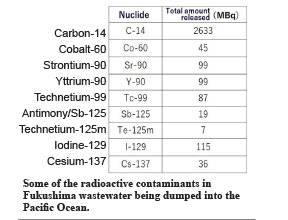
Japan’s Radioactive Waste Discharge Makes Others Bear the Cost
By Chen Xiang
Japan has now completed 20 rounds of discharge, releasing roughly 157,000 tonnes of nuclear-contaminated water in total.
A simulation study by a research team at Tsinghua University [in Beijing] previously showed that after entering the ocean, contaminated water could spread across most of the North Pacific and reach the coast of North America in about 1,200 days, or roughly 3.3 years.
By the start of this latest discharge, nearly three years have passed since Japan began releasing the water, and trace amounts of radionuclides such as tritium and carbon-14 have been detected in many areas of the North Pacific.
The discharge poses long-term, latent, and cumulative risks, with potential ecological and health impacts that warrant close attention. It is not an acute health hazard with immediate effects; its negative impacts may continue to accumulate and spread imperceptibly over an extended period.
The Comprehensive Report on the Safety Review of the ALPS-Treated Water … released by the International Atomic Energy Agency on July 4, 2023, noted that the ALPS “does not remove all radioactive material. Small amounts of different radionuclides remain in the water (although they are well below regulatory limits) even after treatment, and tritium is not removed by the ALPS system at all.”
These residual radioactive substances could potentially accumulate through marine food chains, or food web, and eventually enter the human food supply, posing continuing risks to the health of people living along the North Pacific coast, or who consume seafood products from there, over the coming decades.
It is therefore clear that short-term monitoring results meeting safety standards do not guarantee absolute safety, nor can they justify Japan’s reckless discharge of nuclear-contaminated water…. People in Pacific coastal countries should not be forced to bear the health and ecological consequences of Japan’s nuclear accident.
Japan’s unilateral decision to discharge nuclear-contaminated water into the ocean constitutes a serious violation of international law…. Japan has seriously violated its obligations under the United Nations Convention on the Law of the Sea to protect and preserve the marine environment.
International rules lack binding corrective mechanisms and are unable to effectively halt Japan’s discharge of nuclear-contaminated water. As a result, Japan has been able to shift the costs of managing its nuclear accident and its ecological consequences onto the rest of the world.
— The author, an Associate Research Fellow at the Institute of Japanese Studies, Chinese Academy of Social Sciences, wrote this for People’s Daily.
Leave a Reply