By Ella Heydenfeldt, The Independent, May 7, 2026
Edited for space by Nukewatch Staff
A recent Harvard T. H. Chan School of Public Health analysis found higher cancer mortality rates in U.S. counties located closer to nuclear reactors, while a nonprofit-led report questioned whether decades of Diablo Canyon’s operation may be tied to worsening infant health in surrounding San Luis Obispo [S.L.O.] County. Federal regulators and health officials, however, maintain that radiation exposure from the site is too low to pose a measurable risk.
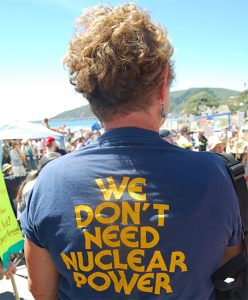
San Luis Obispo Mothers for Peace members argue continued operation of the two pressurized water reactors poses unnecessary risks and costs. They point to roughly $700 million in state support, the growing accumulation of radioactive waste, the negative effects on sea life from the reactors’ once-through cooling system, and their discharge of heated seawater into the ocean.
Declining Infant Health: Correlation or Causation?
On April 29 Radiation and Public Health Project epidemiologist Joseph Mangano presented an analysis of state data showing San Luis Obispo County’s infant health and mortality have been negatively impacted since reactor startup.
Based on publicly available health statistics, the report — “Local Newborn Health Declined As California Nuclear Plant Operates” — states that infant mortality has shifted from a healthy 16-22 percent below the state average in 1968, which is the year reactor construction started and such record-keeping began, to 14 percent below average after Diablo Canyon went into operation in 1985, to about one percent above average today. (Statewide, infant mortality declined from roughly 21 deaths per 1,000 births in 1968 to about 5 per 1,000.) Premature births and birth defects followed similar patterns, with one category of defects reported at 114 percent above the state average.
“One does not find causation through epidemiology,” Mangano said. His report does not establish that emissions from Diablo Canyon caused the changes. But, “the Harvard study changed everything,” Mangano added.
That 2026 study examined nationwide data from 2000-2018 and found that counties closer to nuclear reactors, including S.L.O., had a “robust and consistent” higher rate of cancer mortality, even after adjusting for socioeconomic, demographic, and environmental factors. The association was strongest among older adult men with the most common form of cancer being lung cancer. The researchers emphasized that the study — the first this century to analyze nuclear reactor proximity and cancer deaths across affected counties — do not establish causation, did not measure radiation exposure directly, and pointed to the need for further study.
The Radioactive Tooth Fairy
For reactor operator PG&E, “Diablo Canyon, as with all nuclear [reactors] power plants in the U.S., is regulated and monitored by the U.S. Nuclear Regulatory Commission, which has found our operations meet all safety and security performance objectives,” stated Carina Corral, head of communications for the power company.
Corral added, “PG&E does not consider this report credible. Mr. Mangano has launched similar false claims in the past, also debunked by medical experts, including those at the S.L.O. County Public Health Department as ‘fundamentally flawed.’”
Looking specifically at individual radiation exposure differs from the Harvard analysis and Mangano’s report, which rely on large-scale population and mortality data. This difference of approach complicates the effort to understand the effect of nuclear power plants on health, if any.
Mangano argues that observable shifts in public health data, combined with evidence of radioactive exposure, are enough to warrant concern and further investigation. Regulators and many scientists maintain that without clear causal evidence, the risks remain unproven.
Jean Yamamura contributed reporting to this story.
Leave a Reply