For the 11th Review Conference of the Parties to the Treaty on the Non-Proliferation of Nuclear Weapons – New York, 27 April – 22 May 2026
Drafted by John LaForge for Nukewatch
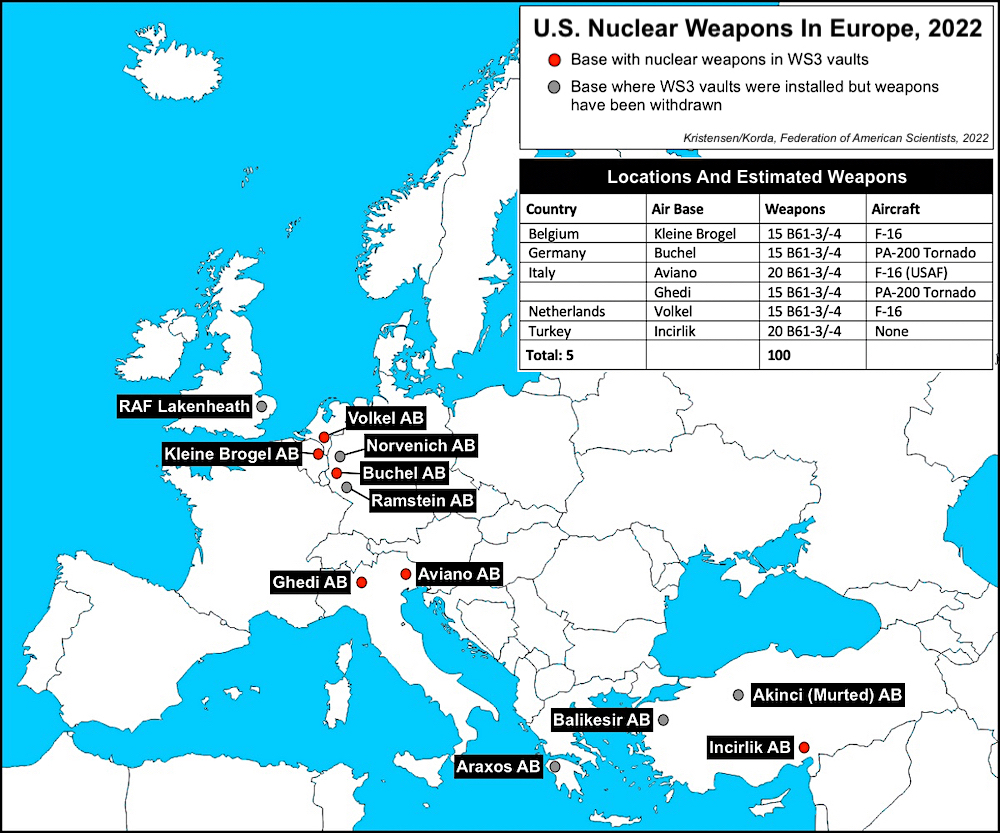
The transfer of thermonuclear weapons from the United States to five other States Parties to the Treaty on the Non-proliferation of Nuclear Weapons (NPT), known as nuclear sharing, is conducted in direct violation of the Treaty’s object and purpose. Defenders of the practice argue that it was accepted as a ‘reservation’ during the NPT’s negotiation, and further contend that, because host states do not exercise full control over the U.S. nuclear weapons, the transfer is incomplete and therefore lawful. Critics respond that no such ‘reservation’ could be valid under international law and that Articles I and II of the NPT separately and distinctly prohibit both the transfer of nuclear weapons and the transfer of ‘control over’ such weapons.
To comply with the binding requirements of the NPT, the United States must withdraw its nuclear weapons from Belgium, Germany, the Netherlands, Turkey, and two in Italy (where they are stationed at two bases).[1] The practice began secretly in September 1954[2] and has continued despite condemnation from UN Member States, non-governmental organizations, legal scholars, and others. (Because the NPT only forbids the transfer of nuclear weapons to non-nuclear-weapon states, U.S. transfers to the U.K. do not technically violate the NPT.)
Nuclear sharing assumed renewed significance when the Russian Federation reportedly copied the NATO model and transferred some of its nuclear weapons to Belarus in 2023[3] — during its war in Ukraine. Russian officials claimed that the transfer complies with the NPT in spite of previously calling U.S. nuclear sharing a violation. In its response to Russia’s, action the United States spoke volumes by not condemning the transfer as a breach of the NPT.
Positive confirmation of U.S. nuclear sharing came from NATO itself in 2019 when one of its Parliamentary Assembly documents was leaked to the press. The document said in part:
‘Within the context of NATO, the United States deploys approximately 150 nuclear weapons in Europe, most notably B61 free-fall bombs…. These bombs are stored in six [U.S.] American and European bases: Kleine Brogel in Belgium, Büchel in Germany, Aviano and Ghedi-Torre in Italy, Volkel in the Netherlands, and Inçirlik in Turkey.’[4]
Approximately 100 U.S. B61 hydrogen bombs are now thought to be stationed at the six bases.[5] The Bulletin of the Atomic Scientists has reported, ‘The new B61-12 H-bombs will begin replacing the older versions in Europe … from early 2024’.[6] The B61-12 thermonuclear bombs can be set to explode with the force of 50-kilotons of TNT, or 3.3 times the force of the U.S. device that killed 140,000 people at Hiroshima.[7] Non-U.S. military pilots flying Belgian, German, Italian, Dutch, and British jet fighters routinely join in nuclear attack exercises including ‘Steadfast Noon.’[8] On January 16, 2025, Jill Hruby of the U.S. National Nuclear Security Administration said, ‘The new B61-12 gravity bombs are fully forward deployed….’[9] However, the new H-bomb’s full deployment is uncertain due to ongoing infrastructure upgrades and the ‘modernizing [of] the weapon storage and security systems’[10] at several of the nuclear sharing bases.
NPT Articles I and II
The ordinary meaning of the terms in Articles I and II of the NPT is precise and unambiguous. Article I provides:
‘Each nuclear-weapon State Party to the Treaty undertakes not to transfer to any recipient whatsoever nuclear weapons or other nuclear explosive devices or control over such weapons or explosive devices directly, or indirectly….’ (Emphasis added.)
Article II states:
‘Each non-nuclear-weapon State Party to the Treaty undertakes not to receive the transfer from any transferor whatsoever of nuclear weapons or other nuclear explosive devices or of control over such weapons or explosive devices directly, or indirectly….’ (Emphasis added.)
The United States, Russian Federation, and the six other states that participate in nuclear sharing, contend that the NPT permits nuclear weapons transfers so long as the receiving state does not obtain possession, ownership, or control of the weapons. However, the disjunctive ‘or’ in Articles I and II, separates the prohibition on transferring nuclear weapons from the prohibition on transferring control over them. Thus, the transfer of nuclear weapons alone — regardless of who controls them — is prohibited.
The meaning of ‘transfer’ is central to this issue. The Nuclear Weapons Ban Monitor 2022 considers the words ‘transfer’ and ‘control’ as used in the 2017 Treaty on the Prohibition of Nuclear Weapons (TPNW), and defines the terms writing: ‘Transfer’ as transmitting possession or ownership, and ‘control’ as the power to detonate a nuclear weapon.[11] However, the ordinary meaning of ‘transfer’ is broader than the NWBM’s qualified and nuanced definition. The Cambridge Dictionary defines ‘transfer’ as: ‘to move someone or something from one place, vehicle, person, or group to another.’[12]
The late Professor Francis A. Boyle of the University of Illinois wrote in 2022: ‘Of course, there was physical “transfer.” These nuclear weapons were physically transferred from the United States to Germany and put on a German military base on sovereign German territory.’[13]
The 1969 Vienna Convention on the Law of Treaties (VCLT) is dispositive. Article 31(1) says: ‘A treaty shall be interpreted in good faith in accordance with the ordinary meaning to be given to the terms of the treaty in their context and in the light of its object and purpose.’[14] The ordinary meaning of the word ‘transfer’ may not be refashioned arbitrarily in order to make the unlawful appear lawful.
Reservations and ‘Integration’ Claims
Some defenders argue that nuclear sharing agreements are permissible ‘reservations’ to the NPT. However, Article 19 of the VCLT allows reservations only if they are not ‘incompatible with the object and purpose of the treaty.’
The Germany section of the International Association of Lawyers Against Nuclear Arms (IALANA Germany), addressed this claim in 2023 stating:
‘In interpreting reservations under Article 31 of the Vienna Convention on the Law of Treaties (VCLT), the wording is decisive, irrespective of what the parties subjectively meant by the formulations used when they concluded the treaty.’[15]
IALANA further concluded that because Germany’s claimed reservation is incompatible with the NPT’s object and purpose, it ‘… cannot be a reservation under international law and is therefore ineffective as a reservation.’[16]
Another defense is that because nuclear sharing predates the NPT, the practice was lawfully ‘integrated’ into the Treaty. Germany’s UN Ambassador Thomas Göbel stated in an official reply letter at the 10th NPT Review Conference, August 4, 2022, writing:
‘NATO’s nuclear sharing arrangements … were put in place well before the NPT entered into force in 1970. This resulted in seamless integration of NATO’s nuclear sharing arrangements into the NPT…’, and ‘fully conforms with Articles I and II of the NPT.’[17]
This flawed reasoning is like a human slaver arguing that because the enslaved persons were lawfully purchased before Lincoln’s Emancipation Proclamation, the slaver could lawfully keep them in bondage. Pre-existing conduct does not override treaty obligations once a state becomes bound by them.
A related claim — that the NPT becomes null and void in the event of war — has been rejected by legal scholars, including the New York-based Lawyers Committee on Nuclear Policy (LCNP).
The LCNP’s Senior Analyst Dr. John Burroughs noted without qualification in a May 3, 1999 paper delivered to a preparatory meeting for the 2000 Nuclear Non-Proliferation Treaty (NPT) Review Conference: ‘The NPT does not provide that it becomes ineffective in time of war. Nor is there any basis in international law for maintaining that it does so.’[18] In 2023, the LCNP explained further:
‘The contention that the NPT would not be legally binding in time of war, qualified as “general war” in testimony before the [U.S.] Senate, is legally wrong, unworkable, and dangerously destabilizing, as explained in non-governmental papers prepared over two decades ago in connection with the question of whether NATO nuclear sharing should be terminated. … the contention was implicitly rebuked by the 2000 NPT [Review Conference] Final Document reaffirmation that “strict observance” of treaty provisions is “central” to “preventing, under any circumstances, the further proliferation of nuclear weapons.”’[19]
Condemnation by NPT States Parties
The People’s Republic of China directly urged an end to nuclear sharing at the 10th Review Conference of the Parties to the NPT. On Aug. 2, 2022, Fu Cong, the head of the Chinese delegation and Director General of the Chinese Foreign Ministry’s Department of Arms Control, said in opening remarks[20] to the conference:
‘The so-called nuclear sharing arrangements run counter to the provisions of the NPT and increase the risks of nuclear proliferation and nuclear conflicts. The United States should withdraw all its nuclear weapons from Europe and refrain from deploying nuclear weapons in any other region.’
The Russian Federation, before transferring nuclear weapons to Belarus, repeatedly called U.S./NATO nuclear sharing a violation of the NPT. In April 2018, the Foreign Ministry issued a statement that said, ‘This is a serious violation of Articles I and II of the NPT.’[21] In April 2015, Foreign Minister Sergei Lavrov stated that, ‘The Americans are breaching the Treaty on the Non-Proliferation of Nuclear Weapons because they have placed their tactical nuclear weapons in the territories of five countries in Europe.’[22]
In 2019, The Non-Aligned Movement, representing 120 NPT States Parties, declared that nuclear weapons sharing ‘constitutes a clear violation of non-proliferation obligations under Articles I and II’, a reiteration of the Movement’s 1998 declaration.[23] Similar criticisms were voiced again by China,[24] the United Arab Emirates, and other States Parties[25] at the August 2022 NPT Review Conference.
Civil Society Opposition
On March 26, 2010, Germany’s Bundestag adopted a joint motion demanding, among other things, the withdrawal of U.S. nuclear weapons from Germany, with a vast majority voting in favor. The motion[26] pledged lawmakers ‘to work … to ensure that the nuclear weapons remaining in Germany are withdrawn’, and to ‘press for the withdrawal’.
On Jan. 16, 2020, a resolution in Belgium’s Chamber of Representatives demanding removal of U.S. nuclear weapons from its Kleine Brogel Air Force base was nearly adopted. Although it was approved by the Parliament’s Foreign Affairs Committee, the full chamber voted it down 74-to-66.[27]
The Bulletin of the Atomic Scientists, in a July 2023 article by Princeton University researchers Moritz Kütt, Pavel Podvig, and Zia Mian, reported: ‘The NPT prohibits both the acquisition of nuclear weapons by non-weapon states and the transfer of nuclear weapons to such countries by the five nuclear weapon states who are parties.’[28] (Emphasis added)
Reaching Critical Will, a program of the Women’s International League for Peace & Freedom, states in its ‘2025 NPT Briefing Book’ by Ray Acheson:
‘All other non-nuclear-armed states should … question actions taken by nuclear-armed states that are contrary to the object and purpose of the NPT, including nuclear sharing. … All the countries involved in nuclear alliances are violating the NPT’s spirit and letter. … If these states genuinely consider the NPT to be the “cornerstone” of the non-proliferation and disarmament regime, they need to … remove nuclear bombs stationed on their territories, and end their involvement in nuclear war planning activities.’[29]
The International Campaign to Abolish Nuclear Weapons, which shared the 2017 Nobel Peace Prize, issued a condemnation of nuclear sharing at the 2023 NPT Preparatory Committee in Vienna,[30] stating in part:
‘We condemn all such deployments… Such deployments must be brought to an immediate end. …This practice runs counter to the fundamental tenets of the Treaty and is a threat to the entire regime. … We are eager to hear from those states that engage in the practice: What is your legal justification?’
The International Association of Lawyers against Nuclear Arms, Germany, condemned nuclear sharing without qualification in its November 2023 letter to the United Nations 2nd Meeting of States Parties to the Treaty on the Prohibition of Nuclear Weapons, which says in part:
‘As a party to the NPT, the non-nuclear-weapon state Germany is obliged under Art. 2 NPT “not to receive the transfer from any transferor whatsoever of nuclear weapons…. or of control over such weapons ….” Similarly, under Art. 1 NPT, the U.S. is obligated “not to transfer to any recipient whatsoever nuclear weapons or other nuclear explosive devices or control over such weapons….” The NPT does not provide an exception for nuclear sharing…. Germany’s nuclear sharing cannot be justified under any aspects of international law, but is nevertheless practiced.’[31]
Conclusion
The Lawyers Committee on Nuclear Policy in New York submitted to a Preparatory Conference for the 11th NPT Review Conference a July 2023 paper that directly addressed the prohibited status of nuclear sharing, declaring, ‘The incompatibility of nuclear sharing with the NPT is based on a straightforward application of NPT Articles I and II.’[32]
This LCNP 2023 paper refers to a 1999 report by the group’s Senior Analyst Dr. John Burroughs, which 27 years ago presented a legal deconstruction of nuclear sharing that has never been rebutted. In it, Burroughs concluded:
‘[T]here are serious questions about the legality of nuclear sharing. The best way to resolve those questions would be to withdraw U.S. nuclear weapons from deployment in European countries and to terminate nuclear sharing arrangements. The United States should also unequivocally renounce the view that the NPT becomes ineffective in time of war.’[33]
Finally, an end to nuclear sharing and the permanent return to the United States of the nuclear weapons it has transferred to European bases would reduce tension and fear over NATO’ s and Russia’ s implied threats of nuclear attacks in the war in Ukraine, would eliminate the risk of accidents with the ‘shared’ nuclear weapons, would constitute a trust-building gesture and a de-escalating incentive for the reciprocal removal of Russian nuclear weapons from Belarus. ###
[1] Leaked NATO Parliamentary Assembly statement, Ann De Boeck, “Finally in black and white: there are American nuclear weapons in Belgium,” De Morgen, July 16, 2019, https://www.demorgen.be/nieuws/eindelijk-zwart-op-wit-er-liggen-amerikaanse-kernwapens-in-belgie~b051dc18/[2] Bernd Hahnfeld, ‘Nuclear sharing’, Board member, IALANA Germany, updated October 2022, https://www.ialana.info/2022/06/nuclear-sharing/
[3] The Bulletin of the Atomic Scientists, ‘Russia is deploying nuclear weapons in Belarus. NATO shouldn’t take the bait,’ April 24, 2023, https://thebulletin.org/2023/04/russia-is-deploying-nuclear-weapons-in-belarus-nato-shouldnt-take-the-bait/
[4] Ibid, note 1
[5] Bulletin of the Atomic Scientists, ‘United States nuclear weapons, 2025,’ Jan. 13, 2025, https://thebulletin.org/premium/2025-01/united-states-nuclear-weapons-2025/
[6] Bulletin of the Atomic Scientists, ‘US nuclear weapons, 2024’, Table 1., note q, May 7, 2024, https://thebulletin.org/wp-content/uploads/2024/05/rbul_a_2339170_t0001_oc.pdf
[7] The Bulletin of the Atomic Scientists, ‘United States nuclear weapons, 2025,’ Jan. 13, 2025, https://thebulletin.org/premium/2025-01/united-states-nuclear-weapons-2025/
[8] NATO press release, ‘NATO Annual Nuclear Exercise, Steadfast Noon’, Oct. 20 2025, https://ac.nato.int/archive/2025-2/nato-annual-nuclear-exercise–steadfast-noon; and Hans Kristensen reported April 11, 2022 that‚ ‘There are unconfirmed rumors that many of the weapons at Incirlik Air Base in Turkey have already been withdrawn and moved to other bases in Europe’, https://fas.org/publication/lakenheath-air-base-added-to-nuclear-weapons-storage-site-upgrades/
[9] U.S. National Nuclear Security Administration, Jill Hruby, remarks at Hudson Institute, Jan. 16, 2025, https://www.energy.gov/nnsa/articles/nnsa-administrator-jill-hruby-remarks-hudson-institute
[10] The Bulletin of the Atomic Scientists, ‘United States Nuclear Weapons, 2024’, May 7, 2024, http://thebulletin.org/premium/2024-05/united-states-nuclear-weapons-2024/
[11] Nuclear Weapons Ban Monitor 2022, by Norwegian People’s Aid, March 2023, p.39
[12] Cambridge Dictionary (Cambridge University Press, 2026), https://dictionary.cambridge.org/dictionary/english/transfer
[13] Francis Boyle (The Criminality of Nuclear Deterrence, 2002 Clarity Press), E-mail to Nukewatch, Aug. 19, 2022
[14] Vienna Convention on the Law of Treaties, https://legal.un.org/ilc/texts/instruments/english/conventions/1_1_1969.pdh
[15] ‘IALANA Germany recommends joining the TPNW’, paper submitted to the 2nd Meeting of States Parties to the Treaty on the Prohibition of Nuclear Weapons, Nov. 14, 2023, p.3, https://docs-library.unoda.org/Treaty_on_the_Prohibition_of_Nuclear_Weapons_-SecondMeeting_of_States_Parties_(2023)/TPNW.MSP_.2023.NGO_.15.pdf
[16] Ibid.
[17] ‘Right of Reply by the Federal Republic of Germany’, Amb. Thomas Göbel, General Debate, NPT Review Conference, Aug. 4, 2022, https://reachingcriticalwill.org/images/documents/Disarmament-fora/npt/revcon2022/statements/4Aug_Germany_RoR.pdf
[18] John Burroughs, Lawyers Committee on Nuclear Policy (The (Il) legality of Threat or Use of Nuclear Weapons, Lit Verlag 1997) ‘Two Legal Issues Confronting NATO and The Non-Proliferation Regime’, May 3, 1999 https://static1.squarespace.com/static/603410a4be1db058065ce8d4/t/6075c2fc4fd4650151cc1dec/1618330365176/Two+Legal+Issues+-+NATO.pdf
[19] Lawyers Committee on Nuclear Policy, ‘Three Issues Confronting the Non-Proliferation/Disarmament Regime’, statement to First UN Prep. Com. Meeting for 11th NPT Rev.Con., July 25, 2023, p.9, https://static1.squarespace.com/static/603410a4be1db058065ce8d4/t/64c050c279fdc079c3c214f2/1690325186314/LCNPWPNuclearThreatsNSAsSharingNPTPrepCom2023.pdf
[20] People’s Daily online, ‘China calls for rejection of double standards in nuclear non-proliferation,’ Aug. 3, 2022, https://en.people.cn/n3/2022/0803/c90000-10130398.html
[21] CNBC, ‘Russia’s Lavrov Says U.S. Breaching Nuclear Arms Agreement,’ Feb. 28, 2018 https://www.cnbc.com/2018/02/28/russias-lavrov-says-us-breaching-nuclear-arms-agreement-ifax.html
[22] Sputnik News, April 22, 2015, ‘U.S. Breaching NPT by Deploying Nuclear Arms in European Countries – Lavrov’, https://sputniknews.com/europe/201504221021239802/
[23] Norwegian People’s Aid, Nuclear Weapons Ban Monitor 2022, March 2023, p.67, note 14, ‘Statement of the Delegation of Indonesia on behalf of the Non-Aligned Movement States Parties to the NPT’, May 2019, at https://bit.ly/3lfKxlo; and Project on European Nuclear Non-Proliferation, Press Release, ‘Non-Aligned Movement Demands an End to NATO Nuclear Sharing’, annex, April 28, 1998
[24] Remarks by H.E. Ambassador Fu Cong’, Ministry of Foreign Affairs of China, Aug. 2, 2022, at https://bit.ly/3YiHKTD
[25] ‘UAE Statement NPT RevCon 2020 – Cluster I – General Issues’, Permanent Mission of the UAE to the UN, Aug. 4, 2022, at: http://bit.ly/40PS484
[26] German Bundestag, March 24, 2010, ‘Motion: Germany must set clear signs for a world free of nuclear weapons’, https://www.bundestag.de/webarchiv/textarchiv/2010/29155758_kw12_de_abruestung-201446
[27] Brussels Times, Jan. 17, 2020, https://www.brusselstimes.com/90143/removal-of-us-nuclear-weapons-from-belgium-narrowly-rejected-by-lawmakers-nato-kleine-brogel-deterrant-tpnw-un-npt-nuclear-heads
[28] Bulletin of the Atomic Scientists, ‘Bombs away: Confronting the deployment of nuclear weapons in non-nuclear weapon countries’, July 28, 2023, https://thebulletin.org/2023/07/bombs-away-confronting-the-deployment-of-nuclear-weapons-in-non-nuclear-weapon-countries/
[29] Ray Acheson (Banning the Bomb, Smashing the Patriarchy, Rowman & Littlefield, 2021), 2024 NPT Briefing Book, Reaching Critical Will, WILPF, April 2025
https://reachingcriticalwill.org/images/documents/Publications/2024-npt-briefing-book.pdf
[30] ICAN statement on nuclear sharing to NPT Prepcom, Aug. 2, 2023
https://www.icanw.org/ican_statement_on_nuclear_sharing_to_npt_prepcom_2023
[31] Ibid, note 15
[32] Lawyers Committee on Nuclear Policy statement to First UN Prep.Com. For the 11th NPT Rev.Con., ‘Three Issues Confronting the Non-Proliferation/Disarmament Regime,’ July 25, 2023, p.7 https://static1.squarespace.com/static/603410a4be1db058065ce8d4/t/64c050c279fdc079c3c214f2/1690325186314/LCNPWPNuclearThreatsNSAsSharingNPTPrepCom2023.pdf
[33] John Burroughs, Lawyers Committee on Nuclear Policy, ‘Two Legal Issues Confronting NATO and The Non-Proliferation Regime’, for the 1999 Prep.Com. for the 2000 NPT Rev.Con., May 3, 1999, https://static1.squarespace.com/static/603410a4be1db058065ce8d4/t/6075c2fc4fd4650151cc1dec/1618330365176/Two+Legal+Issues+-+NATO.pdf
Leave a Reply