Nukewatch

Working for a nuclear-free future since 1979

  • Issues
    • Direct Action
    • Environmental Justice
    • Nuclear Power
      • Chernobyl
      • Fukushima
    • Nuclear Weapons
    • On The Bright Side
    • Radiation Exposure
    • Radioactive Waste
    • Renewable Energy
    • Uranium Mining
    • US Bombs Out of Germany
  • Quarterly Newsletter
    • Quarterly Newsletter
    • Newsletter Archives
  • Resources
    • Nuclear Heartland Book
    • Fact Sheets
    • Reports, Studies & Publications
      • The New Nuclear Weapons: $1.74 Trillion for H-bomb Profiteers and Fake Cleanups
      • Nuclear Power: Dead In the Water It Poisoned
      • Thorium Fuel’s Advantages as Mythical as Thor
      • Greenpeace on Fukushima 2016
      • Drinking Water at Risk: Toxic Military Wastes Haunt Lake Superior
    • Nukewatch in the News
    • Links
    • Videos
  • About
    • About Nukewatch
    • Contact Us
  • Get Involved
    • Action Alerts!
    • Calendar
  • Donate

July 14, 2025 by Nukewatch Leave a Comment

Uranium Mining, Milling, and Ablation, Oh My!

By Leona Morgan

In November 2023, from the other side of the planet, then President Biden announced that the United States would commit to tripling nuclear power by 2050, claiming it’s a solution to climate change, thereby igniting a new wave of uranium interests and continued resource colonialism worldwide. Since then, more than 30 countries have followed suit, prompting a new uranium boom, or more likely a new uranium bubble.

Uranium is a necessary component for both nuclear energy and weapons. From cradle to grave, fossil fuels are used for production and transport of nuclear materials. Because the carbon output of front-end and back-end processes are not counted in the carbon footprint of nuclear development, states have been passing new laws proclaiming that nuclear is a “carbon-free” or “clean energy” resource ⸺ fueling this nuclear propaganda fire.

Trump has issued several executive orders pushing for bad energy projects including more nuclear, as well as shrinking National Monuments and fast-tracking mines. This puts all communities near uranium deposits and abandoned uranium mines (AUMs) at risk of new and continued radioactive contamination and exposures.
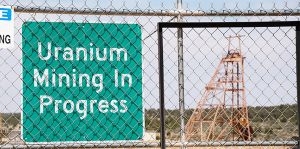
New uranium mining started in the Southwest in late 2023, with uranium ore stockpiling near the Grand Canyon, beginning in January 2024, at Energy Fuels’ Pinyon Plain uranium mine. Uranium transport between the Grand Canyon and the Four Corners areas, from the mine to the mill, started in July 2024 and was temporarily paused for six months.

“Haul No!” is a Diné-led campaign focused on stopping transport of uranium through Diné traditional homelands. Due to impacts still endured by Diné residents from the Manhattan Project, the Navajo Nation has a law prohibiting new uranium mining on the reservation. The Navajo Nation also had a law prohibiting uranium transport, which was recently amended from banning transport to regulating transport.

Haul No! used community organizing and social media to boost awareness and inspire resistance to new mining and transport. The campaign was successful in getting the Navajo Nation government involved, which garnered support from Governor Hobbs of Arizona to pause the transport. Unexpectedly, the Navajo Nation ended up going into business with Energy Fuels, allowing transport from both the Pinyon Plain mine and another proposed uranium mine in New Mexico. The Roca Honda mine is at the base of sacred Tsoodził, also known as Mt. Taylor. Under the guise of “cleanup,” the tribe is also allowing additional transport from AUMs to Energy Fuel’s White Mesa Mill in southeast Utah, exacerbating impacts to the Ute Mountain Ute nation.

The Navajo Nation has at least 523 AUMs and several uranium mills scattered throughout and around Diné Bikeyah (traditional homelands), none of which are properly cleaned up, creating health risks for local communities. In a misguided attempt to remediate these AUMs, the Navajo Nation is looking to Disa Technologies, a company proposing “ablation,” which uses water to separate more radioactive wastes [using high-pressure water to separate usable uranium from mine waste] for removal to White Mesa Mill, leaving other non-profitable contamination on Navajo. However, ablation, as a means of uranium production, violates Navajo Nation law. In addition to AUMs, four former uranium mills located on Navajo are ongoing sources of surface and groundwater contamination, also not adequately addressed by the federal government.

Like the proposed copper mine threatening sacred Apache Oakflat in Arizona, hard rock mines established under the 1872 mining law exist by design to steal Indigenous homelands. With this old law and new push for domestic energy independence, Indigenous nations are working around the clock to protect their communities and sacred places from various extractive industry and energy projects: from lithium, hydrogen and rare earth elements production to pumped storage hydropower, renewed coal mining and beyond.

Uranium mining is just one part of a larger fight against resource exploitation, racism, genocide, capitalism, imperialism, and greenwashing, all under the umbrella of nuclear colonialism.

This year, several new mining and milling proposals are on the table in the Intermountain West region, using both conventional and in situ leach methods. The Velvet-Wood uranium and vanadium mine in Utah was green lit by the Trump administration in only fourteen days! With the price of uranium exceeding $100/pound (USD) last year, and the onslaught of Trump’s push for critical minerals and national security, this uranium bubble has just begun. In order to fight nuclear colonialism, the front-end of both nuclear energy and weapons needs to be stopped.

— Leona Morgan (she/her), co-founder of Haul No!, is a Diné activist and community organizer fighting nuclear colonialism, based in Albuquerque, New Mexico.

Filed Under: Uncategorized

July 14, 2025 by Nukewatch Leave a Comment

Who Has Time to Think About Nuclear Weapons?

Nukewatch’s Kelly Lundeen was arrested with 16 other abolitionists including Frida Berrigan whose article follows at the U.S. Mission to the United Nations in New York, demanding that the U.S. join the nuclear weapons ban treaty. See report, p. 3. Photo: Ellen Grady.

By Frida Berrigan

Nuclear weapons might be low on the list of most people’s concerns right now, but resisting them has never been more important.

“Pretty far from the pulse.” That was the comment someone on social media wrote below a photo of me getting arrested at an anti-nuclear protest near the United Nations in early March. Despite being strangely immune to my winning smile and pooh-poohing someone else’s work and passion to perhaps feel a bit superior, that person wasn’t wrong. After all, who has time to think about nuclear weapons when there’s so much else to worry about: Trump-Musk’s kleptocracy and government-busting, the daily fresh hell of Trump-Vance’s war on woke or the rise of white nationalists. Nuclear weapons — the most powerful and destructive weapon in the world — are not even on most people’s list of top 10 fears or top 10 causes they care about.

Unfortunately, this lack of interest doesn’t mean that nuclear weapons have somehow auto-disarmed. Thankfully, there is a serious, militant, and ever burgeoning international movement — mostly from the Global South — that is working toward nuclear abolition and that has led to the creation of the Treaty on the Prohibition of Nuclear Weapons. The treaty came out of grassroots organizing initiated by the nations most affected by nuclear weapons every day. It is no small feat that the Treaty on the Prohibition of Nuclear Weapons has now been signed and ratified by half the world’s governments. Sadly (but not surprisingly), the United States — the world’s largest nuclear power and only country to use nuclear weapons in war — has yet to sign on.

And that’s the reason I was in New York City on March 5, standing on First Avenue and 45th Street, with my hands behind my back in metal handcuffs. While parties to the TPNW were meeting inside the United Nations, protesters convened by the Atlantic Life Community, Nukewatch, and War Resisters League were standing outside, calling on a recalcitrant United States to send someone from the U.S. Mission to attend.

The goal was to block traffic in front of the United Nations, ostensibly making it easier for the U.S. delegation to get to the meeting. As we prepared to block traffic, I grabbed onto the banner imploring the U.S. to join the treaty. It was 40 feet long, made of taped strips of paper, and extremely fragile and slippery. Holding onto it in the late winter wind took so much concentration that I forgot to be fearful as I stepped into traffic. A block away, another team carried a banner saying “Ban nuclear weapons which are illegal and immoral.”

It was a moment of genuine happiness. In the end, 17 of us were arrested. Although we didn’t convince the U.S. to send anyone to the treaty meeting, we did make a pretty big stink — and a team from our group wheatpasted the text of the related Nuclear Non-proliferation Treaty onto the ground in front of the U.S. Mission.

So, going back to that person who commented “pretty far from the pulse” on the photo of my arrest, I’ll say this: The pulse is the resistance — and it is inside the resister. It gets bigger when we resist together, it helps us overcome fear and stay connected. In actions large or small, individual acts or mass movements, photographed or unnoticed, the pulse is there in the resistance. We couldn’t be closer to the pulse, because it is inside of us!

— Frida Berrigan is an author and columnist with Waging Nonviolence. This article, originally published at wagingnonviolence.org, was shortened for space.

Filed Under: Newsletter Archives, Nuclear Power, Nuclear Weapons, Quarterly Newsletter, Uncategorized

July 14, 2025 by Nukewatch Leave a Comment

U.S. ‘Nuclear Umbrella’ is a Death Wish

Mark Taylor creates & donates political art for Nukewatch and has more at www.DeMOCKracy.ink

Some recent headlines speak volumes of thoughtless mush.

“Europe Is Ready to Shelter Under France’s Nuclear Umbrella” (Foreign Policy); “Can Europe Build Its Own Nuclear Umbrella?” (FirstPost); “France has a nuclear umbrella. Could its European allies fit under it?” (BBC); “To many in Europe, Trump has punched holes in NATO’s nuclear umbrella” (CNN); “Canada’s allies are wondering if they can still shelter under the U.S. nuclear umbrella” (CBS).

The phrase “nuclear umbrella” is designed to evoke the image of an impenetrable shield of protection. In the comforting euphemism of diplomats, the phrase means a promise to “defend” compliant non-nuclear states using nuclear weapons. In military circles, it is one government’s threat to attack a third country with nuclear weapons on behalf of an ally that has no nukes.

The practice of holding a “nuclear umbrella” for allies is sometimes called “extended deterrence.” It’s been offered by the United States to nuclear-free European countries, along with Japan, Australia, South Korea, and others.

CNN reported that Polish President Andrzej Duda, on March 13, called on President Trump to deploy U.S. nuclear weapons in Poland, much like it does in Italy, Germany, the Netherlands, and Belgium. CBS News reported on May 7 that current talk of the “nuclear umbrella” is “driven by Trump’s threats not to protect allies that don’t meet his expectations.”

The Carnegie Endowment for International Peace reported recently that Europeans “seriously worry about whether Washington will continue to extend nuclear deterrence — sometimes referred to as a nuclear ‘umbrella’ — to the continent.” The “Europeans” the CEIP refers to are only those who have no understanding of nuclear weapons.

Use of the sugar-coated word “deterrence” hides the ghastly, devastating, suicidal reality of nuclear weapons attacks, and has the additional power of teaching the public to live in fear of other countries. As one vice president of a group called “Liberal International” put it recently, “The U.S. nuclear umbrella over Europe is the ultimate defense against hostilities toward NATO countries.” The question “What would a nuclear attack achieve?” never enters the conversation.

The late Daniel Ellsberg, as an advisor to Secretary of Defense Robert McNamara, drafted plans for nuclear attacks. He wrote in The Doomsday Machine: Confessions of a Nuclear War Planner, “The plan called for a total of 40 megatons — megatons — on Moscow, about four thousand times more than the bomb over Hiroshima.” In Things That Can and Cannot Be Said, Ellsberg says about this plan, “Our private, top-secret estimates were that we would kill every European, a hundred million Europeans, without a single U.S. or Soviet warhead landing on West Europe. Just from the fallout of the attacks we were planning on Russia and East Europe. One hundred million.”

The self-destructive nature of nuclear war was understood by some Europeans, including Germany’s (future Chancellor) Helmut Schmidt, who warned in his 1962 book Defense or Retaliation that the use of U.S. nuclear weapons “will not defend Europe, but destroy it.”

Today’s editors and heads of state ought to be focused on how to eliminate nuclear umbrellas rather than hundreds of millions of compatriots, allies and friends. — JL

Filed Under: Newsletter Archives, Nuclear Weapons, Quarterly Newsletter, War

July 14, 2025 by Nukewatch Leave a Comment

President Trump to Remove Nuclear Power Guardrails

From Beyond Nuclear, May 15, 2025

On May 14, 2025, E&E News online updated reports on President Donald Trump’s four “pre-decisional” White House Executive Orders to radically alter the historic role of the U.S. Nuclear Regulatory Commission (NRC) to oversee the performance of reactor design “safety reviews” and the regulatory approval of reactor siting, construction, and operation for commercial nuclear power reactors.

In President Trump’s view, the NRC’s “overly burdensome regulations” are the primary obstacle to guaranteeing the development and construction of a national “nuclear renaissance.” As a result, the White House is eyeing a “wholesale regulatory revision” of the NRC that includes mandatory “reductions in force.” Simultaneously, the White House is considering authorizing the U.S. Department of Energy (DOE) and Department of Defense (DOD) to take charge of quadrupling the current domestic nuclear power capacity to 400 gigawatts by 2050. In order to achieve this goal, the draft Executive Orders outline: 1) “overhauling NRC”; 2) significantly accelerating “nuclear R&D”; 3) redefining commercial nuclear power development as critical “national security” infrastructure; and 4) dramatically expanding the U.S. “nuclear supply chain” to include ramping up domestic uranium mining, milling, enrichment, and fabrication of nuclear reactor fuel.

While no energy generation system is entirely domestically sourced, the U.S. nuclear fuel supply is predominantly sourced through foreign imports. According to the U.S. Energy Information Agency
reporting in 2025, U.S. domestic uranium mines produce roughly 1% of the uranium concentrate U3O8 (triuranium octoxide or uranium yellowcake), needed to fuel the current U.S. reactor fleet in 2023. Foreign imports accounted for 99% of our nation’s U3O8, with 48% coming from Russia, Kazakhstan and Uzbekistan. Presently, Russia is also the only commercially viable global supplier of high-assay, low enriched uranium fuel needed for proposed Small Modular Reactor designs, including Bill Gate’s TerraPower “Natrium” liquid sodium-cooled fast reactor and X-Energy’s Xe-100 high-temperature, gas-cooled, pebble-bed reactor.

A Trump Administration Executive Order says that it will no longer recognize federal agencies as “independent” but rather will consider all of them subject to presidential supervision and control. All “significant regulatory actions” of the NRC would be reviewed by the White House’s Office of Information and Regulatory Affairs, or OIRA, opening the process to White House review for comments, edits, and influence. E&E News observed that the new process “obscures the public record of internal commission deliberations” and is an apparent violation of the Atomic Energy Act which clearly mandates that NRC decision-making remain independent.

The draft order to overhaul the NRC would also require the agency to reconsider its standard for radiation exposure where it now understands that there is no safe dose of radiation. Dr. Edwin Lyman, a physicist and Director of Nuclear Power Safety for the Union of Concerned Scientists, is quoted in the E&E News article, saying, “Documented scientific evidence has only indicated that [low-level radiation exposure] is more dangerous than was known decades ago, when these standards were set.” Furthermore, Dr. Lyman adds, “Evidence has emerged about the impact of the level of radiation exposure on cardiovascular disease.”

The White House draft order to reframe nuclear power deployment for “national security” sets up the DOE and the DOD to “work around the NRC-led licensing and safety review processes” by providing the Secretaries of Defense and Energy accelerated schedules to “identify military facilities at which advanced nuclear technologies can be immediately installed and deployed.” Those military base-sited nuclear power reactors could then provide transmission to the electric grid for commercial power.

It is alarming that Trump’s Executive Orders fast tracking the still theoretical and cost-prohibitive construction of unproven “Generation IV” reactors by destroying the NRC comes at precisely the wrong time.

This is the 50th Anniversary Year of the creation of the NRC, following the abolition of the Atomic Energy Commission by Congress, because of the AEC’s blatant fast-track promotion and licensing of power reactors, and its disregard for public health and safety. Today, too many of those aging and deteriorating nuclear power stations are approaching or have exceeded 50 years of harsh operating experience involving: radioactive neutron bombardment; embrittlement; cracking in base metal and weld materials; and metallic fatigue and corrosion under a combination of extreme heat, high pressure, and heavy vibration. Nobody knows better the growing level of uncertainty, the multitude of technical knowledge gaps, and innumerable shrinking reactor safety margins thank those NRC nuclear engineers fired by executive order. Certainly, not Trump.

Filed Under: Newsletter Archives, Nuclear Power, Quarterly Newsletter

July 14, 2025 by Nukewatch Leave a Comment

‘No New Nuclear Bombs!’ Six Arrested at Kansas City H-bomb Factory

By Brian Terrell

Twenty-three activists gathered at dawn May 19 outside the so-called Kansas City “National Security Campus” to protest its nuclear weapons production.

The group greeted workers arriving for the early shift at the KCNSC, a government facility operated by Honeywell which makes 80 percent of the electrical and mechanical parts for the U.S. military’s nuclear weapons arsenal.

At present, the KCNSC is participating in seven “modernization programs” for land-based, air-dropped, and sea-launched nuclear weapons, including the newly accelerated production of the B61-13 gravity bomb which is to be 25 times more powerful than the atomic bomb the U.S. Army Air Corps dropped on Hiroshima. It is said to be more “precise” than earlier versions of the B61 — as if a 300-kiloton thermonuclear bomb needs precision. The U.S. Hiroshima bomb incinerated 4.4 square miles immediately killing between 70,000 and 140,000 people with fire, blast, and radiation.* Twenty-five of these new H-bombs could incinerate 110 square miles.

At the entrance to the nuclear weapons assembly complex in Kansas City, Kansas May 19, nuclear weapons abolitionists joined a protest and six were arrested. Photo: Jim Hannah.

Even with over 7,000 employees, the KCNSC is undergoing an expansion that will double its size. A banner on the gate of the vast construction site reads “Safe, efficient and timely delivery of KC next critical infrastructure,” celebrating several contractors’ contributions to the government’s mad rush to produce more powerful and easier to use nuclear bombs.

In anticipation of the protest, the “campus” security closed the main gate, directing workers to another entrance. After the morning rush, six activists — Ann Suellentrop of Kansas City, Kansas; Jane and Henry Stoever of Overland Park, Kansas; Mike Miles of Luck, Wisc.; Brother Louis Rodemann of Kansas City, Missouri; and myself — took the protest onto the KCNSC. We were placed under arrest by officers of the Federal Protection Force who turned us over to the Kansas City Police Department who cited us for alleged violations of local ordinances. We were released with orders to appear in court in late June.

— Brian Terrell is a long-time member of the Strangers and Guests Catholic Worker in Maloy, Iowa.
*Whole World on Fire, by Lynn Eden, Cornell Univ. Press 2004, p.20.

Filed Under: Direct Action, Military Spending, Newsletter Archives, Nuclear Weapons, Quarterly Newsletter

  • « Previous Page
  • 1
  • …
  • 19
  • 20
  • 21
  • 22
  • 23
  • …
  • 266
  • Next Page »

Stay Connected

  • Facebook
  • Twitter

Subscribe

Donate

Categories

  • B61 Bombs in Europe
  • Chernobyl
  • Counterfeit Reactor Parts
  • Depleted Uranium
  • Direct Action
  • Environment
  • Environmental Justice
  • Fukushima
  • Lake Superior Barrels
  • Military Spending
  • Newsletter Archives
  • North Korea
  • Nuclear Power
  • Nuclear Weapons
  • Office News
  • On The Bright Side
  • Photo Gallery
  • Protect the Water Close Xcel's Monticello Reactor
  • Quarterly Newsletter
  • Radiation Exposure
  • Radioactive Waste
  • Renewable Energy
  • Social Issues
  • Sulfide Mining
  • Through the Prism of Nonviolence
  • Uncategorized
  • Uranium Mining
  • US Bombs Out of Germany
  • War
  • Weekly Column

Contact Us

(715) 472-4185
nukewatch1@lakeland.ws

Address:
740A Round Lake Road
Luck, Wisconsin 54853
USA

Donate To Nukewatch

News & Information on Nuclear Weapons,
Power, Waste & Nonviolent Resistance

Stay Connected

  • Facebook
  • Twitter

© 2026 · Nukewatch