Nukewatch

Working for a nuclear-free future since 1979

  • Issues
    • Direct Action
    • Environmental Justice
    • Nuclear Power
      • Chernobyl
      • Fukushima
    • Nuclear Weapons
    • On The Bright Side
    • Radiation Exposure
    • Radioactive Waste
    • Renewable Energy
    • Uranium Mining
    • US Bombs Out of Germany
  • Quarterly Newsletter
    • Quarterly Newsletter
    • Newsletter Archives
  • Resources
    • Nuclear Heartland Book
    • Fact Sheets
    • Reports, Studies & Publications
      • The New Nuclear Weapons: $1.74 Trillion for H-bomb Profiteers and Fake Cleanups
      • Nuclear Power: Dead In the Water It Poisoned
      • Thorium Fuel’s Advantages as Mythical as Thor
      • Greenpeace on Fukushima 2016
      • Drinking Water at Risk: Toxic Military Wastes Haunt Lake Superior
    • Nukewatch in the News
    • Links
    • Videos
  • About
    • About Nukewatch
    • Contact Us
  • Get Involved
    • Action Alerts!
    • Calendar
  • Donate

January 18, 2024 by Nukewatch Leave a Comment

Nukewatch Quarterly Winter 2023/2024

Click the links below to access articles from the Winter 2023/2024 Quarterly Newsletter. Page numbers take you to the pdf of each page as they appear in the print version. Individual articles are also tagged by issue category.

Page 1

Tritium Leaks at Monticello Nuclear Reactor: It Ain’t Just Hydrogen

B61-13: Biden Orders Yet Another New H-bomb

Page 2

European Court of Human Rights May Hear Appeals of Nuclear Weapons Protest Convictions

Lawsuit Filed in Rome Against Stationing of U.S. Nuclear Weapons in Italy

Nukewatch at UN Nuclear Ban Treaty Meetings

Page 3

The Weapons Connection

Biden Returns from Israel Empty-Handed

Page 4 

Study Finds Low- Level Radiation Deadlier than Previously Thought Nuclear Industry Pushes Deregulation

Fukushima: Contamination in Spades

Page 5

Renowned Economist on Nuclear Power: “From a business perspective, it’s over. We don’t have the water.”

Nuclear Power’s Magical Thinking Debunked

Page 6

If You Love Nuclear Energy, You’re in Bed with Nuclear Weapons

First Attempt to Build Small Reactors in U.S. Nixed over Cost

Nuclear Power: Uninsurable, Dangerous, Slow, too Expensive

Page 7

Call to Action to Oppose New Nuclear Weapons

Documentary on Radioactive Waste Wins Prize

Nearly Everyone Breathing Polluted Air

Page 8

Owners Want Monticello Reactor to Run 80 Years

Filed Under: Newsletter Archives, Quarterly Newsletter

January 18, 2024 by Nukewatch 1 Comment

Tritium Leaks at Monticello Nuclear Reactor: It Ain’t Just Hydrogen

Concentrations 1, 2, 3, and 4 according to Xcel website. Concentration 5 according to Minn. Public Radio, Apr. 24. Concentrations 6, 7 according to USGS.
By Kelly Lundeen

The word ‘tritium’ dotted regional headlines this year, accompanied by misleading information about the radioactive substance. The March 17, 2023 weekly edition of Monticello Times announced, “400,000 gallons of water contaminated with radioactive tritium leaked from Monticello nuclear power plant.” Again on March 23, the Times followed up, “Xcel, regulators knew of tritium leak four months before notice.” On March 16, the St. Paul Pioneer Press assured the public that “Regulators monitor tritium leak at Xcel Energy’s Monticello nuclear plant.”

The large radioactive water leak at a concentration of 5 million picocuries-per-liter (pCi/L) of tritium was discovered one year ago by the Monticello reactor’s operator, Northern States Power. Four months later a second leak appeared when the fix failed. This forced the reactor to be shut down for a week, prompting regulators to finally release information about the leak to the public.

Xcel claims to have fixed the leak and continues pumping and collecting the radioactive groundwater to store onsite for reuse. The firm is also building a 600-foot underground wall 20 feet from the Mississippi River to prevent the radioactive groundwater from entering the River, even though, on July 20, Minnesota Public Radio warned, “Xcel: Leaked groundwater containing tritium may have reached Mississippi River in Monticello.”

Xcel has dodged questions about how far the radioactive water could have spread. The company claims that no tritium has been detected beyond the reactor facility boundaries, nor entered the Mississippi River, yet it has never specified where its testing is being done. Groundwater moves between 1 foot-per-day and 1 foot-per-decade, but the Mississippi River in Minnesota flows about 12,000 cubic feet-per-second, which could quickly disperse the tritiated water. Groundwater typically provides about 40-50 percent of the surface water to rivers, meaning the contaminated groundwater could have entered the Mississippi without being detected depending on where water is tested.

What is tritium?

What is this radioactive isotope that made headlines in mainstream newspapers? Tritium is a radioactive isotope of hydrogen. Much of the news coverage about the tritium leak at the Monticello reactor is deceptively reassuring. Mainstream media parrot misleading myths about tritium peddled by industry and the Nuclear Regulatory Commission (NRC).

Myth # 1

“Tritium is safe because it is ‘naturally occurring’ in the environment,” Pioneer Press, March 16

While it is true that tritium occurs in nature, its only natural source is in the upper atmosphere. In the chart below you can see that estimated naturally occurring tritium in groundwater — deposited from the upper atmosphere — ranges from 6 to 26 pCi/L. Additional tritium has been dispersed due to atmospheric nuclear weapons tests and routine or accidental nuclear reactor discharges.

Myth #2

“Tritium emits a weak form of radiation, a low-energy beta particle,” NRC

Radiation from tritium is not low-energy, but rather low-range, and its emissions are concentrated in a small space. It can be eight times more biologically damaging than other types of radiation if ingested or inhaled, and can even incorporate into DNA molecules affecting chromosomes.

Myth #3

“Tritium is a mildly radioactive form of hydrogen that occurs naturally,” Minnesota Public Radio, August 17

Tritium atoms replace hydrogen atoms in water molecules making the water itself radioactive. It is not simply water with tritium, it is tritiated water. Once it is part of water it follows the water cycle, traveling through groundwater, absorbed by roots of plants and into our food, or evaporated into the atmosphere and returned to the Earth through precipitation.

The body cannot distinguish clean water from tritiated water, making it more dangerous than other radionuclides. Its capacity to be exchanged with hydrogen gives it the special ability to bind with organic materials in plants, food, humans, and other animals.

Hydrogen is one of the building blocks of the human body and of all life. Humans are about 60 percent water. Tritium, disguised as hydrogen, is therefore more dangerous due to its similarity to hydrogen, not less dangerous. When a fetus is growing, its tissue collects tritium at twice the concentration of maternal tissue.

Around nuclear power facilities, children are the ones who suffer the most. They are about one and a half times more likely to be born with embryonal cancer and have over double the likelihood of childhood leukemia, caused by standard operation alone. That doesn’t include the accidents.

Myth #4

“The tritium radiation does not travel very far in air and cannot penetrate the skin,” NRC

Soil, plants, and food grown near nuclear reactors have been found to be contaminated up to 60 miles from the reactor site. In the case of Monticello, this includes the entire Minneapolis/St. Paul metro area, a population of 4 million people.

Tritium is created as a byproduct in the coolant inside the reactor core. While it may not be able to penetrate skin, there are other points of exposure that make a protective layer of skin irrelevant. Tritium is released legally by regular operation of all nuclear reactors in the form of radioactive water vapor. As long as people living around the reactor breath, the tritium will be inhaled, easily bypassing the skin. It can also be ingested through consumption of food grown around the reactor.

This article would not have been possible without information collected from radiation classes offered by the Gender & Radiation Information Project and Beyond Nuclear. (genderandradiation.org/classes)

— Sources include: Xcel Energy Monticello Groundwater Status and Background, Nov. 21, 2022; Minn. Public Radio, April 24, 2023; United States Geological Society (USGS) National Ground-Water Monitoring Network 2008, 1998; “Treatise on Geochemistry,” Volume 5, 2003, Pages 319-364, published by USGS, 2003

Filed Under: Environment, Newsletter Archives, Nuclear Power, Protect the Water Close Xcel's Monticello Reactor, Quarterly Newsletter, Radiation Exposure

January 18, 2024 by Nukewatch 1 Comment

B61-13: Biden Orders Yet Another New H-bomb

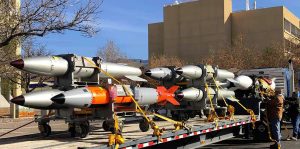
B61 H-bombs in tow. Sandia National Lab photo.
By John LaForge
On October 27, the Pentagon announced its intention to produce yet another modification of its B61 thermonuclear gravity bomb warhead design, to be called the B61-13. The plan needs congressional authorization which is nearly axiomatic when nuclear weapons spending is proposed.
The surprise decision “comes shortly after another new nuclear bomb — the B61-12 — began full-scale production last year and is currently entering the U.S. nuclear arsenal,” reported Hans Kristensen and Matt Korda for the Federation of American Scientists.[1] The military said it wanted 480 of the B61-12s, and that it would replace the B61-3s and -4s now stationed in Europe for use by fighter jet pilots from Germany, Italy, Belgium, the Netherlands, and Turkey.
The Pentagon’s press release says that the new B61-13 is not intended for the five European air forces, and that it will be stationed in the U.S. and used only on heavy bombers. However, Kristensen and Korda reported, “Nonetheless … the [jet] fighters that are destined to deliver the B61-12 will also be capable of delivering the B61-13.” They also report, “The B61-13 will have the same maximum yield as the B61-7 (360 kilotons), according to defense officials, a significant increase compared with the 50-kiloton B61-12 it is intended to supplement.” Such an enormous kiloton yield is 24 times the force of the Hiroshima bomb which killed 140,000 people.
Commenting on the dubious reasons put forward for buying more nuclear weapons (the U.S. has over 5,000), the two analysts wrote that “The case for the B61-13 is strange,” that the Pentagon’s justification “is hard to see,” that the “military mission” of the new bomb “is somewhat of a mystery,” and that, “The military doesn’t need an additional, more powerful gravity bomb.”
A Pentagon press release on the new H-bomb says only that its reasons for another bomb are “a changing security environment,” and the need to deter Russia and China. Since not much has changed in U.S.-Russia or U.S.-China relations in decades, and since the current U.S. nuclear arsenal packs catastrophic devastation beyond human imagination, the Biden administration’s and the Pentagon’s rationale for another nuclear weapon is simply asinine.
—  Federation of American Scientists, Oct. 27, 2023

Filed Under: B61 Bombs in Europe, Military Spending, Newsletter Archives, Nuclear Weapons, Quarterly Newsletter

January 18, 2024 by Nukewatch 1 Comment

European Court of Human Rights May Hear Appeals of Nuclear Weapons Protest Convictions

By John LaForge

German and U.S. nuclear weapons resisters continue their quixotic jousting match with the criminal justice system. Emphasis on the word criminal.

After dozens of “go-in” actions against the presence of U.S. nuclear weapons at Germany’s Büchel air base, and following scores of trial court convictions for “trespassing” at the NATO base, twenty individual appeals to Germany’s high-level Constitutional Court have now been rejected without comment. The high court has simply upheld the rulings of the Regional Court in Koblenz finding the resisters guilty. Koblenz judges have repeatedly found that secret arrangements between the U.S. and Germany have legalized the shipment to and deployment of U.S. nuclear bombs at Büchel.

Nuclear abolitionists, including Nukewatch’s John LaForge and many others, have argued that binding U.S. and German treaty law forbids any and all such transfer of nuclear weapons (known as nuclear proliferation), and consequently that nonviolent actions attempting to interfere with such violations are justifiable acts of “crime prevention.”

As of September, a total of six nuclear resisters have filed applications or appeals with the European Court of Human Rights, in Strasbourg, France, arguing that the convictions were in error. The ECHR, made up of 42 judges, one from every state party to the European Convention on Human Rights, has a rigid set of standards to be met to win a hearing, and defendants must first have exhausted all the means of redress in their state and federal courts.

A sleeping “Madame Justice” was “woken up” by protesters before Germany’s Constitutional Court.

In LaForge’s appeal to the ECHR, filed in May, the court has indicated some interest in the case, but has not yet formally decided to hear it. In June, the court wrote that one signature and one document were missing from the application. “Normally this would mean that your application would be rejected,” the court said. “However, in view of the particular circumstances of the case, you are requested, on an exceptional basis, to complete your file” and supply the needed information by August 7.

After receiving the required materials, the Legal Secretary wrote on October 9, “The court will deal with the case … as soon as the course of business permits.”

In late September, John joined German anti-nuclear bicyclists in a public protest ride between the two high courts. Beginning with a rally at the doors of the Constitutional Court in Karlsruhe, Germany, sixteen riders spent two days cycling to Strasbourg and the gates of the ECHR, just across the Rhine River border separating Germany and France.

In front of both court complexes, group members spoke of the increasing dangers and legal nihilism of nuclear sharing, and a small troupe performed a theatrical piece called “Wake Up Justice!” in which a sleepy, inattentive “Madame Justice,” portrayed by Lies Welker (pictured outside the Constitutional Court), was woken by the shouts and cries of citizens demanding that she do something about the threats to humanity posed by the nuclear war planners.

Filed Under: B61 Bombs in Europe, Direct Action, Newsletter Archives, Nuclear Weapons, Quarterly Newsletter, US Bombs Out of Germany

January 18, 2024 by Nukewatch Leave a Comment

Lawsuit Filed in Rome Against Stationing of U.S. Nuclear Weapons in Italy

By John LaForge

A formal complaint, submitted October 2, 2023 to Italy’s Public Prosecutor’s Office at the Court of Rome, demands a criminal investigation of the stationing of U.S. nuclear weapons on the national territory of Italy. The lawsuit also calls for the pursuit of all Italian persons who may be criminally responsible for the weapons’ importation and deployment. The complaint was signed by representatives of 22 organizations and says that the presence of U.S. nuclear weapons in Italy is certain, even though it has never been officially acknowledged by the government. The open secret of the transfer to Italy of the B61 H-bombs has been confirmed by numerous newspaper reports, scientific journals, leaked NATO documents, and the effective admission by the U.S. government that it has transferred nuclear weapons to Belgium, the Netherlands, Germany, Italy, and Turkey. U.S. B61 gravity bombs are reportedly now stationed at Italy’s air force bases at Ghedi and Aviano. The legal complaint recalls that Italy ratified the Treaty on the Nonproliferation of Nuclear Weapons (NPT) on April 24, 1975, and argues that the treaty’s Articles I and II prohibit the transfer of foreign nuclear weapons to Italy. The complaint also charges that the presence of U.S. nuclear weapons in Italian territory violates Italian federal law related to weapons and import licenses. — For a copy of the lawsuit, email us at nukewatch1@lakeland.ws.

Several nuclear weapons related upgrades underway at Ghedi Air Base in 2021, the year Italy hosted the annual NATO “Steadfast Noon” war games. Photo: Federation of American Scientists.

Filed Under: B61 Bombs in Europe, Newsletter Archives, Nuclear Weapons, Quarterly Newsletter

  • « Previous Page
  • 1
  • …
  • 45
  • 46
  • 47
  • 48
  • 49
  • …
  • 266
  • Next Page »

Stay Connected

  • Facebook
  • Twitter

Subscribe

Donate

Categories

  • B61 Bombs in Europe
  • Chernobyl
  • Counterfeit Reactor Parts
  • Depleted Uranium
  • Direct Action
  • Environment
  • Environmental Justice
  • Fukushima
  • Lake Superior Barrels
  • Military Spending
  • Newsletter Archives
  • North Korea
  • Nuclear Power
  • Nuclear Weapons
  • Office News
  • On The Bright Side
  • Photo Gallery
  • Protect the Water Close Xcel's Monticello Reactor
  • Quarterly Newsletter
  • Radiation Exposure
  • Radioactive Waste
  • Renewable Energy
  • Social Issues
  • Sulfide Mining
  • Through the Prism of Nonviolence
  • Uncategorized
  • Uranium Mining
  • US Bombs Out of Germany
  • War
  • Weekly Column

Contact Us

(715) 472-4185
nukewatch1@lakeland.ws

Address:
740A Round Lake Road
Luck, Wisconsin 54853
USA

Donate To Nukewatch

News & Information on Nuclear Weapons,
Power, Waste & Nonviolent Resistance

Stay Connected

  • Facebook
  • Twitter

© 2026 · Nukewatch