Nukewatch

Working for a nuclear-free future since 1979

  • Issues
    • Direct Action
    • Environmental Justice
    • Nuclear Power
      • Chernobyl
      • Fukushima
    • Nuclear Weapons
    • On The Bright Side
    • Radiation Exposure
    • Radioactive Waste
    • Renewable Energy
    • Uranium Mining
    • US Bombs Out of Germany
  • Quarterly Newsletter
    • Quarterly Newsletter
    • Newsletter Archives
  • Resources
    • Nuclear Heartland Book
    • Fact Sheets
    • Reports, Studies & Publications
      • The New Nuclear Weapons: $1.74 Trillion for H-bomb Profiteers and Fake Cleanups
      • Nuclear Power: Dead In the Water It Poisoned
      • Thorium Fuel’s Advantages as Mythical as Thor
      • Greenpeace on Fukushima 2016
      • Drinking Water at Risk: Toxic Military Wastes Haunt Lake Superior
    • Nukewatch in the News
    • Links
    • Videos
  • About
    • About Nukewatch
    • Contact Us
  • Get Involved
    • Action Alerts!
    • Calendar
  • Donate

July 14, 2025 by Nukewatch Leave a Comment

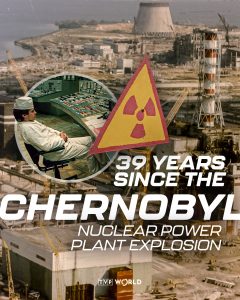
39th Chernobyl Anniversary: Radiation Warnings Still Apply

On April 26 1986, the no. 4 reactor of the Chernobyl Nuclear Power Plant exploded

The Belarusian Department for Nuclear and Radiation Safety said at a press conference on Earth Day that 39 years after the April 26, 1986, Chernobyl disaster, “60% of cesium-137 and 62% of strontium-90 have decayed.” Yekaterina Shmeleva, the Deputy Head of the Department, reported that the “area of radioactive contamination” includes about 12% of the country’s territory — some 9,600 square miles — an area bigger that either Vermont (9,249 sq mi), New Hampshire (8,969), Massachusetts (7,838) or New Jersey (7,419). Shmeleva reported that the 1,859 settlements in the “zones of radioactive contamination” have a population of about 930,000, including 181,000 children. Belta reported that Shmeleva “urged [the public] to carefully choose the places for summer foraging and to do radiation control of mushrooms and berries.” Left unsaid was that it takes thirty years for cesium-137 to decay by half, and that it will not decay completely for another 261 years — until the year 2286. In their 2006 study “The Other Chernobyl Report,” Ian Fairlie and David Sumner note that, “particularly large areas of Belarus, Ukraine and Russia were contaminated with high levels of radioactivity.” — Belarusian Telegraph Agency (Belta), April 22, 2025

Filed Under: Chernobyl, Newsletter Archives, Nuclear Power, Quarterly Newsletter

July 14, 2025 by Nukewatch 1 Comment

Fukushima Radioactive Waste Problems Metastasize

The Tokyo Electric Power Company, Tepco, reported on March 21 that two specially designed and newly installed robots will need three years to remove about 3,000 sandbags from the basements of the three destroyed reactor buildings at Fukushima-Daiichi, in Japan.

The sandbags were used in the panic-driven initial days of the triple reactor meltdowns of March 2011, when highly radioactive water gushed into the reactor basements and had to be diverted. Interesting Engineering reports that the sandbags are in areas “with lethal radiation levels” too hazardous for manual work.

The robots will be operated remotely due to the sandbags’ fierce radioactivity, because of the large bulk of the bags which weigh a total of 41 tons, and because of the chaotic wreckage in the destroyed reactors’ basements, the project is expected to take at least until March 2028, according to Tepco.

News reports did not specify the sort of radioactive materials that contaminate the deadly sandbags, but the melted reactor No. 3 was using fuel made partially of plutonium, the most toxic material known to science, which is radioactively hazardous for 240,000 years. Deadly isotopes beyond plutonium that make the high radiation zones too hot for humans include strontium-90, cesium-137 and -134, iodine-131, cobalt-60, carbon-14, tritium, technetium, neptunium, and americium.

Tepco says the deadly sandbags will be “sealed in dedicated containers” and moved to a temporary storage site. The company’s plan for long-term containment of this radioactive waste was not outlined and Tepco was not compelled by the press or the government to explain its strategy.

In Tokyo, the Citizens Nuclear Information Center (CNIC) reports that the sandbags have deteriorated, and cannot be recovered with the bags intact, forcing engineers to consider pumping them out together with the basement’s stagnant water, and then enclosing it all in containers.

Slow decommissioning at risk from quakes

Until at least 2027, the sandbags in addition to tons of highly radioactive sludge produced by filtering contaminated cooling water has to be kept in an area still at risk of flooding from potential earthquakes and tsunamis, the CNIC reported.

A March 31 report by Japan’s Cabinet Office’s disaster management working group says that a long-predicted “mega-quake,” if it occurs as anticipated along the Nankai Trough off Japan’s southwest Pacific coast, would likely trigger huge tsunamis, destroy thousands of buildings, spawn mass fires, cost Japan $1.81 trillion, and potentially kill 300,000 people. Under the report’s worst-case scenario, a magnitude-9 earthquake could see 1.23 million evacuees fleeing the area, or about 10% of its total population.

The Nankai trough is where the Philippine Sea Plate is subducting under the Eurasian Plate and accumulating tectonic pressure that can snap. The magnitude 9.1 undersea tectonic eruption of March 11, 2011 — Japan’s worst ever recorded earthquake whose power smashed reactor foundations at Fukushima Daiichi and flooded the site with tsunami waves — moved the island of Honshu, Japan’s largest, an astounding eight feet eastward.

Japan is one of the earth’s most earthquake-prone areas, and because of Fukushima’s daily accumulation of contaminated cooling water, some 1.3 million tonnes of this highly radioactive liquid waste is held in 1,000 giant tanks near the coast. So the sludge containers, the sandbags, and the 1,000 wastewater tanks are all vulnerable to daily tremors and the dreaded mega-quake.

Filed Under: Fukushima, Newsletter Archives, Nuclear Power, Quarterly Newsletter

May 30, 2025 by Nukewatch Leave a Comment

RADIATION and HARM to HUMAN HEALTH

THE CASE AGAINST NUCLEAR POWER

A Beyond Nuclear publication

See the report here:

Beyond Nuclear says about reactor radiation harms: It’s time to set the record straight on radiation and the damage it causes, particularly to pregnancy, children and women. Contrary to what Trump’s recent Exec. Order claims, abundant and largely officially ignored, scientific evidence demonstrates that childhood cancers increase around normally operating nuclear facilities, with indications that these cancers begin during pregnancy. Uranium mining to get fuel for reactors, a worldwide environmental justice travesty, is associated with a number of health impacts. Even already existing background radiation is associated with childhood cancers —a fact that nuclear proponents conveniently forget— as they compound impacts by releasing radiation accidentally, and routinely, from nuclear reactors; releases USNRC has been only too happy to oblige. Clearly our current radiation standards aren’t protective ENOUGH.

Filed Under: Environment, Nuclear Power, Radiation Exposure

April 7, 2025 by Nukewatch Leave a Comment

The Lies Have It: Xcel Energy Wins Operating Extension for Nation’s 6th Oldest Nuclear Reactor

By John LaForge

I.F. Stone famously said, “All governments are run by liars and nothing they say should be believed.” The aphorism applies equally well to nuclear reactor operators, including Minneapolis based Xcel Energy.

The U.S. Nuclear Regulatory Commission (NRC) has granted Xcel a second license extension for operating its 53-year-old Monticello reactor on the Mississippi River in Minnesota. The decision will permit this General Electric jalopy, a Fukushima clone, to run until it’s 80 years old — a dangerous feat that’s never been done in the history of nuclear power. The NRC received over 3,000 public comments mostly critical of the extension, but the commission has rubber-stamped 87 of 92 similar requests, so call the NRC “Never Really Concerned.”

The NRC nod is based partly on the commission’s Final Environmental Impact Statement (EIS) for the re-licensing, even though the document confirms that Xcel repeatedly made false statements about its massive 2022-23 leak of radioactive cooling water. According to a March 16, 2023, Associated Press (AP) story, Xcel’s first public response to the major leak was, “There’s no danger to the public.” Xcel then proceeded to understate by more than half the leak’s actual volume, estimating it was only 400,000 gallons.

Xcel eventually acknowledged that the volume of the leak, from an old corroded underground pipe, was 829,000 gallons, and that the groundwater plume of reactor cooling water — some of which would later reach the Mississippi River — had a radioactive footprint of some fourteen curies of tritium — a very large amount. (For reference, the 1979 partial reactor meltdown at Three Mile Island released an estimated 15 curies of gaseous radioactive iodine-131 to the Pennsylvania atmosphere. Other radioactive materials went into the Susquehanna River.)

Xcel’s 829,000-gallon leak was always a direct threat to drinking water because — as the company’s own 2023 Annual Radioactive Effluent Release Report states on page 13 — “It is assumed groundwater continuously flows to the river…” The Mississippi is the drinking water source for 20 million people, including Minneapolis, St. Paul, and their surrounding suburbs 37 miles downstream from the leaky reactor.

The extension will allow the Monticello reactor to operate until it’s 80 years old.

The fact that Xcel’s radioactive groundwater plume would automatically move toward the Mississippi meant the leak posed a gargantuan public relations problem. Lying about it was Xcel’s and the NRC’s first action. One NRC spokesperson, Victoria Mitlyng, told WCCO TV News, March 17, 2023, “There is no pathway for the tritium to get into drinking water.”

This mis-step was so blatant that, following pressure from Nukewatch, NRC Senior Environmental Project Manager Stephen S. Koenick publicly apologized for the fudge, at an NRC open meeting in the city of Monticello, May 15, 2024. Koenick told the gathering, “I know we had meetings in which we reported there were no indication[s] of a tritium leak making it to the Mississippi. However, in our Draft Environmental Impact Statement, we do say, we do conclude there were some very low concentrations of tritium in the Mississippi River.”

Curies and picocuries: code language helps to confuse

When these radioactive accidents take place, public relations language is employed by the industry to confuse, befog, and try to trivialize their size, scope, and potential health and environmental effects. Xcel reported to the NRC Dec. 15, 2022 that its leaked cooling water contained 5,020,000 “picocuries of radioactive tritium per liter,” sometimes written as “picocuries/liter.” This concentration is 251 times the EPA’s allowable limit for drinking water.

A picocurie is one-trillionth of a curie. Anything in the world divisible by one trillion is naturally very large, and a curie is a very large cache of radioactivity indeed. One curie amounts to 37 billion atomic disintegrations-per-second.

The NRC’s final EIS states on page 3-48, “Monticello reported an abnormal discharge to the Mississippi River from tritium contaminated groundwater of 0.167 curies of tritium between 07/27/23 and 12/31/23….”

The figure “0.167 curies” may give the impression of a small amount, but this amount of tritium contamination leaked to the Mississippi translates to 167 billion picocuries. Again, 20,000 picocuries-per liter is the current EPA allowable drinking water limit.

Over seven million gallons of groundwater has been pumped from Xcel’s onsite wells to try and keep more tritium from reaching the Mississippi. The final EIS says about this pollution at page 3-206 “For the period from January 1, 2023 to December 31, 2023, a total of 0.388 Ci [curies] of tritium (released via natural evaporation from the temporary tanks and the groundwater remediation pond) was reported during calendar year 2023.” This is to say 388 billion picocuries of tritium were sent floating around Minnesota’s Wright and Sherburne counties. This underreported and unplanned, emergency stop-gap response poses some risk for the surrounding residents who breathe.

Xcel’s estimated leak of 14 curies of tritium will contaminate the moving groundwater for a very long time. Its radioactive half-life is 12.3 years, so the tritium will persist for about 12 decades while it decays to helium-3 (radioactive substances are considered hazardous for ten half lives). Once tritium contaminates water, it is impossibly expensive to remove. A new textbook on tritium reports, “its half-life is short enough that it is extremely radioactive. For a given mass, it is, for instance, about 150,000 times as radioactive, in terms of disintegrations per unit time, as plutonium-239. One teaspoon of tritiated water would contaminate about 100 billion gallons of water to the U.S. drinking water limit.”

Alarmingly, when tritium is internalized (ingested or inhaled) it can result in problem pregnancies, miscarriages, and birth abnormalities because this machine-made radioactive poison crosses the placenta where it threatens the fetus. Yet the NRC has neither imposed a penalty nor even issued a rebuke to Xcel for its enormous leak or for its public lying that still paints a false picture of its consequences.

Xcel’s home website seen Jan. 8, 2025 still includes the uncorrected notice of March 16, 2023 that claims, “Xcel Energy took swift action to contain the leak to the plant site, which poses no health and safety risk to the local community or the environment,” and in the next paragraph it still says, “the leaked water is fully contained on-site and has not been detected beyond the facility”. Of course, Xcel knows that nothing “contains” groundwater which is constantly moving willy-nilly. This company’s public pronouncements must not be believed.

The Coalition for a Nuclear-Free Mississippi River, made up of regional environmental, climate, and justice groups has vowed to see the reactor closed before the achy, breaky Monticello unit causes a more catastrophic radiation release.

— John LaForge and the Coalition for a Nuclear-Free Mississippi River, Lindsay Potter contributed research to this report.

Filed Under: Environment, Newsletter Archives, Nuclear Power, Quarterly Newsletter

April 7, 2025 by Nukewatch 1 Comment

Minnesota Legislature Considers Repeal of Nuclear Moratorium

By Lindsay Potter

Bills are circulating in the Minnesota legislature to repeal the state’s 31-year-old moratorium on building new nuclear reactors. Members of the Nukewatch and the Coalition for a Nuclear-Free Mississippi River testified before committees in the House and Senate and are collaborating with the Rise and Repair Alliance to oppose the repeal. Now is the time for Minnesota residents to write, email, and call state legislators: urge them to oppose the repeal. As the Nukewatch Quarterly has emphasized again and again, nuclear power cannot aid in confronting the climate crisis — it is simply too costly and too slow. (See Welcome to Planet Vogtle: The Lessons of Georgia’s Nuclear Boondoggle and Seven Reasons Why Nuclear Energy is Not the Answer to Solve Climate Change.)

Nuclear electricity costs about 3-14 times that of onshore wind, takes 7 to 21 years longer between planning and operation than wind, and produces 9 to 37 times the emissions as wind. Nuclear creates risk and cost associated with nuclear weapons proliferation, meltdowns and accidents, the uranium fuel chain, radiation health risks, radioactive waste, threats to vital water sources, and environmental racism.

Nuclear power has received four times more federal funding for research and development over the last 70 years than renewables and is still the most expensive energy option. The U.S. Energy Information Agency’s 2024 comparison of energy sources calculated that nuclear power costs three to four times more than the combination of renewable wind and solar power plus back-up batteries. This does not include the cost of meltdowns or accidents, or the cost of packaging and storing radioactive waste, which must be isolated from the environment for hundreds of thousands of years.

So far, the only U.S. long-term waste storage project, at Yucca Mountain, Nev., had a projected total cost of $96 billion, took 18 years and wasted $8 billion before being cancelled as scientifically unviable. Canada has proposed a waste site 90 miles northeast of Minnesota’s Voyageurs National Park and 150 miles north of the Boundary Waters Canoe Area Wilderness.

Prospective small modular reactor (SMR) technology has yet to produce a single commercial reactor in the U.S., and the first licensed project folded after costs soared. Like large reactors, SMRs produce radioactive waste and suffer the same climate-worsening construction times and cost overruns.

Leading experts have shown we do not need nuclear to reach 100% renewable energy in Minnesota — this can be done with wind, solar, and battery storage. Research has shown batteries can meet demand fluctuations more effectively than nuclear.

Visit nukewatchinfo.org/protect-minnesotas-nuclear-moratorium/ to find template letters and how to contact legislators.

Filed Under: Environment, Newsletter Archives, Nuclear Power, Protect the Water Close Xcel's Monticello Reactor, Quarterly Newsletter

  • « Previous Page
  • 1
  • …
  • 11
  • 12
  • 13
  • 14
  • 15
  • …
  • 94
  • Next Page »

Stay Connected

  • Facebook
  • Twitter

Subscribe

Donate

Categories

  • B61 Bombs in Europe
  • Chernobyl
  • Counterfeit Reactor Parts
  • Depleted Uranium
  • Direct Action
  • Environment
  • Environmental Justice
  • Fukushima
  • Lake Superior Barrels
  • Military Spending
  • Newsletter Archives
  • North Korea
  • Nuclear Power
  • Nuclear Weapons
  • Office News
  • On The Bright Side
  • Photo Gallery
  • Protect the Water Close Xcel's Monticello Reactor
  • Quarterly Newsletter
  • Radiation Exposure
  • Radioactive Waste
  • Renewable Energy
  • Social Issues
  • Sulfide Mining
  • Through the Prism of Nonviolence
  • Uncategorized
  • Uranium Mining
  • US Bombs Out of Germany
  • War
  • Weekly Column

Contact Us

(715) 472-4185
nukewatch1@lakeland.ws

Address:
740A Round Lake Road
Luck, Wisconsin 54853
USA

Donate To Nukewatch

News & Information on Nuclear Weapons,
Power, Waste & Nonviolent Resistance

Stay Connected

  • Facebook
  • Twitter

© 2026 · Nukewatch