Nukewatch

Working for a nuclear-free future since 1979

  • Issues
    • Direct Action
    • Environmental Justice
    • Nuclear Power
      • Chernobyl
      • Fukushima
    • Nuclear Weapons
    • On The Bright Side
    • Radiation Exposure
    • Radioactive Waste
    • Renewable Energy
    • Uranium Mining
    • US Bombs Out of Germany
  • Quarterly Newsletter
    • Quarterly Newsletter
    • Newsletter Archives
  • Resources
    • Nuclear Heartland Book
    • Fact Sheets
    • Reports, Studies & Publications
      • The New Nuclear Weapons: $1.74 Trillion for H-bomb Profiteers and Fake Cleanups
      • Nuclear Power: Dead In the Water It Poisoned
      • Thorium Fuel’s Advantages as Mythical as Thor
      • Greenpeace on Fukushima 2016
      • Drinking Water at Risk: Toxic Military Wastes Haunt Lake Superior
    • Nukewatch in the News
    • Links
    • Videos
  • About
    • About Nukewatch
    • Contact Us
  • Get Involved
    • Action Alerts!
    • Calendar
  • Donate

November 5, 2025 by Nukewatch Leave a Comment

“The Beginning of Justice”: RECA Extended, Expanded

Youth from Polk Middle School in Albuquerque and Southwest Organizing Project join Tularosa Basin Downwinders Consortium co-founder Tina Cordova, left, at the 80th commemoration of the Trinity test with the newly unveiled historic marker. For the first time, Trinity downwinders are eligible for compensation for radiation exposure damage under the reauthorized RECA. Photo by Seth Sheldon, ICAN

By Danielle Prokop and Julia Goldberg

The July 16th 80th anniversary of the Trinity Test arrived in New Mexico at a poignant moment, and serves as just one example of the state’s nuclear legacy. Generations of survivors of the federal government’s nuclear testing program and the state’s uranium mining industry have waited for years for recognition from the United States as they watched their friends and families die from cancers.

The 1990 federal Radiation Exposure Compensation Act (RECA) — created to provide restitution to people sickened by exposure to radiation — excluded New Mexico’s downwinders and post-1971 uranium miners, and expired in 2024, after years of lobbying for expansion by victims and New Mexico’s elected leaders. Over the years, the coalition calling for
RECA’s expansion and extension has grown across states and become a bipartisan effort. In the end, Republican U.S. Senator Josh Hawley of Missouri got it over the finish line as a provision in Trump’s massive tax and spending bill.

“It was quite a relief, because we’ve waited so long,” said Tina Cordova, founder of the Tularosa Basin Downwinders Consortium, during a news conference. “Honestly, the acknowledgment is long past due,” she said. “But I also want to recognize…that we’re not there yet. We still have a lot of work to do.”

RECA’s two-year expansion “will not be long enough for us to get everybody enrolled,” Cordova said. The bill also provides $100,000 lump sum payouts but no longer includes health care coverage. “We will take the win, and we will continue our fight…. And we will also never forget that there are some very important people that have been left out: the people of Guam, the people of Colorado, the people of Montana, the remainder of Arizona and Nevada…. We will continue to stand shoulder-to-shoulder with our sisters and brothers from those places who we’ve come to love.”

— For updates and info’ on applying for RECA go to trinitydownwinders.com. This article was originally published at Source New Mexico and has been shortened for space.

Filed Under: Direct Action, Newsletter Archives, Nuclear Power, Quarterly Newsletter

November 5, 2025 by Nukewatch Leave a Comment

Serial Killers on the Loose: Cancer Death Rates Rising in Reactor Host Communities

Analysis of CDC data shows excess cancer deaths in counties that host the 16 oldest U.S. reactors

In commercial nuclear power reactors, after capital costs of construction are paid, which for the Monticello reactor in Minnesota was in the early 1990s, selling nuclear electricity is extremely profitable. Xcel Energy sells electricity for about $0.10/kWh. At this rate, every day that Monticello operates, it produces over $1.5 million that primarily pays Xcel Energy managers and shareholders.

Nuclear fission occurs in commercial nuclear reactors because uranium-235 atoms explode in chain reactions that produce atomic debris and extreme amounts of heat. Every element on the Periodic Table and all its radioactive isotopes are part of this debris, including gases such as radioactive helium, xenon, iodine, and krypton, and fine particulates like strontium-90. These materials are vented to the air or get absorbed by primary cooling water that circulates through reactor cores, and they must be removed in order for reactors to continue functioning.

The radioactive debris gets stripped out of primary cooling water, collected in holding tanks, and is held for some period. Due to the volume of these stripped materials, it is not profitable to contain them until they are no longer dangerous. So, after storing them for a designated period, they get released to the atmosphere under specified weather conditions. These are “routine radioactive releases.” Once these radioactive materials get released, they disperse into our biosphere. They are available for absorption, ingestion, and inhalation by living things, including humans.

Radiation monitoring at reactor sites is not designed, or intended, to detect these radioactive releases or to identify where they migrate or where they might accumulate. Radiation causes cancer. According to the 2005 National Academy of Sciences BEIR VII Report (Biological Effects of Ionizing Radiation), every exposure to radiation has the potential to cause cancer. There is no safe dose. While infants, children and women are more susceptible than adult males, every molecule of radiation routinely released by nuclear facilities has potential to initiate cancer in a person.

Joseph Mangano, an epidemiologist with master’s degrees in Public Health and Business Administration, is sole or co-author of 41 peer-reviewed medical journal articles, including articles published by The Lancet and The British Medical Journal.

The Center for Disease Control (CDC) public health data analyzed by Mangano identifies cancer mortality over three time periods in counties that host 16 of the nation’s oldest nuclear power reactors. Mangano’s analysis compares CDC reported cancer mortality in host counties with state-wide cancer mortality averages. The bottom-line results of this analysis are presented on the map of “Excess Cancer Deaths” below. The first time period of Mangano’s analysis, 1968-1978, establishes the baseline for comparison and accounts for an initial cancer latency period, as the first of the 16 oldest nuclear reactors came on-line in 1969.

Mangano’s CDC data analysis finds significant excess cancer deaths for host counties for 15 of the 16 oldest nuclear facilities. Further, the analysis finds that excess cancer deaths are greater, often significantly greater, in the 1999-2020 time-period than between 1979 and 1998. This is not surprising, considering that more people were exposed for longer periods of time during the 1999-2020 time frame.

What is the value of a human life? The results of Mangano’s analysis of CDC county-by-county public health data are clear: commercial nuclear operations are killing residents at an accelerating and alarming rate. His analysis found that the Monticello reactor accounted for 328 excess deaths from 1999 to 2020.

Every two months in Wright and Sherburne counties, cancer kills three more people as a result of radiation released into the environment by Monticello nuclear operations. What would be the public response if every three weeks, news broadcasters identified a victim and announced that the Wright and Sherburne county “serial killer” had struck again? How long, as a society, would we find such killing to be acceptable? This death toll in exchange for expensive electricity and corporate profiteering is intolerable, so nuclear reactors must be phased out.

Projected excess cancer deaths, 2031-2050, in Minnesota’s Wright and Sherburne counties

The Monticello nuclear power reactor started operating in 1971, and its recently-extended license expires in 2051, meaning Monticello could operate for up to 80 years (the oldest U.S. reactors started 55 years ago). The NRC has approved six applications for reactors to extend licenses up to 80 years. It is currently reviewing 16 others, and expects at least 19 more.

Reactors were designed to last 40 years, based on deterioration of mechanical parts. Keeping reactors well past the 40-year mark raises safety and health issues. The more than 100 cancer-causing gases and metallic particles routinely released from Monticello into the environment, alongside those from accidental radioactive leaks, can enter human bodies by way of air, food, and water, potentially leading to higher cancer rates.

In 1968-1978, the age-adjusted death rate for Wright and Sherburne counties was 10.5% below the U.S. rate (wonder.cdc.gov). Since then, the two-county rate has steadily moved closer to equaling the U.S. rate. In the most recent 12-year period for which final data are available (2009-2020), the local rate was just 2.2% below the U.S. rate. Then, for the first time, the local rate exceeded the U.S. rate in 2015, 2017, 2020, 2022, and 2023.

The population of Sherburne and Wright counties increased between 1970 and 2020, from 115,527 to 180,270. Projected future numbers are 269,000 in 2030 and 343,000 in 2050. The estimated number of Sherburne and Wright county residents who will die of cancer in the two decades 2031-2050 is 10,010.

The proposal to extend the license for the Monticello reactor for 20 years starting in 2031 was approved by federal regulators. Numerous concerns over local safety and health have been raised. While regulators are not obligated by law to monitor trends in local disease and death rates near reactors, the routine release of radioactive isotopes into the environment raises the issue of excess cancers in this 20-year period.

Two models, each using a different assumption about future differences between local and national cancer death rates, estimate that between 831 and 1,662 excess local cancer deaths would occur in 2031-2050, or between 8.3% and 16.6% of all 10,010 estimated cancer deaths.

Many factors can contribute to cancer mortality, including exposure to environmental toxins such as radioactivity emitted from nuclear reactors like Monticello. The health risks of continued operation of an aging and corroding reactor up to 80 years is a new issue, as Monticello is one of the oldest in the U.S.

Any decision to renew Monticello’s license for an additional 20 years should have included a thorough review of health hazards by officials, followed by public discussion. The historical shift from Sherburne and Wright Counties from a low-cancer area to one nearly equal to the national rate ⸺ and the potential for this to continue or worsen in the future, in an area with a rapidly-rising population ⸺ must be considered as one criterion in this decision.

⸺ Map and analysis by George Crocker of the North American Water Office, and Joseph Mangano, the Director of the Radiation and Public Health Project. This article is taken from a longer brochure currently available from the Coalition for a Nuclear-Free Mississippi River. To learn more, visit the website and sign the petition to shut down the Monticello reactor at nuclearfreemississippi.wordpress.com.

Filed Under: Environment, Newsletter Archives, Nuclear Power, Quarterly Newsletter, Radiation Exposure

November 5, 2025 by Nukewatch 1 Comment

Opinion: Cancer Machines: Nuclear Power and Waste

By Susu Jeffrey

The Monticello nuclear power reactor is on the Mississippi River about 35 miles northwest of Minneapolis, Minn. Xcel Energy’s two other Prairie Island reactors, plus about 50 giant dry casks storing waste reactor fuel, are all in the floodplain of the Mississippi, and adjacent to the Prairie Island Indian Community reservation. This radioactive waste is 48 miles southeast of Minneapolis and St. Paul.

There are no plans to move the waste off-island because there is no national, state, or municipal dump licensed for this deadly material. In fact, 34 more concrete encased steel waste casks are planned to be filled. Think of these waste container sites, like the 94 reactors at 54 U.S. sites, as permanent radioactive waste dumps.

The greater Twin Cities’ 3.7-million people are in the nuclear “shadow” (within 50 miles) of all three of Xcel’s nukes. The Mississippi River serves 20 million people with drinking water, way beyond Minnesota’s population of 5.7 million. Xcels’s aging nukes are a national threat.

The Monticello reactor was licensed for 40 years in 1970, and went online in 1971, the year it had two radioactive cesium spills. In 2010, its license was renewed for another 20 years until 2030. Xcel Energy has even been granted an extension for another 20 years until 2050. Octogenarian nukes are considered “safe enough” now by the nuclear/government consortium. The relicensing is a corporate/financial security move recently approved by the Minnesota Public Utilities Commission. Paperwork is one thing, pipes are another.

In November 2022, a 50-year-old underground pipe leaked 829,000 gallons of tritium-contaminated cooling water into the groundwater, some of which reached the Mississippi River according to the Nuclear Regulatory Commission (NRC). Xcel failed to make the radioactive spill public for four months. At a May 15, 2024 public hearing in Monticello where citizens testified “We don’t trust you. You lie,” an NRC executive “clarified” and apologized for the NRC’s and Xcel’s “miscommunication” that none was found in the Great River. Senior NRC Environmental Project Manager Stephen J. Koenick admitted some tritium had been measured in the Mississippi. Tritium bonds with water and cannot be separated out. The runaway tritium will persist in the environment for ten half-lives or about 123 years. For approximately the next six generations, it will be a part of the drinking water wherever those isotopes wander.

There is no telling where Xcel’s radioactive pollution will land among the 50 percent of men and 33 percent of women currently estimated to host a cancer invasion during our lifetimes. (National Public Radio, Feb. 17, 2025) There is tremendous popular, fear-driven support for the oncology industry. The good news is that while cancer numbers are up so is the cancer survival rate. However, at nuclear weapons, reactor and radioactive waste sites, “accidents” happen, along with permitted and routine radioactive emissions. Radioactivity cannot be contained. When I was a newspaper reporter in Brevard County, Florida, where Cape Canaveral is located, I learned that nuclear waste cannot be rocketed off into space because it’s too hot, too heavy, and because the rockets are too faulty.

Nuclear safety regulations changing

Some of President Trump’s cost-cutting executive orders will slash the NRC’s radiation exposure standards, cut commission staff, delete or “revise” regulations, trash the commission’s independent status, and make reactor operations more dangerous than ever.

Joseph Mangano and Ernest Sternglass did a study of eight downwind U.S. communities in the two years after a nuclear reactor closure. A remarkable 17.4 percent drop in infant mortality was found. “We finally have peer-reviewed accurate data attaching nuclear power reactors to death and injury in the host communities,” New York State Assemblyman Richard Brodsky said of the 2002 report in the Archives of Environmental Health. Some of Mangano’s more recent work is cited on the following page.

Show your support for Nukewatch and our work to protect air, water, soil, and living ecosystems from profiteering by weapons manufacturers, utilities, and mining companies. Put your dollars to work educating, protesting & resisting nuclear weapons, reactors, and waste.

Monopoly capitalism or public service?

Clearly the Monticello reactor was designed to make money. In November 2024, Minnesota Attorney General Keith Ellison wrote that Xcel has “aggressively” pursued multi-year rate hikes while earning large profits. In 2024 Xcel reported $1.94-billion net earnings, a profit margin up 14% from 2023.

According to Xcel propaganda, its 54-year-old reactor is “the biggest employer and largest local taxpayer” in Monticello, Minn., and generates an estimated $550 million in regional economic activity each year. And like profits, cancer rates are up notably among people under 50, and rising faster among women than men, the American Cancer Society reports.

Selling piecemeal fix-it parts for geriatric machinery is a lucrative business. Locating a leaking, underground cooling water pipe, between buildings, and removing and replacing it, was a non-negotiable emergency at an old nuclear reactor with miles of underground piping. These expenses figure into utility rate hikes.

Xcel eventually wins its rate increases and re-licensing “asks.” These asks get rewritten and resubmitted until a “compromise” is reached. In 2025, residential customers will pay $5.39 more per month, down from the original ask of $9.89, according to Minnesota Public Radio. In April this year Xcel Energy applied to increase overall electric rates by 11.8 percent in 2026 and roughly 7.2 percent in 2027, or by $150.7 million over the two years.

Cancer

St. Jude’s Children’s Hospital advertises heavily with videos of big-eyed, bald children cancer patients. In a review of published studies of 136 nuclear reactor sites in the European Journal of Cancer Care in 2007, elevated leukemia disease rates in children were documented in the U.S., U.K., France, Germany, Spain, Japan, and Canada. This is not a new story.

The danger of intellectual disabilities in fetuses exposed in the womb was reported in The New York Times, page A1 on Dec. 20, 1989. Ingested tritium crosses the placenta. In addition to the health costs of breathing and ingesting emissions from operating reactors, there is the costly problem of how to containerize its long-lived waste, but that’s another book-length article.

⸺ The public is encouraged to oppose Xcel’s current two-tier rate increase request. The firm wants 9.6% more this year, and another 3.6% in 2026. Written comments are being taken until Dec. 30, 2025. For talking points and the address to write, see: nuclearfreemississippi.wordpress.com

⸺ Susu Jeffrey is a poet and writer living in Minneapolis. She has opposed nuclear weapons and nuclear power since before her 1977 arrest at the Seabrook reactor in New Hampshire.

Filed Under: Newsletter Archives, Nuclear Power, Quarterly Newsletter, Radioactive Waste

August 29, 2025 by Nukewatch 1 Comment

Fukushima Recovery Plagued with Setbacks

By John LaForge

Fukushima Workers Flee Site After Tsunami Scare

Japan is one of the most earthquake prone areas in the world, and the regular quakes raise traumatic memories of the March 11, 2011 record-breaker that left 19,000 dead and smashed the six-reactor Fukushima-Daiichi site. A magnitude 5.5 quake struck just off Japan’s southeast Tokara coast July 3; a mag. 4.2 quake hit east of Iwaki, in Fukushima Prefecture July 12; and a mag. 4.1 quake shook the same area July 25.

In late July, an extremely powerful 8.8-magnitude quake struck Avacha Bay in Russia’s Far East, triggering tsunami warnings and evacuations across the entire Pacific Rim. The U.S. Geological Survey said the quake was one of the strongest ever recorded.

The owner/operator of the wrecked reactor complex, Tokyo Electric Power Co., evacuated its entire staff of 4,000 in response to warnings of a possible nine-foot tsunami, after first halting its pumping of radioactive wastewater into the Pacific.

Elsewhere in Japan, over 1.9 million people were urged to evacuate the eastern seaboard, and a 4-foot tsunami wave did strike north of Fukushima at Iwate Prefecture, some 1,090 miles from Avacha Bay, site of the major Russian earthquake.

China partially lifts ban on Japanese seafood imports

China “conditionally resumed” the importation of Japanese seafood products June 30 ⸺ with the exception of the 10 prefectures closest to the Fukushima disaster site ⸺ after conducting water sample inspections off the coast of the site. Beijing had banned all such imports from Japan as a protest and precaution, following the 2023 start of deliberately discharging large volumes of radioactively contaminated cooling water into the Pacific Ocean. The 2023 ban was imposed to “comprehensively prevent the food safety risks of radioactive contamination caused by the discharge of nuclear wastewater from Fukushima into the sea,” China’s General Administration of Customs said then. Shocked by Japan’s action, Beijing’s Foreign Ministry added that the discharge was an “extremely selfish and irresponsible act,” which would “push the risks onto the whole world (and) pass on the pain to future generations of human beings,” the Agence France-Presse reported.

Chinese customs officials said June 30 the seafood import ban would continue for ten prefectures, namely Fukushima and its nine closest neighboring states. Products from other regions will need health certificates, radioactive substance detection qualification certificates, and production area certificates issued by the Japanese government for Chinese customs declarations, the government said.

Relatedly, Hong Kong announced that it will maintain its ban on Japanese seafood, sea salt, and seaweed imports from the same ten prefectures still targeted by mainland China ¾ Fukushima, Gunma, Tochigi, Ibaraki, Miyagi, Niigata, Nagano, Saitama, Tokyo, and Chiba ¾ citing ongoing concerns about the risks associated with the discharge of radioactive wastewater.

Tepco Lost $6 Billion as Meltdown Recovery Falters

Tokyo Electric Power Co. Holdings corporation (Tepco) lost $5.8 billion (903 billion yen) between April and June this year as the owner and operator of the triple reactor meltdown at Fukushima, overrun with the costs of inventing, designing, building, and testing robotic machines with which to remotely extract the ferociously radioactive melted reactor fuel from deep inside the earth-quake and tsunami-wrecked reactors. There are a total of over 880 metric tonnes of “corium” or melted and rubblized uranium and plutonium fuel in three reactors that Tepco claims it will extract. Nikkei-Asia reported August 1st that Tepco says it has $4.7 billion “earmarked for future demolition work” (700 billion yen), which doesn’t even cover this spring’s one-quarter loss. Tepco has said that its preparations for the extraction are “expected to take 12 to 15 years.”

The quarterly financial loss makes a mockery of announced plans by the government and TEPCO to fully complete decommissioning of the rubbished reactors by 2051.

Two out of 14-to-20-million tonnes of radioactive soil buried on PM’s office grounds, in “safety” parody

In a surreal display of political slapstick July 19th, the office of Japan’s Prime Minister Shigeru Ishiba buried on his office’s garden grounds two cubic meters of radioactive soil scraped up during Fukushima clean-up operations (in which some 14-to-20 million cubic meters of topsoil and debris were collected) ¾ “to show it is safe to reuse.”

Nippon Television reported that “The radioactive cesium concentration in the soil being buried is 6,400 Becquerels per kilogram” (Bq/kg). “Becquerels” are a standard measuring unit of radioactivity. The 6,400 is below the legally permitted limit of 8,000 Bq/Kg.

The radiation emitted by the soil comes from cesium-137 which was spewed in large amounts by Fukushima’s melting and exploding reactors, and which came down as fallout. Cesium fallout still contaminates huge areas of forests and farm lands in the region.

The millions of tons of collected soil now in storage are being tested and sorted to identify material with cesium at 8,000 Bq/Kg or less. Several million tons of it may then be used as fill in construction projects, road-building, and railway embankments all around Japan. Asphalt, farm soil, “or layers of other materials should be used to seal in the radioactivity,” Akira Asakawa, an Environment Ministry official with the soil project, told the Agence France-Presse.

The PM’s demonstration plot is the first “reuse” of the poisoned waste, while experiments elsewhere have been halted due to public protest. The PM’s contaminated dirt was covered up with about eight inches of normal soil to provide some radiation shielding.

Any radiation exposure is unsafe, but negative effects like radiation sickness, immune disorders, or cancers caused by contact with the radioactive soil would take years or decades to appear, owing to the latency period between radiation exposure and the onset of induced health problems. The joke seems to be that since Prime Minister Ishiba hasn’t dropped dead after walking by, low-dose exposure must be harmless.

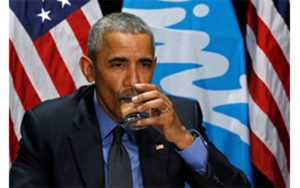
Readers may remember a very similar high-level comedy sketch performed by former President Barack Obama, who traveled to Flint, Michigan in May 2016. Drinking water supplies there had been contaminated with lead and to calm the public uproar, Obama sat before the cameras and theatrically downed a glass of water. The straight-faced routine was proof positive, and rock-solid confirmation beyond doubt of any kind whatsoever that Flint’s tap water was safe to drink. Bottom’s up!


“Yes, We Fooled You.” President Barack Obama drank a glass of filtered water in Flint, Michigan, which was scandalized by lead-poisoned drinking water, during a meeting there with officials. Photo: Carlos Barria/Reuters

Fukushima Disaster Response to Last Eons

Countless dilemmas and setbacks have plagued the now 14-year-long emergency response to the triple reactor meltdown and widespread radiation releases that began March 11, 2011 at Fukushima on Japan’s northeast coast.

Perhaps the most enormous of stumbling blocks, acknowledged by Tepco July 29, are the “unprecedented” technical complexities of finding, contacting, removing, and containerizing 880 tonnes of highly radioactive melted reactor fuel still smoldering at the bottom of the three devastated reactors.

Unprecedented is the key word here, since the industry has never before had to contain such a large mass of wasted and unapproachable radioactivity. All the work of dealing with the wasted fuel must be done robotically and remotely, since the waste’s fierce radioactivity kills living things that come near. Just planning and preparing to remove the “corium” material will take at least another 12 years.

Toyoshi Fuketa, head of a regulatory body overseeing the site, said at a press conference earlier that “The difficulty of retrieving the first handful of debris has become apparent,” the Kyodo News agency reported.

In 14 years’ time, engineers managed to design, build, test, and rebuild a one-of-a-kind robot that removed less than one-gram of the waste fuel from reactor No. 2 last year. That November “breakthrough” was three years behind schedule, “and some experts estimate that the decommissioning work could take more than a century,” CBS News and Mainichi Japan reported.

The torturously slow process has made Tepco’s early prediction of complete cleanup by 2051 (40 years’ time) appear to have been made up for PR reasons.

Tepco said July 29 that it would need another 12 to 15 years’ worth of preparation ¾ until 2040 ¾ “before starting the full-scale removal of melted fuel” at the No. 3 reactor. Tepco earlier claimed that “full-scale” extraction would begin four years ago, in 2021 according to the daily Asahi Shimbun August 1.

Of an estimated 880 tons of debris, only 0.9 gram has been recovered to date. With one million grams in a tonne, Tepco has only 879 million-plus grams to go, and “A simple calculation based on the time since the accident suggests the removal process could take another 13.6 billion years to complete,” the Asahi Shimbun smirked.

China’s reactor report card omits embarrassing emission info’

China issues annual reports on its large nuclear power operations known as “China Nuclear Energy.” The 2024 edition, its latest, made headlines by omitting for the first-time information on the routine radioactive gases and liquids released from its operating reactors.

Kyodo News reported that the omission may be a way to avoid accusations of hypocrisy since China has strenuously condemned Japan’s discharge of radioactively contaminated wastewater to the Pacific. At the same time China’s domestic reactors in 2022 reportedly “released wastewater containing tritium at levels up to nine times higher than the annual discharge limit” set by Japan’s discharge authorities. ###

Filed Under: Environment, Environmental Justice, Fukushima, Nuclear Power, Radiation Exposure, Radioactive Waste, Weekly Column

July 14, 2025 by Nukewatch Leave a Comment

Xcel’s String of Radioactive Releases

Utility’s Dirty Record at Monticello

Xcel Energy, Inc., the giant utility and natural gas delivery firm based in Minneapolis, Minn., has more than 5.8 million customers across eight states. The company’s PR says it will be carbon neutral by 2050, and that its nuclear power operations are “safe” and “clean” — even after its 829,000-gallon leak of highly radioactive cooling water in late 2022. As if such an industrial giant cares about nature, its website says, “We’re building a future powered by clean, reliable, affordable energy.”

In fact, Xcel’s reactors are expensive, unreliable — being regularly shut down by mishaps or refueling — and produce dirty, deadly, long-lived radioactive wastes every day. Xcel’s three old reactors in Minnesota, like all reactors everywhere, routinely release radioactive gases and liquids to the air and to water bodies.[1]

And Xcel’s reactor operations have a long history of both accidental and deliberate radioactive releases. Many of Xcel’s radiation accidents and intentional dispersals have been reported in news and regulatory reports, cited here. They are worth noting in view of the company’s pro-nuclear, greenwashing PR.

• On March 19, 2025, when the reactor was roaring at 97 percent power, its pressure vessel water level dropped and caused an unplanned emergency reactor shutdown. [2] The cause of the cooling water loss is “under investigation.” The Nuclear Regulatory Commission (NRC) reported that before the shutdown, “a single feedwater pump tripped which would lower [the] reactor water level.” Reactor expert David Lochbaum of the Union of Concerned Scientists wrote about this incident: “The Three Mile Island-2 accident was initiated when a condensate cleanup system miscue tripped a feedwater pump.” (NRC Event Report No. 57618, Monticello; David Lochbaum, email to Nukewatch, March 20, 2025)

• On December 14, 2023, Xcel was fined $14,000 by the Minnesota Pollution Control Agency (MPCA) for exceeding radioactive water storage limits. Xcel was storing more than 400,000 gallons of tritium-contaminated groundwater above a legal limit in temporary tanks without a permit. (MPCA, Dec. 14, 2023, https://www.pca.state.mn.us/news-and-stories/xcel-energy-inc-fined-14000-related-to-tritiated-water-storage-at-monticello-nuclear-facility)

• On May 26, 2023, Xcel reported a spill of 300-600 gallons of contaminated groundwater, with tritium activity of 194,000 picocuries per-liter, that overflowed from a holding tank onto the ground near the well from which it was pumped. Extensive pumping of groundwater is attempting to recover some of the tritium (radioactive hydrogen) and other radioactive materials released in the major cooling water leak of 2022-2023. (NRC Event Reports for 05/24/2023 – 05/25/2023, Power Reactor Event Number 56535; and NRC [document] 2023-TN9610; Xcel 2023-TN9609)

• Beginning sometime in late 2022 or earlier, one or two 50-year-old corroded underground pipes leaked an estimated 829,000 gallons of highly radioactive cooling water — with tritium activity over 5-million picocuries per-liter — into the ground, and the plume of tritiated groundwater reached the Mississippi River by spring 2023. [See below] (NRC, “Environmental Impact Statement Regarding Subsequent License Renewal for Monticello, Draft Report for Comment, April 2024, p.3-47 https://www.nrc.gov/docs/ML2410/ML24102A276.pdf)

• In July 2015, Federal investigators accused Xcel of willfully violating inspecting procedures and falsifying their reports about safety-related welding tests of radioactive waste casks. (“Feds allege Xcel contractors falsified weld tests at Monticello nuclear plant,” Minneapolis Star-Tribune, July 28, 2015)

• In 2009, workers found tritium-contaminated water leaking from an electrical conduit inside the reactor building basement. Xcel later said the leak had contaminated groundwater in concentrations above the 20,000 PiC/L drinking water maximum. (St. Paul Pioneer Press, Sept. 12 and 18, 2009)

• On September 11, 2008, a cable fault tripped the transformer which supplied power to the site. This resulted in a loss of off-site power and the plant automatically shut down. After the shut-down, the reactor suffered other equipment problems with safety-related systems. (“NRC Begins Special Inspection at Monticello,” NRC press release, Sept. 19, 2008)

• In January 2007, a 35,000-pound control box broke from its steel I-beam mount, fell onto a large steam pipe, and caused an unplanned, indefinite reactor shutdown. The mechanisms inside the control box malfunctioned and opened valves in four other steam pipes, said Jan Strasma of the NRC. The crash caused a loss of main steam line pressure prompting the reactor “scram.” The failure of welding holding the 13-ton box was likely caused by embrittlement and stress fatigue from 36 years of machine vibrations. (“A massive control box broke loose, triggering an indefinite shutdown,” Minneapolis Star-Tribune, Jan. 17, 2007)

• On May 5, 1982, about 1,300 gallons of radioactive water leaked from the reactor into the Mississippi River in an accident that was said to be “no threat” to the public. (“A-water released by NSP,” Minneapolis Star, Dec. 29, 1971, p.29; “Reactor leak ‘no threat,’” Montreal Gazette, May 5, 1982, p. H15)

• On December 20, 1971, Xcel (then Northern States Power or NSP) intentionally dumped an estimated 8,500 gallons of cesium-137-contaminated wastewater into the Mississippi River “to conduct maintenance.” The city of Minneapolis temporarily shut off its drinking water intake from the Mississippi because of this release. (“Radioactive discharge fits state standards,” Minneapolis Star, Dec. 21, 1971, p.16)

• In November 1971, NSP discharged “about 50,000 gallons of low-level radioactive water from the Monticello [reactor] into the Mississippi to permit the repair of a loose baffle.” (“NSP to delay atom discharges,” The Minneapolis Star, Wed., November 24, 1971, p.23.)

Xcel still lying about 829,000-gallon cooling water leak, & threat to drinking water

On Xcel’s Monticello reactor website pages regarding recovery of groundwater contaminated by its massive leak, under the heading “Current status and background,” Xcel still falsely states: “Tritium has not been detected in drinking water, or in the [Mississippi] river despite increased sampling by the company and state regulators.”[3]

Xcel is doubly false here: First, the Nuclear Regulatory Commission reported that Monticello’s leaked tritium had been detected in the Mississippi River, as of March 2023; and, secondly, the great river is drinking water for up to 20 million people.

The NRC’s Environmental Project Management Branch 1 Chief Stephen Koenick, at a public hearing in Monticello, Minn. May 15, 2024, said in part: “[A]s you have looked in our Draft Environmental Impact Statement [DEIS], we do conclude there were some very low concentrations of tritium in the Mississippi River.”

The DEIS says: “Tritium detections in wells near the Mississippi Riverbank … in 2023 indicate tritium-impacted groundwater likely discharged to the river. Minor levels … of tritium were measured in river samples in March and April 2023.”[4]

The same Xcel web page even makes this ludicrously self-incriminating claim: “The radiation levels in the leaked water are so low that, even if it were to enter a drinking water source, a person could drink it and it would be as safe as the food they eat on an average day.”

Xcel’s massive leak contained 5,020,000 picocuries of tritium per-liter (measured Nov. 2022), while the U.S. EPA’s Safe Drinking Water Act limit is 20,000 picocuries per-liter. — Nukewatch Fact Sheet
_________
Notes
[1] Xcel Energy, “2023 Annual Radioactive Effluent Release Report,” Dec. 18, 2023, https://www.nrc.gov/docs/ML2413/ML24135A191.pdf; The Guardian, “Radioactive material and pesticides among new contaminants found in U.S. tap water,” Nov. 3, 2021, https://www.theguardian.com/environment/2021/nov/03/us-tap-water-contaminants-discovery-radioactive-material-pesticides
[2] The reactor pressure vessel contains the uranium fuel rods, reactor cooling water, the reactor core, and fittings to direct cooling water circulation.
[3] XcelEnergy.com, accessed May 2, 2025, https://mn.my.xcelenergy.com/s/outage-safety/public-safety/monticello-groundwater
[4] NRC, “Environmental Impact Statement Regarding Subsequent License Renewal for Monticello, Draft Report for Comment, April 2024, p.3-47 https://www.nrc.gov/docs/ML2410/ML24102A276.pdf

Filed Under: Newsletter Archives, Nuclear Power, Quarterly Newsletter

  • « Previous Page
  • 1
  • …
  • 9
  • 10
  • 11
  • 12
  • 13
  • …
  • 94
  • Next Page »

Stay Connected

  • Facebook
  • Twitter

Subscribe

Donate

Categories

  • B61 Bombs in Europe
  • Chernobyl
  • Counterfeit Reactor Parts
  • Depleted Uranium
  • Direct Action
  • Environment
  • Environmental Justice
  • Fukushima
  • Lake Superior Barrels
  • Military Spending
  • Newsletter Archives
  • North Korea
  • Nuclear Power
  • Nuclear Weapons
  • Office News
  • On The Bright Side
  • Photo Gallery
  • Protect the Water Close Xcel's Monticello Reactor
  • Quarterly Newsletter
  • Radiation Exposure
  • Radioactive Waste
  • Renewable Energy
  • Social Issues
  • Sulfide Mining
  • Through the Prism of Nonviolence
  • Uncategorized
  • Uranium Mining
  • US Bombs Out of Germany
  • War
  • Weekly Column

Contact Us

(715) 472-4185
nukewatch1@lakeland.ws

Address:
740A Round Lake Road
Luck, Wisconsin 54853
USA

Donate To Nukewatch

News & Information on Nuclear Weapons,
Power, Waste & Nonviolent Resistance

Stay Connected

  • Facebook
  • Twitter

© 2026 · Nukewatch