Nukewatch

Working for a nuclear-free future since 1979

  • Issues
    • Direct Action
    • Environmental Justice
    • Nuclear Power
      • Chernobyl
      • Fukushima
    • Nuclear Weapons
    • On The Bright Side
    • Radiation Exposure
    • Radioactive Waste
    • Renewable Energy
    • Uranium Mining
    • US Bombs Out of Germany
  • Quarterly Newsletter
    • Quarterly Newsletter
    • Newsletter Archives
  • Resources
    • Nuclear Heartland Book
    • Fact Sheets
    • Reports, Studies & Publications
      • The New Nuclear Weapons: $1.74 Trillion for H-bomb Profiteers and Fake Cleanups
      • Nuclear Power: Dead In the Water It Poisoned
      • Thorium Fuel’s Advantages as Mythical as Thor
      • Greenpeace on Fukushima 2016
      • Drinking Water at Risk: Toxic Military Wastes Haunt Lake Superior
    • Nukewatch in the News
    • Links
    • Videos
  • About
    • About Nukewatch
    • Contact Us
  • Get Involved
    • Action Alerts!
    • Calendar
  • Donate

July 23, 2024 by Nukewatch Leave a Comment

“Gigantic Subsea Nuclear Graveyard”

By Lindsay Potter
telegraph.co.uk

The United Kingdom is considering an unprecedented deep-sea Geological Disposal Facility (GDF) under the sea floor for high-level radioactive waste, currently estimated to cost $83 billion and take 150 years to build — making it the “biggest, longest-lasting, and most expensive infrastructure project ever undertaken in the U.K.,” according to the London Telegraph. The GDF would be a 3,500-foot-deep shaft with multiple tunnels to be filled and then sealed with cement. The London Telegraph reports that the shaft would connect to “huge vaults … excavated in the impermeable clays … scientists hope could provide a last resting place for Britain’s nuclear legacy.” The proposed sites are off the coast of Lincolnshire or off the coast of Cumbria, both areas dependent on tourism.

Professor of Energy Policy at Greenwich University Dr. Steven Thomas said, “these [cost] estimates are no more than a wild guess.” For now, contractor Nuclear Waste Services Co. (NWS) anticipates storing 26 million cubic feet of waste — 750,000 cubic feet are currently awaiting burial and the rest is estimated waste to be accumulated by the U.K.’s next generation of nuclear reactors. The waste includes 110,000 tons of uranium and 120 tons of plutonium. Uranium-238 takes 4.5 billion years for half to decay. Neil Hyatt, NWS’s chief scientific advisor, points out the waste will be deadly likely beyond the end of our civilization. “We’re talking about a piece of infrastructure that’s going to go with us on a journey into the future, for as far forward [in time] as homo sapiens has existed,” he said. Claire Corkhill, professor of radioactive waste management at Bristol University, who is also a member of the Government’s advisory Committee on Radioactive Waste Management, said, “We owe it to future generations to ensure that we have a solution for the radioactive waste generated from new nuclear power stations before we start producing it.”

— Le Show, May 12; electricityinfo.org, May 6; London Telegraph, May 5, 2024

Filed Under: Environment, Environmental Justice, Newsletter Archives, Nuclear Power, Quarterly Newsletter, Radioactive Waste

July 23, 2024 by Nukewatch 1 Comment

Canadians Fight Dump Near Ottawa River

The Chalk River site. Image: The Council of Canadians. Learn more at stopnuclearwaste.com.
By Lindsay Potter

In January, the Canadian Nuclear Safety Commission amended the operating license for the Canada Nuclear Laboratories’ (CNL) Chalk River site authorizing construction of a “near surface disposal facility” to hold one million cubic meters of radioactive waste one kilometer from the Ottawa River, drinking water source for more than ten million people. The proposed NSDF is seven stories high and larger than 70 NHL hockey rinks.

The “low-level radioactive waste” destined for burial includes contaminated building materials, soil, equipment, tools, etc. The site, near Deep River, Ontario, upriver from Ottawa and Montreal, is unceded Anishinabeg Algonquin Nation territory. The Ottawa River has been a sacred and vital waterway for First Nations for thousands of years.

The NSDF is described as an “earthen mound” containing twelve disposal “cells,” each to be lined and covered. The proposal also includes systems for collecting leachate, detecting leaks, monitoring, as well as other infrastructure for treating wastewater and cleaning trucks, workstations, and personnel.

Once construction is finished, the commission must grant CNL an additional license before it begins burying radioactive waste in the facility. The NSDF is projected to operate for 50 years, followed by a 30-year “closure phase” and a 300-year “post-closure phase,” wrapping up in 2400.

The commission says the project “is not likely to cause significant adverse environmental effects,” but there is already a long list of radioactive contamination at the site, affecting the groundwater, tributaries — including Perch Lake and Perch Creek — and wetlands that feed into the Ottawa River. The licensing process has been riddled with complexities.

Opposition by First Nations, Environmentalists, and Other Local Leaders

Of the eleven Algonquin groups in the area, ten expressed strong opposition to the NSDF, citing concerns for the safety of the waters of Kichi Zibi (the Algonquin name for the Ottawa River), health risks to people and wildlife, violation of treaty obligations and sacred sites, lack of prior and informed consent, and industry influence over the commission.

Dozens of mayors with the Montreal Metropolitan Community as well as 140 other municipalities in Ontario and Quebec oppose the project. Maja Vodanovic, mayor of the Lachine borough in Montreal, told CBC News, “Nuclear energy is not clean energy … Yes, it doesn’t produce the [same] greenhouse gas effects like oil, but it creates very dangerous waste.” The Canadian Museum of Nature also denounced the NSDF over concerns it could harm two endangered species living in the watershed.

Though the commission maintains it consulted Indigenous groups in accordance with requirements under Canadian and international law, Algonquin leaders are pursuing further legal action, citing treaty violations. Lance Haymond, chief of Kebaowek First Nation, told CBC, “We are very fearful that in 10, 15, 20 years, this project will continue to pose a risk … to all Canadians who use and depend on the Ottawa River as their drinking water source.”

Chief Dylan Whiteduck of Kitigan Zibi Anishinābeg First Nation told CBC, “They always knew they wanted to do this and they were going to do it with or without us.” Justin Roy of Kebaowek First Nation said, “When building a camp and you need potable drinking water and you build a well, you don’t go and build your outhouse beside that well.”

Industry Inside Job

The Canadian Nuclear Safety Commission, charged with determining the NSDF’s safety and granting its operating license, claims it “is an independent administrative tribunal set up at arm’s length from government, without ties to the nuclear industry.” But five of the Commission’s six members have unabashed ties to the nuclear industry.

— CBC News Jan. 11, 2024, Oct. 24, 2023; Canadian Nuclear Safety Commission

Look for Part Two of this story in the upcoming Nukewatch Fall Quarterly. Learn about the fraudulent multi-nationals set to run the project, the radioactive legacy left by decades of nuclear work at Chalk River, its links to the Manhattan Project, and the next steps forward for opposition groups.

Filed Under: Environment, Environmental Justice, Newsletter Archives, Nuclear Power, Nuclear Weapons, Quarterly Newsletter, Radioactive Waste

July 22, 2024 by Nukewatch 3 Comments

Emerging AI Use in the Nuclear Industry

By Mari Inoue

The nuclear industry has been exploring possibilities of the use of Artificial Intelligence in military systems and to facilitate and enhance the work of the Nuclear Regulatory Commission. Following are some AI trends in the nuclear sector as well as agencies that oversee the use of AI tools:

In mid-April 2024, the North Atlantic Treaty Organization (NATO) published on its website, “Should artificial intelligence be banned from nuclear weapons systems?,” an article written by a physics professor. The article argues that “AI systems offer an opportunity to strengthen nuclear deterrence by providing a more accurate and capable defensive nuclear response … AI is simply a strategic tool, like nuclear weapons themselves. Concern over AI should not preclude the use of AI in strengthening nuclear deterrence. Nor should AI be deployed in those systems simply for the sake of deployment.”

In May 2023, Senators Ed Markey (D-MA), Elizabeth Warren (D-MA), Jeff Markley (D-OR), and Bernie Sanders (I-VT) introduced S.1364, Block Nuclear Launch by Autonomous Artificial Intelligence Act of 2023. The bill prohibits the use of federal funds to deploy nuclear weapons with autonomous weapons systems that are not subject to meaningful human control. The bill aims to ensure that no decision to launch a nuclear weapon or to select or engage targets for such purposes is made by AI.

“We would never defer a decision on nuclear employment to AI,” said Paul Dean, the U.S. State Department’s Principal Deputy Assistant Secretary in the Bureau of Arms Control, in a May 1, 2024, briefing.

photo: rawpixel.com

On October 30, 2023, President Biden signed an executive order on the “Safe, Secure, and Trustworthy Development and Use of Artificial Intelligence.” In regard to developing guidelines for AI safety and security in the nuclear sector, it ordered the Secretary of Energy to “develop tools to evaluate AI capabilities to generate outputs that may represent nuclear, nonproliferation, biological, chemical, critical infrastructure, and energy-security threats or hazards” solely for the purposes of “guarding against these threats.”

On December 12, 2023, as per the aforementioned executive order, the DOE launched the Office of Critical and Emerging Technology to coordinate research on AI that could be used in the energy, military, and health sectors. On May 30, 2024, it announced that Vanderbilt University and Oak Ridge National Laboratory, both in Tennessee, will partner to develop dependable AI for U.S. military applications.

In May 2023, the Nuclear Regulatory Commission published the Artificial Intelligence Strategic Plan Fiscal Years 2023-2027. It describes how the agency will execute its five strategic goals which include strengthening and expanding AI partnerships. Furthermore, in its policy memo of April 25, 2024, the NRC concluded that “successful internal adoption of AI” will “strengthen the agency’s ability to regulate the use of AI in NRC-regulated activities.” In fiscal year 2025, the NRC plans to invest in acquiring generative AI services and integrating AI with the online public search technology used by the NRC, also known as ADAMS.

In March 2024, the Office of Management and Budget issued its first government-wide policy to mitigate the risks of AI, and recognized, among other things, that the use of AI is presumed to be safety-impacting if used to control the safety-critical functions within nuclear reactors, materials, and waste.

AI is energy intensive. According to the recent analysis by the Electric Power Research Institute, data centers could consume up to 9% of U.S. electricity generation by 2030, more than double the amount currently used. Furthermore, internet queries using AI require approximately ten times the electricity of traditional internet searches. The nuclear energy sector, backed by Silicon Valley billionaires, is aiming to build new reactors to power data centers in order to meet the energy demand of the AI industry.

— Oak Ridge National Laboratory, May 30; NBC, March 7, 2024; Department of Energy, Dec. 12, 2023

— Mari Inoue, is a lawyer and activist based in New York City, born and raised in Tokyo, and co-founder of Manhattan Project for a Nuclear-Free World (mp-nuclear-free.com).

Filed Under: Newsletter Archives, Nuclear Power, Nuclear Weapons, Quarterly Newsletter

April 18, 2024 by Nukewatch Leave a Comment

Is Leaked, Radioactive Tritium in Mississippi River Drinking Water?

By John LaForge

Xcel Energy’s Monticello nuclear reactor on the Mississippi River has leaked some 829,000 gallons of wastewater contaminated with radioactive tritium into the groundwater on site,1 more than double the 400,000 gallons Xcel first estimated. The company has since replaced two leaking pipes, built an underground retaining wall, and is cleaning up after a second spill and its temporary reactor shutdown. Yet according to WCCO TV, for July 20, 2023, Xcel said a “small amount of leaked water may have reached the Mississippi River.”2

On March 18, 2023, the Associated Press (AP) reported that a representative of the U.S. Nuclear Regulatory Commission (NRC) told them that the tritium-contaminated wastewater from the reactor couldn’t contaminate the water people drink. The AP reporters quoted NRC spokesperson Victoria Mitlyng, writing: “Mitlyng said there is no pathway for the tritium to get into drinking water.”3

In fact, there are two pathways for the tritium leak to get into drinking water. First, the tritium in the 829,000-gallon leak is now in a groundwater plume that can move beyond Xcel’s Monticello site and reach private or public drinking water wells.

Second, the groundwater plume, which moves toward the Mississippi,4 will contaminate the river which supplies drinking water to one million-plus people in the Twin Cities and their suburbs and 38 million people downstream.

Legend – The Nuclear Regulatory Commission defines two emergency planning zones around nuclear reactors: a “plume exposure pathway zone” with a radius of 10 miles (dark yellow circle at center), concerned primarily with exposure to, and inhalation of, airborne radioactive contamination; and an “ingestion pathway zone” of about 50 miles (pale yellow circle), concerned primarily with ingestion of food and liquid contaminated by radioactivity. Numbers and red circles indicate approximate county population at risk. Arrows indicate wind direction.
Map Fine Print – Zone definitions: U.S. Nuclear Regulatory Commission. Population data: U.S. Census 2020 block groups with centers inside respective exposure zones. Wind data: National Weather Service 2023 daily summaries. Map by Carl Sack, 2024.

Perhaps Mitlyng was misquoted, since the NRC and the AP have both reported that the plume of tritium-contaminated groundwater can move outside Xcel’s boundary. In fact, both agencies have reported that Xcel’s stated purpose in hastily building an underground steel wall between the reactor and the Mississippi is to prevent the radioactive groundwater from entering the river.5

The AP reported March 24, 2023 that Chris Clark, the president of Xcel Energy,
acknowledged that the radioactive pollution can reach the Mississippi. The AP reported: “Even if the tritium reached the river, which Clark assured wouldn’t happen, it would dissipate within a few yards.”6 Clark’s assurance is either a mistake or a deliberate fib, because “dissipate” means to disappear or vanish. However, tritium contamination in water lasts 123 years.

Further, there is no way to remove tritium from water once it’s contaminated — as the 1.5 million tons of tritiated wastewater being pumped into the Pacific Ocean from the three-reactor earthquake/tsunami/meltdown site at Fukushima proves.

Why is Xcel’s tritium in the groundwater and the Great River such a threat to the people and animals that rely on it? As the NRC says, “This is because tritium travels as a form of water through the soil faster than other radionuclides.”7 The city of Minneapolis proudly declares, “Our water comes from the Mississippi River. Roughly 21 billion gallons of water are pumped from the river each year, and 57 million gallons of drinking water delivered every day.”8

We can’t say, “There’s nothing we can do.”

Everyone can comment to the government regarding the risks posed by Monticello’s operations, when Xcel issues (this spring) its draft supplemental environmental impact statement (DSEIS) regarding the firm’s request to extend its license and run the 54-year-old reactor until 2050, when it will turn 80.

The comment period will last four to six weeks and open after the DSEIS is released. Check Nukewatch’s website to learn when the period has opened. Use one of Nukewatch’s sample comments or your own. Plan to make your voice heard in person once the NRC schedules a public hearing on the license extension. nukewatchinfo.org/monticello.

Notes:

[1] Xcel Energy, “Subsequent License Renewal Application Response to Request for Additional Information and Request
for Confirmation of Information – Set 1 Part 2,” p. 6, Dec. 18, 2023, https://adamswebsearch2.nrc.gov/webSearch2/main.jsp?AccessionNumber=ML23352A081

and The Monticello Times, “Xcel groundwater recovery enters final phase,” Dec. 21, 2023, https://www.hometownsource.com/monticello_times/xcel-groundwater-recovery-enters-final-phase/article_7e834ce8-9ea3-11ee-8e03-9f36a6b5d962.html

[2] CBS Minnesota, WCCO Staff, “Xcel Energy: Small amount of leaked water may have reached the Mississippi River,”
July 20, 2023, https://www.cbsnews.com/minnesota/news/xcel-energy-small-amount-of-leaked-water-may-have-reached-
the-mississippi-river/

[3] Associated Press, “Regulators: Nuclear plant leak didn’t require public notice,” by Michael Phillis and Amancia Biraben, March 18, 2023, https://apnews.com/article/xcel-energy-nuclear-leak-tritium-6e522afbb12ad26925c40d833853088d

[4] Doug Wetzstein of the Minn. Pollution Control Agency told WCCO television last March, “The groundwater beneath
the facility … moves in the direction of the Mississippi River.” https://www.youtube.com/watch?v=r5c6j7UZZA0&ab_channel=WCCO-CBSMinnesota

[5] Nuclear Engineering International, “Xcel Energy to build underground barrier to contain radioactive water leak at Monticello NPP, August 22, 2023, https://www.neimagazine.com/news/newsxcel-energy-to-build-underground-barrier-to-contain-radioactive-water-leak-at-monticello-npp-11090330; Xcel illustration of its wall is at https://www.ci.monticello.mn.us/Blog.aspx?IID=59; WCCO Staff, CBS Minnesota, “Xcel Energy to begin construction on underground barrier at Monticello nuclear plant,” August 18, 2023, https://www.cbsnews.com/minnesota/news/xcel-energy-to-begin-construction-on-underground-barrier-at-monticello-nuclear-plant/

[6]Associated Press, “Minnesota nuclear plant shuts down for leak; residents worry,” by Trisha Ahmed and Matthew Daly, March 24, 2023, www.apnews.com/article/minnesota-nuclear-plant-leak-6b72b6f9cd2a1141aadd985b68654e04

[7] “NRC List of Leaks and Spills at Operating U.S. Commercial Nuclear Power Plants,” https://adamswebsearch2.nrc.gov/webSearch2/main.jsp?AccessionNumber=ML23284A16

[8] www.minneapolismn.gov, Treatment and Delivery Process, “Our water comes from the Mississippi River,” https://www2.minneapolismn.gov/government/departments/public-works/water-treatment-distribution/treat-deliver/

Filed Under: Environment, Environmental Justice, Newsletter Archives, Nuclear Power, Protect the Water Close Xcel's Monticello Reactor, Quarterly Newsletter, Radiation Exposure

April 18, 2024 by Nukewatch Leave a Comment

Nuclear Justice in Maohi Nui

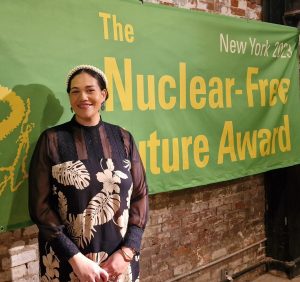
Hinamoeura Morgant-Cross receives the Nuclear -Free Future Award in New York, November 2023. Photo: Jean-Marie Collin.

Hinamoeura Morgant-Cross is a young French Polynesian whose realization that her own leukemia was a legacy of the French atomic tests in the South Pacific led her into activism. She works to ensure that the stories and experiences of the victims and their families will not be forgotten and to pressure the French government to both acknowledge responsibility and provide medical and financial support.

She was elected to the Polynesian Assembly of Representatives in May 2023 and shepherded a unanimous Assembly vote supporting the Treaty on the Prohibition of Nuclear Weapons. Morgant-Cross received the Nuclear-Free Futures Award in 2023 during the 2nd Meeting of the States Parties to the TPNW in New York. Nukewatch will feature the second part of her story in the summer 2024 Quarterly.

By Hinamoeura Morgant-Cross

TAHITI, MAOHI NUI — I was born in 1988 in Tahiti, the main island of French Polynesia. Until I was seven, France continued to explode nuclear bombs on my islands. Growing up, I never learned about the consequences of nuclear bombs at school. I didn’t even know there had been so many bombs, but what I did learn was that “thanks to nuclear power” we are a developed country.

Maohi Nui, known to the Western colonial world as French Polynesia, is a former French colony comprising more than 118 islands spanning almost one million square miles in the South Pacific Ocean. Maohi Nui belongs to France as a French collectivity with shared autonomy between the French government and the collectivity, a status that compromises our sovereignty on nuclear and other issues. France carried out dozens of atmospheric and underground tests in Algeria. But when Algeria gained independence in 1962, France turned to Maohi Nui to continue its nuclear experiments. Between 1966 and 1996 France detonated 193 nuclear bombs — 46 atmospheric and 147 underground — on the islands of Moruroa and Fangataufa and in our lagoons.

The French nuclear experimentation center is located 750 miles from Tahiti, but the nearest populated island to the testing zone, the island of Tureia, is only 75 miles away.

Evacuation occurred only once in the entire 30 years of experimentation. The sole island of Tureia was temporarily evacuated a few weeks before August 24, 1968 when the first French H-bomb test Canopus was dropped, 150 times more powerful than those which destroyed Hiroshima and Nagasaki. The French army instructed inhabitants of the island of Mangareva, 250 miles from ground zero, only to shelter from rain. No recommendations were made regarding water or food.

The fight for nuclear justice in Maohi Nui consists of properly educating the population about our nuclear history, which has been concealed by France for too long and downplayed for too long. Internationally, the anti-nuclear movement is denouncing the environmental and health consequences of France’s 193 nuclear bombs.

I’ve been a member of the Assembly of French Polynesia since May 2023, and I’m a fervent anti-nuclear campaigner. In September 2023, I presented a motion for a resolution in support of the United Nations Treaty on the Prohibition of Nuclear Weapons (TPNW) which was supported unanimously by members of the Assembly.

An extract of the resolution: “Today, it is very regrettable for French Polynesia, its population and its environment, that the French State is not a signatory to this Treaty and does not take part in the meetings of the States Parties to the TPNW. This is why, through this motion for a resolution, it is imperative that, as the territory that hosted the French nuclear testing center (Centre d’expérimentation du Pacifique – CEP), and as the population that was and still is a victim of nuclear fallout, we support the TPNW and solemnly ask the Head of State to: as a first step, encourage France to attend the next meetings of the States Parties to the TPNW as an observer state; secondly, work towards France’s accession to this new international standard.”

Through this resolution, my wish was to send a powerful message to France, but also to the international community and in particular to the countries taking part in the TPNW meetings: as a French collectivity, Maohi Nui has not the ability to sign onto the TPNW, but wants to be part of the meetings and discussions. Thanks to ICAN, representatives of the community of Maohi Nui were able to take part in the two meetings of the TPNW.

Filed Under: Environment, Environmental Justice, Newsletter Archives, Nuclear Power, Nuclear Weapons, Quarterly Newsletter, Radiation Exposure

  • « Previous Page
  • 1
  • …
  • 20
  • 21
  • 22
  • 23
  • 24
  • …
  • 94
  • Next Page »

Stay Connected

  • Facebook
  • Twitter

Subscribe

Donate

Categories

  • B61 Bombs in Europe
  • Chernobyl
  • Counterfeit Reactor Parts
  • Depleted Uranium
  • Direct Action
  • Environment
  • Environmental Justice
  • Fukushima
  • Lake Superior Barrels
  • Military Spending
  • Newsletter Archives
  • North Korea
  • Nuclear Power
  • Nuclear Weapons
  • Office News
  • On The Bright Side
  • Photo Gallery
  • Protect the Water Close Xcel's Monticello Reactor
  • Quarterly Newsletter
  • Radiation Exposure
  • Radioactive Waste
  • Renewable Energy
  • Social Issues
  • Sulfide Mining
  • Through the Prism of Nonviolence
  • Uncategorized
  • Uranium Mining
  • US Bombs Out of Germany
  • War
  • Weekly Column

Contact Us

(715) 472-4185
nukewatch1@lakeland.ws

Address:
740A Round Lake Road
Luck, Wisconsin 54853
USA

Donate To Nukewatch

News & Information on Nuclear Weapons,
Power, Waste & Nonviolent Resistance

Stay Connected

  • Facebook
  • Twitter

© 2026 · Nukewatch