Nukewatch

Working for a nuclear-free future since 1979

  • Issues
    • Direct Action
    • Environmental Justice
    • Nuclear Power
      • Chernobyl
      • Fukushima
    • Nuclear Weapons
    • On The Bright Side
    • Radiation Exposure
    • Radioactive Waste
    • Renewable Energy
    • Uranium Mining
    • US Bombs Out of Germany
  • Quarterly Newsletter
    • Quarterly Newsletter
    • Newsletter Archives
  • Resources
    • Nuclear Heartland Book
    • Fact Sheets
    • Reports, Studies & Publications
      • The New Nuclear Weapons: $1.74 Trillion for H-bomb Profiteers and Fake Cleanups
      • Nuclear Power: Dead In the Water It Poisoned
      • Thorium Fuel’s Advantages as Mythical as Thor
      • Greenpeace on Fukushima 2016
      • Drinking Water at Risk: Toxic Military Wastes Haunt Lake Superior
    • Nukewatch in the News
    • Links
    • Videos
  • About
    • About Nukewatch
    • Contact Us
  • Get Involved
    • Action Alerts!
    • Calendar
  • Donate

August 6, 2024 by Nukewatch Leave a Comment

Aging Monticello Nuclear Reactor Endangering Human Health

By Joseph J. Mangano

The Monticello nuclear reactor, one of the oldest in the world, has requested permission from federal regulators to extend its license for 20 years. If approved, the reactor in Monticello, Minn. could stay open for up to 80 years after its 1970 launch.

An 80-year-old reactor is an unknown quantity. Only a few, including Monticello, have even passed the 50-year mark. But federal regulators have approved all six requests for U.S. reactors to remain active up to 80 years, and are considering 10 others. Approvals are expected for all, as federal regulators have never rejected an extension.

A nuclear reactor is a complex array of mechanical parts. Over time, these parts become brittle and corrode. Aging at a reactor like Monticello presents multiple threats to safety and health, including:

1. The chance of a catastrophic meltdown increases; with over 3 million persons living within 50 miles of Monticello, many thousands would suffer from radiation poisoning or cancer.

2. The amount of highly radioactive waste that must be stored at each site — forever — in deep pools of water or steel and concrete casks would increase; currently, Monticello waste is nearly equal to the amount released during the Chornobyl meltdown.

3. Routine releases of over 100 radioactive particles and gases, only created when a reactor operates or a nuclear weapon explodes, are likely to increase; these toxic products enter bodies of nearby residents through breathing and the food chain.

These concerns are a reality at Monticello. In November 2022, a leaky pipe released large amounts of water contaminated with radioactive tritium at the site. Xcel Energy, which owns the reactor, failed to report this for four months — until a second large leak occurred — while trying to fix the first leak. The total amount of contaminated water is greater than an Olympic-sized swimming pool. Any entry into local drinking water from these enormous spills is a health risk.

U.S. reactors have operated over six decades, but federal regulators have only conducted one study of cancer in local residents. That report used statistics before 1985, and is thus outdated. No studies are currently planned.

Monticello is in Wright County, close to the border of Sherburne County. Almost all residents of these counties live within 25 miles of the reactor, and are most vulnerable to exposures from environmental releases. These counties are fast-growing areas just outside of the Twin Cities, with a current population of more than 250,000.

In the late 1960s and early 1970s, before and just after the Monticello reactor started up, the two-county death rate was 6 to 7% below that of other Minnesota counties — for cancers, and for all causes combined. This pattern is expected in an area with low rates of people who lack health insurance, who are disabled, or who live in poverty.

By the late 1970s, the two-county death rate exceeded the state rate for all causes, and has remained high ever since. If the local rate had remained 6-7% below the state, over 4,000 fewer deaths would have occurred. Cancer death rates are also high; in the two most recent years (2022 and 2023), the local rate was 9% and 20% above the state, respectively.

Many factors can account for an elevated risk of death. But one clue that Monticello releases may have been one factor is cancer mortality among children – who are much more likely to be harmed by a dose of radiation than are adults. Prior to the early 1990s, local child cancer mortality was 37% below the state, but has been 14% above ever since.

The push to keep the Monticello reactor running does little as a solution for future energy needs, as it only accounts for 9% of Minnesota’s electricity. However, safe and renewable sources accounted for 31% of the state’s electricity in 2022, most of it wind power, a number that is rising each year.

Unlike nuclear power, the wind and sun pose no cancer risk, and will last forever. The application to keep Monticello open should be denied, and the reactor should close in 2030, the end of its current license period.

— Joseph J. Mangano, MPH MBA, is an epidemiologist and Executive Director of the Radiation and Public Health Project.

Filed Under: Environment, Environmental Justice, Newsletter Archives, Nuclear Power, Protect the Water Close Xcel's Monticello Reactor, Quarterly Newsletter, Radiation Exposure

August 6, 2024 by Nukewatch 1 Comment

NRC Apologizes, Admits: Monticello’s Leaked Tritium Reached the Mississippi River

The blue outlined area is the “extent of tritium-impacted groundwater as of August 2023,” from the leaked, radioactive coolant water at Xcel Energy’s Monticello nuclear reactor. The blue shaded area marks tritium concentrations above the EPA safe drinking water limit, extending to the Mississippi River bank. Source: Xcel Energy, NRC Draft Environmental Impact Statement
By Nukewatch Staff

At a public hearing in Monticello, Minnesota, on May 15, the U.S. Nuclear Regulatory Commission (NRC) apologized for public claims made by its staff that radioactive tritium in a massive 2022 leak of cooling water from the Monticello reactor, had not reached the Mississippi River. The river is the drinking water source for 20 million people including the Minneapolis/St. Paul metro area.

In opening remarks to the NRC-sponsored hearing at the Monticello Community Center, Senior Environmental Project Manager Stephen Koenick apologized for the NRC’s often-repeated assurances that the leaked tritium from the 53-year-old reactor had not been detected in the Mississippi.

In his shocking yet underreported public apology, Koenick said: “I would like to take a moment to address and clarify some miscommunication regarding the presence of detectable tritium in the Mississippi River. I know we … reported there were no indication[s] of [a] tritium leak [which] made it to the Mississippi. However … in our Draft Environmental Impact Statement, we … conclude there were some very low concentrations of tritium in the Mississippi River.” Koenick went on to say, “So we apologize for this miscommunication.”

As far as Nukewatch can tell, only the weekly Monticello Times reported on the rare public apology and the eyebrow-raising admission that radioactive tritium from the plume caused by the 2022 leak had contaminated the Mississippi. The paper published a report by Nukewatch’s Kelly Lundeen and John LaForge on the front page of its June 6 issue under the headline “NRC apologizes, changes its stance on tritium leak: Now says low concentrations got into Mississippi River.”

Xcel Energy’s 2023 “Annual Radioactive Effluent Release Report” says on page two, “Tritium was detected in newly developed MW-33A [monitoring well-33A] and MW-37A which resulted in MNGP [Monticello Nuclear Generating Plant] reporting an abnormal discharge to the Mississippi River.”

What Koenick meant by “miscommunication” were claims repeatedly made to the press that no tritium had been found by Xcel’s testing of the river. On March 18, 2023, NRC spokesperson Victoria Mitlyng even told the press, “There is no pathway for the tritium to get into drinking water.” As recently as May 7, 2024, NRC presenters at an NRC-sponsored public hearing, also held in Monticello, said on the record that Xcel had found “no detectable levels” of tritium in the Mississippi. Xcel Energy, which owns the reactor, made many similar misstatements. A company website posting still online says, “We test the river regularly for tritium and have not found any, indicating that if it is present, it is at such low levels, and is dispersing so quickly, that it cannot be detected by highly sensitive instruments.” This directly contradicts well test results that Xcel submitted to the NRC on December 18 proving they found detectable tritium levels in the Mississippi River at several points over the summer of 2023. Xcel has applied for a second operating license extension which, if granted, would allow the Monticello reactor to run until the age of 80.

Filed Under: Environment, Newsletter Archives, Nuclear Power, Protect the Water Close Xcel's Monticello Reactor, Quarterly Newsletter, Radiation Exposure

August 6, 2024 by Nukewatch Leave a Comment

Nuclear Power: Ill-Advised

By George Crocker

Certain Minnesota legislators are interested in new nuclear power plants to address problems resulting from climate change.

Perhaps these politicians have recent and exciting new information about how to overcome the multitude of economic problems that cause new commercial reactors to be much too expensive. It would be good to find that out, because back in July 2018, for one example, Proceedings of the National Academy of Sciences concluded that nuclear fission power is just too expensive relative to the competition. A new reactor would start out costing about $13.61 million per megawatt and go up from there. New solar costs about $1 million per megawatt, with wind at about $2 million per megawatt, and wind and solar costs continue dropping.

Perhaps these politicians have also figured out how to manage high-level nuclear waste for the required 240,000 years, now that Yucca Mountain, the nation’s only proposed high-level nuclear waste repository has been shut down and abandoned for years, and U.S. federal courts recently stopped the nuclear industry from developing a dump to hold 100,000 metric tons of spent fuel on top of the Ogallala Aquifer in eastern New Mexico. These politicians probably also have a time machine to manage the fact that climate chaos is upon us as you read these words, but even in Nuclear Magic Land, if history teaches anything, new reactors will take upward of ten years to construct. There’s also the CO 2 from burning the coal to boil the uranium to refine nuclear fuel to acceptable levels of U-235.

If the Legislature were actually interested in combating climate chaos, it could pass legislation that enables the development of more than 8,000 megawatts in Minnesota of new renewable energy capacity, plus energy storage, that can be immediately installed and commissioned on the low-voltage side of virtually every load-serving substation in the state. Strategically sizing this new renewable energy capacity will allow it to come online immediately, because all the electricity will get consumed within the footprint of the substation and no new transmission would be needed.

— George Crocker is executive director of the North American Water Office. Letter originally published in Minneapolis Star Tribune on April 10, 2024.

Filed Under: Environment, Newsletter Archives, Nuclear Power, Protect the Water Close Xcel's Monticello Reactor, Quarterly Newsletter, Radioactive Waste

August 6, 2024 by Nukewatch Leave a Comment

Monticello Draft EIS Ignores Climate Change, Federal Law

Xcel Energy’s Monticello Nuclear Reactor on the Mississippi River in Monticello, Minn.
By Nukewatch Staff

Reactor operations expert Paul Gunter at Beyond Nuclear, reports in written comments to the Nuclear Regulatory Commission (NRC) that its Draft Environmental Impact Statement (DEIS) regarding Xcel Energy’s license renewal application for its Monticello, Minn. reactor should be withdrawn because it ignores the likely impact of climate change on nuclear accident risks, particularly the chances of Mississippi River flooding. Ignoring climate issues in the DEIS, Gunter says, violates requirements of the U.S. National Environmental Policy Act (NEPA).

NEPA mandates that federal agencies take a “hard look” at environmental impacts for all major federal actions, but the NRC’s DEIS disregards climate risks saying they “are outside the scope of the NRC staff’s … environmental review.”

However, binding NRC regulations now require that, “If new information about changing environmental conditions (such as rising sea levels or potential flooding…) becomes available, the NRC will evaluate the new information.”

Such new information was presented on April 2, 2024, by the Government Accounting Office, an investigative arm of Congress, in its report, “Nuclear Power Plants: NRC Should Take Action to Fully Consider the Potential Impacts of Climate Change.” The report singles out Monticello in an appendix, finding that as the unit is located in the flood plain of the Mississippi River, the reactor’s “Exposure for Selected Natural Hazards” includes “Flood Hazard” which it rates as “High.”

Filed Under: Environment, Environmental Justice, Newsletter Archives, Nuclear Power, Protect the Water Close Xcel's Monticello Reactor, Quarterly Newsletter

August 6, 2024 by Nukewatch Leave a Comment

Environmental Group Issues Demands on Monticello License Extension Process

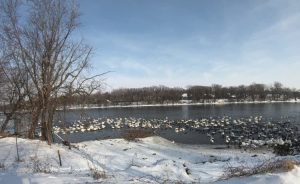
Trumpeter Swans on the Mississippi River in Monticello, Minn.
By Nukewatch Staff

In June, the Rainbow Warrior Collective filed a 16-page complaint to the Nuclear Regulatory Commission (NRC), Minnesota state regulatory agencies, Minnesota Attorney General Keith Ellison, and the Environmental Protection Agency. The Collective calls for the withdrawal of the NRC’s Draft Environmental Impact Statement (DEIS) for Xcel Energy’s Monticello reactor license extension, and for an investigation into the 829,000 gallon leak of cooling water. Authored by Kelsey Beaumaster, Vanessa Friedhoff, and John Miller, the comprehensive review of the NRC’s DEIS concludes with these specific demands:

[1] Given the extensive scope of information that needs to be considered and the substantial public interest, we urge the NRC to re-establish and extend the public comment period for the DEIS.

[2] Mandate the creation and enforcement of a legally binding agreement between Xcel and all relevant regulatory bodies to address past, present, and future contamination of drinking water, including a thorough assessment and remediation plan, transparent public reporting, funding for significant research, and independent oversight, with all costs borne by the polluter or the entity applying for a license extension.

[3] Investigate the allegations regarding the evaporation of tritiated water and disclose all relevant dose calculations and health risk assessments. Require funding of independent research to prove such operations are “as safe” as alleged by Xcel Energy.

[4] Ensure accountability for the manipulation of scientific data, silencing of public concerns, and the cover-up of environmental incidents, all of which constitute a deliberate deception of the public.

[5] Consider appointing a Special Prosecutor to handle the investigation into the tritium leak and nuclear moratorium matters, involving the public utilities commission. This ensures transparency and impartiality, aligning with legal protocols in Minnesota.

— For the full report contact nukewatch1@lakeland.ws.

Filed Under: Environment, Environmental Justice, Newsletter Archives, Nuclear Power, Protect the Water Close Xcel's Monticello Reactor, Quarterly Newsletter

  • « Previous Page
  • 1
  • 2
  • 3
  • 4
  • 5
  • 6
  • Next Page »

Stay Connected

  • Facebook
  • Twitter

Subscribe

Donate

Categories

  • B61 Bombs in Europe
  • Chernobyl
  • Counterfeit Reactor Parts
  • Depleted Uranium
  • Direct Action
  • Environment
  • Environmental Justice
  • Fukushima
  • Lake Superior Barrels
  • Military Spending
  • Newsletter Archives
  • North Korea
  • Nuclear Power
  • Nuclear Weapons
  • Office News
  • On The Bright Side
  • Photo Gallery
  • Protect the Water Close Xcel's Monticello Reactor
  • Quarterly Newsletter
  • Radiation Exposure
  • Radioactive Waste
  • Renewable Energy
  • Social Issues
  • Sulfide Mining
  • Through the Prism of Nonviolence
  • Uncategorized
  • Uranium Mining
  • US Bombs Out of Germany
  • War
  • Weekly Column

Contact Us

(715) 472-4185
nukewatch1@lakeland.ws

Address:
740A Round Lake Road
Luck, Wisconsin 54853
USA

Donate To Nukewatch

News & Information on Nuclear Weapons,
Power, Waste & Nonviolent Resistance

Stay Connected

  • Facebook
  • Twitter

© 2026 · Nukewatch