Nukewatch

Working for a nuclear-free future since 1979

  • Issues
    • Direct Action
    • Environmental Justice
    • Nuclear Power
      • Chernobyl
      • Fukushima
    • Nuclear Weapons
    • On The Bright Side
    • Radiation Exposure
    • Radioactive Waste
    • Renewable Energy
    • Uranium Mining
    • US Bombs Out of Germany
  • Quarterly Newsletter
    • Quarterly Newsletter
    • Newsletter Archives
  • Resources
    • Nuclear Heartland Book
    • Fact Sheets
    • Reports, Studies & Publications
      • The New Nuclear Weapons: $1.74 Trillion for H-bomb Profiteers and Fake Cleanups
      • Nuclear Power: Dead In the Water It Poisoned
      • Thorium Fuel’s Advantages as Mythical as Thor
      • Greenpeace on Fukushima 2016
      • Drinking Water at Risk: Toxic Military Wastes Haunt Lake Superior
    • Nukewatch in the News
    • Links
    • Videos
  • About
    • About Nukewatch
    • Contact Us
  • Get Involved
    • Action Alerts!
    • Calendar
  • Donate

January 18, 2024 by Nukewatch Leave a Comment

If You Love Nuclear Energy, You’re in Bed with Nuclear Weapons

Photo: wikipedia
By Harvey Wasserman

There is no separation between nuclear power and nuclear war. The “Peaceful Atom” is a radioactive myth.

The world’s fleet of atomic reactors is the happy-faced infrastructure for the global radioactive weapons industry.

In the United States, 94 commercial nukes comprise the core foundation of the world’s biggest Bomb machine. They are, above all, military devices.

Amidst the massive multi-billion-dollar government-sponsored expansion of the Piketon-Portsmouth Enrichment facility in southern Ohio, the prime function of every U.S. reactor is to be an essential provider of waste management, fuel, and expertise for radioactive weapons of mass destruction.

The Biden Administration is now further blurring the lines with a controversial plan to use weapons-grade materials in civilian reactors, a move that can — according to Scientific American — greatly facilitate the building of more Bombs.

The public smokescreen for all this back-door weapons proliferation remains an updated version of the original “too cheap to meter” lie that “our friend the atom” now produces “carbon-free” energy.

In fact, virtually all operating reactors spew radioactive carbon-14 into the biosphere while emitting countless tons more greenhouse gasses through the mining, milling, enrichment, and ultimate attempted disposal of fuel.

Commercial reactors operate at ~570 degrees Fahrenheit, pouring massive quantities of waste heat into the atmosphere and nearby rivers, lakes, and oceans.

And they churn out electricity at far higher cost than solar, wind, hydro, battery storage, efficiency, and other green energy sources. At massive geezer sites like Diablo Canyon, Cali., the nukes’ hyper-expensive, inflexible baseload supply clogs the grid and blocks off far cheaper, far more flexible renewable sources.

At the tail end of the fuel cycle, uranium, plutonium, hyper-radioactive cladding, and other components now find their way into the warheads and depleted uranium shells of global mass destruction. The reactors themselves are pre-deployed weapons of radioactive suicide.

The devastating explosions at Chernobyl and Fukushima underscore the potential of atomic reactors to spew their own apocalyptic quantities of deadly radiation throughout the planet.

But the Ukrainian war zone exposure of six Zaporizhzhia nukes also makes it terrifyingly clear that even a single errant shell fired by a warring nation or a tiny terror group could send one or more lethal Chernobyl-sized clouds over all of Europe and, via the jet stream, throughout the planet.

Even less dramatic catastrophes at Three Mile Island, Fermi One, Santa Susana, Windscale-Sellafield, Kyshtym, Mutsu, Kashiwazaki, and more have produced massive health, ecological, and financial fallout. Each sitting nuke and its fuel pool thus plays the role of a pre-deployed weapon of apocalyptic mass suicide.

None are insured. Nor are they reliably inspected by the Nuclear Regulatory Commission, International Atomic Energy Agency, or other so-called regulatory bodies throughout the world.

So one must ask: if atomic reactors can’t economically compete, can’t be insured, operate un-inspected, worsen climate chaos, are sitting ducks for terror attack, and so much more….why are they still running?

The answer is clear: they are the unspoken infrastructure for our nation’s Bomb-making machine, playing the same role for dozens of other countries around the world.

So next time someone tells you to support nuclear power, ask them:

“Exactly which reactors can you prove to be safe?”

“Which ones’ future are you ready to personally guarantee?” … and …

“Why do you support these atomic reactors’ irreplaceable role in the continued production of nuclear weapons?”

— Harvey Wasserman wrote this for CounterPunch (Oct. 27, 2023), and is author with Norman Solomon of Killing Our Own: The Disaster of America’s Experience with Atomic Radiation (Delta 1982).


Filed Under: Newsletter Archives, Nuclear Power, Nuclear Weapons, Quarterly Newsletter

January 18, 2024 by Nukewatch Leave a Comment

First Attempt to Build Small Reactors in U.S. Nixed over Cost

By Lindsay Potter

NuScale Power Corp., the first company to win approval for a small “modular” nuclear reactor (SMNR) design in the U.S., pulled the plug on its flagship project in Utah after costs ballooned 53 percent. NuScale and non-profit state utility partner UAMPS agreed to build a dozen 77-megawatt reactors at the Idaho National Laboratory (INL) to begin delivering electricity in 2029. But the cost per-megawatt-hour rose from $53 to $89, and subscribers began to pull out. The deal was canceled in November despite receiving $232 million in federal taxpayer handouts from a $1.4 billion non-competitive DOE grant.


INL uses nuclear reactors and related radioactive material to research and manufacture systems for energy production as well as military technology. The lab is the lead manufacturer of armor, featuring depleted uranium, for U.S. Abrams tanks. Export-version (non-D.U.-armored) Abrams have been used to fire D.U. munitions in Iraq, Afghanistan, and most recently in Ukraine.


Description of location of DU heavy armor plates on Abrams tanks. Different Abrams tanks have DU in different parts of armor and some versions of the tank, ostensibly the ones sent to Ukraine, do not have DU armor, though they are designed to fire DU munitions.

NuScale chief executive officer John Hopkins said, “Once you’re on a dead horse, you dismount quickly. That’s where we are here.” Another deal with Standard Power to build 24 SMNRs is faltering, and NuScale has ambitions to sell reactors to Romania, Kazakhstan, Poland, and Ukraine — despite the clear warning bells of the nuclear time bomb at Zaporizhzhia.


NuScale pitches their project as “carbon free,” failing to acknowledge the carbon-intensive nuclear fuel chain, production of the reactors, and radioactive waste handling and transportation. David Schlissel, director at the Institute for Energy Economics and Financial Analysis said, “We are happy for the communities who dodged a huge financial debacle … As we have repeatedly shown, SMNRs that are being hyped by the nuclear industry and its allies are simply too late, too expensive, too uncertain … There are less risky and more proven alternatives for addressing growing energy needs and the global warming crisis.”

— Reuters, Nov. 9; Data Center Dynamics, Nov. 9; Bloomberg News, Nov. 8; Al Jazeera, Sept. 7, 2023; inl.gov

Filed Under: Depleted Uranium, Newsletter Archives, Nuclear Power, Quarterly Newsletter

January 18, 2024 by Nukewatch Leave a Comment

Nuclear Power: Uninsurable, Dangerous, Slow, too Expensive

Editor’s Note: Asked publicly June 23, 2023, “Should nuclear play a role in our country’s transition…?” presidential hopeful Robert F. Kennedy, Jr. answered with the following:

“I’m all for nuclear energy if it can be made safe and if it can be made economically competitive.

“Right now it’s not safe, and you shouldn’t take my word for it. You should take the word of the insurance industry which is the ultimate arbiter of risk in this country. The insurance companies will not insure nuclear power. And so the nuclear industry had to go to Congress, and in a sleazy legislative maneuver in the middle of the night, [it] passed the Price Anderson Act, which essentially immunizes the nuclear industry from accountability for its own accidents.

“My house in New York is 22 miles from the Indian Point Power Plant [and] I had a provision in my insurance policy that says this policy does not cover you for radiation damage from a nuclear power plant accident. All of the insurance policies in this country have something essentially like that. So you are bearing the burden of their risk and they don’t have to pay any attention to risk, because the country has immunized them.

“Is it economic? No. The last nuclear [reactor] built has a price-per gigawatt of $14 billion.

“For a solar plant, right now, the construction costs about $1.1 billion a gigawatt. A coal plant costs about $3.6 billion per-gigawatt. So, you know, a solar plant costs on

Photo:grilled.com

e-fourteenth (1/14) of what a nuke reactor costs.

“We can make energy by burning prime rib if we wanted, but it wouldn’t make any sense.

“And once you build a solar or wind plant, it’s free energy forever, because the electrons are hitting the Earth for free. All we’re doing is building a system to pick them [electrons] up and harvest them.

“Once you build a nuke plant you have to go do uranium mining, which is very, very expensive; you have to have regular outages [for refueling], you have to hire safety technicians that are ruinously expensive, and then you have to dispose of the waste, and take care of it for the next 30 thousand years, which is five times the length of recorded human history. So how can it possibly be economic?

“They told us when they first built these plants that nuclear energy would be “too cheap to meter.” It’s turned out to be the most prohibitively expensive way to boil a pot of water that’s ever been devised.

“And now [the industry is] saying, ‘Well don’t worry, we’ve got a new generation of nukes that solves a lot of these problems,’ and my answer to that is: ‘Show us. Show us that.’

“Number one, no nuclear [reactor] will be built anywhere in the world, no utility will build any, unless the public subsidizes essentially the entire cost of construction. That’s not competitive. Industry should pay for all of its costs, including the disposal of their waste — which is a lesson we were all supposed to have learned in kindergarten.

“I tell the public: If they can do it without public assistance, if they can be competitive in the marketplace, I’m all for them.”

— This is not an endorsement of Kennedy’s campaign as the Progressive Foundation/Nukewatch doesn’t make endorsements.

Filed Under: Newsletter Archives, Nuclear Power, Protect the Water Close Xcel's Monticello Reactor, Quarterly Newsletter, Renewable Energy

January 18, 2024 by Nukewatch Leave a Comment

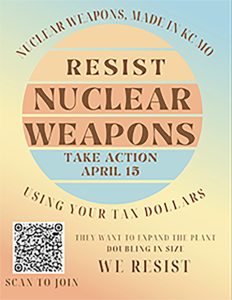
Call to Action to Oppose New Nuclear Weapons

PeaceWorks in Kansas City, Missouri, is issuing a Call to Action to oppose the start of a new 21st Century nuclear arms race beginning in Kansas City, Missouri now.

The “KC National Security Campus,” formerly the Kansas City Plant, announced Nov. 7, 2023, that the complex plans to double in size next year and increase its number of worke

rs to Cold War levels of 9,000. The KC National Security Campus is one of the eight major centers that together produce U.S. nuclear weapons, and KC makes over 85% of the parts.

We invite you to join in a Resistance Retreat from Friday to Sunday, April 12-15, at Jerusalem Farm, 520 Garfield Ave., Kansas City, Missouri. Register by contacting PeaceWorks vice-chair Ann Suellentrop at annsuellen@gmail.com or 913-271-7925.

Biden’s “National Posture Review” promotes so-called “deterrence,” but endorses preparations for full-scale nuclear war and pretends the U.S. could “win” a war against Russia and China. The U.S. is preparing for World War III by making all new nuclear weapons systems, warheads, ICBMs, jet bombers, and submarines — at a cost of over $2 trillion over the next 30 years.

— PeaceWorks

Filed Under: Direct Action, Military Spending, Newsletter Archives, Nuclear Weapons, Quarterly Newsletter, War

January 18, 2024 by Nukewatch Leave a Comment

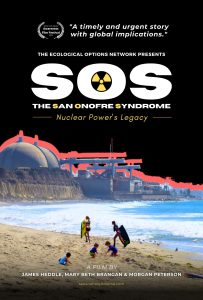
Documentary on Radioactive Waste Wins Prize


Photo:sanonofresyndrome.com/press-kit


By John LaForge

The new documentary film from producer/director Mary Beth Brangan, “SOS – The San Onofre Syndrome: Nuclear Power’s Legacy” [https://sanonofresyndrome.com/], has won the Awareness Film Festival’s Documentary Feature Grand Jury Award — beating the festival’s 100 other documentary entries. Brangan says that the film “chronicles a community’s victory over leaking reactors, only to confront a chilling reality — deadly radioactive waste stranded next to a rising sea. As temporary containers decay, a nationwide crisis emerges, and the race to avert catastrophe becomes a stark countdown against time.” Haled as “a timely and urgent story with global implications,” the film was recently accepted into the next International Uranium Festival to be screened in Rio de Janeiro, Berlin, and eighteen U.S. cities in 2024.

— SOS: info@sanonofresyndrome.com; https://sanonofresyndrome.com

Filed Under: Environment, Environmental Justice, Newsletter Archives, Nuclear Power, Quarterly Newsletter, Radiation Exposure, Radioactive Waste

  • « Previous Page
  • 1
  • …
  • 43
  • 44
  • 45
  • 46
  • 47
  • …
  • 222
  • Next Page »

Stay Connected

  • Facebook
  • Twitter

Subscribe

Donate

Categories

  • B61 Bombs in Europe
  • Chernobyl
  • Counterfeit Reactor Parts
  • Depleted Uranium
  • Direct Action
  • Environment
  • Environmental Justice
  • Fukushima
  • Lake Superior Barrels
  • Military Spending
  • Newsletter Archives
  • North Korea
  • Nuclear Power
  • Nuclear Weapons
  • Office News
  • On The Bright Side
  • Photo Gallery
  • Protect the Water Close Xcel's Monticello Reactor
  • Quarterly Newsletter
  • Radiation Exposure
  • Radioactive Waste
  • Renewable Energy
  • Social Issues
  • Sulfide Mining
  • Through the Prism of Nonviolence
  • Uncategorized
  • Uranium Mining
  • US Bombs Out of Germany
  • War
  • Weekly Column

Contact Us

(715) 472-4185
nukewatch1@lakeland.ws

Address:
740A Round Lake Road
Luck, Wisconsin 54853
USA

Donate To Nukewatch

News & Information on Nuclear Weapons,
Power, Waste & Nonviolent Resistance

Stay Connected

  • Facebook
  • Twitter

© 2026 · Nukewatch