Nukewatch

Working for a nuclear-free future since 1979

  • Issues
    • Direct Action
    • Environmental Justice
    • Nuclear Power
      • Chernobyl
      • Fukushima
    • Nuclear Weapons
    • On The Bright Side
    • Radiation Exposure
    • Radioactive Waste
    • Renewable Energy
    • Uranium Mining
    • US Bombs Out of Germany
  • Quarterly Newsletter
    • Quarterly Newsletter
    • Newsletter Archives
  • Resources
    • Nuclear Heartland Book
    • Fact Sheets
    • Reports, Studies & Publications
      • The New Nuclear Weapons: $1.74 Trillion for H-bomb Profiteers and Fake Cleanups
      • Nuclear Power: Dead In the Water It Poisoned
      • Thorium Fuel’s Advantages as Mythical as Thor
      • Greenpeace on Fukushima 2016
      • Drinking Water at Risk: Toxic Military Wastes Haunt Lake Superior
    • Nukewatch in the News
    • Links
    • Videos
  • About
    • About Nukewatch
    • Contact Us
  • Get Involved
    • Action Alerts!
    • Calendar
  • Donate

January 18, 2024 by Nukewatch Leave a Comment

Biden Returns from Israel Empty-Handed

By Ralph Nader

If President Joe Biden were a pony, instead of a perennial warhorse (e.g., gung-ho for Bush/Cheney’s criminal destruction of Iraq), he would have his tail between his legs on his return from a one-day trip to Israel. He failed to achieve any immediate, critical objectives while the ongoing destruction of Gaza and the defenseless Palestinians continues.

Did Biden get Israel and Egypt to allow the exit of hundreds of American citizens fleeing the Gazan firestorm? No!

Did Biden open up corridors for humanitarian aid to the babies, children, women, elderly, and other civilians in Gaza who had nothing to do with the October 7th Hamas homicide/suicide attack on Israelis? No!

To the contrary, earlier in the week he cruelly ordered his UN Ambassador to veto a widely supported resolution calling for a humanitarian ceasefire.

Did he forcefully double down on his earlier counsel to the Israeli government to obey the laws of war, then and now, being openly violated? No! He continued his silence after the Israeli Defense Minister ordered his soldiers with the genocidal command, “No electricity, no food, no fuel, no water…” That death sentence includes patients in hospitals who must endure the carpet bombing of this long-time blockaded tiny strip of desert holding 2.3 million people. (See, Convention on the Prevention and Punishment of the Crime of Genocide).

Did Biden press for the exchange of Hamas’ hostages for the release of Palestinian prisoners, including young Palestinians, who have been in Israeli jails for years without due process or charges? No! Worse, Biden failed to object to the Israeli military stating that the release of over 200 Israeli hostages is a “secondary priority” to smashing Hamas and Gaza “into the Stone Age.” This policy flouts the moral codes of many venerable Judaic sages described in an October 19, 2023, New York Times column by Mikahel Manekin titled “The Safety of the Hostages Must Come First.” Israel conducted two prisoners-for-hostages’ exchanges, one in 2004 and one in 2011.

Did Biden, in strong terms, tell the Israeli politicians that they have already exacted revenge many times over on the stateless people of Gaza — in civilian lives lost, injuries, related spread of disease, destitution, and destruction? Did he say it is inhumane and counterproductive to bomb hospitals, clinics, schools, mosques, churches, apartment buildings, water mains, electric networks, and ambulances, all of which is in violation of civilized norms and rules of war? Of course not. He greenlighted Israel’s genocidal warfare from the beginning of the Israeli assault and sent U.S. weaponry. He is enabling other actions of “co-belligerency” against the defenseless Palestinians in the West Bank and Gaza.

Did he even get the 20 trucks of humanitarian aid waiting at the Rafah crossing — also bombed by the Israelis — from Egypt into Gaza before he left? No!

Biden did come back with a bill for the American taxpayers — who for decades have been forced to pay for these Israeli wars. Now Biden wants Congress to approve $14 billion for Israel to address the colossal failure of Netanyahu’s extremist coalition to protect its own citizens on the border. (Adding only $100 million for Palestinian relief).

That sum of money, to be authorized without any Congressional hearings or Congressional oversight, is greater than the combined annual budgets of the FDA, OSHA, NHTSA, and the section of HHS, whose missions are to reduce the loss of hundreds of thousands of preventable U.S. fatalities in the workplace, on the highways, and in the marketplace and the hospitals. (See, the 2016 peer-reviewed study from the John Hopkins University of Medicine).

Lastly, still not calling a ceasefire, Biden is disregarding his own military’s private advice against an Israeli ground invasion of Gaza as raising the risk of a larger war in the Middle East that would clearly be against the national interests of the American people and U.S. security.

He could have done what President Eisenhower did in 1956, when he demanded that the Israeli, British, and French attack on Egypt stop immediately.

And stop, they did!

After all, the U.S. has some influence over Israel, to put it mildly. The U.S. endorses all Israeli aggressions (including Israel’s admission to bombing hundreds of sites in Syria, mired in its civil war and no threat, in addition to striking Damascus International Airport). All with U.S. advanced weapons, and billions of dollars in annual aid to Israel, a prosperous military, technological, and economic superpower. In fact, Israel’s social safety net is better than that of the U.S.!

Biden provides total diplomatic cover in the U.S. with Washington’s automatic UN vetoes, and pressures allies to follow the party line.

Moreover, Biden seems unwilling to recognize the historical origins of this conflict that now has mighty Israel occupying, colonizing, brutalizing and
stealing land and water from the twenty-two percent of the original Palestine left for millions of Palestinians under Israeli daily control.

Biden should take a moment in the Oval Office to read page 121 of the book The Jewish Paradox by Nahum Goldman (January 1, 1978), the head of the World Zionist Organization. He quotes the leading Founder of the Israeli state, David Ben-Gurion as candidly saying to him: “If I were an Arab leader, I would never sign an agreement with Israel. It is normal; we have taken their country. It is true God promised it to us, but how could that interest them? Our God is not theirs. There has been Anti-Semitism, the Nazis, Hitler, Auschwitz, but was that their fault? They see but one thing: we have come and stolen their country. Why would they accept that?”

Photo: ABC News.

Today’s Israeli leaders refuse to demonstrate this degree of empathy. Instead, they provoke and deny the creation of a Palestinian state, envisioned by the Oslo Accords they signed in 1993, hurl the most racist epithets (“animals,” “vermin,” “snakes”), and make sure the politicians in the U.S. Congress never utter the words “Palestinians also have a right to defend themselves” as violently subjugated victims of Israel the superpower.

Many members of Congress who demand giving Israel whatever money and weaponry it wants for whatever it does, violating human rights under international law in its illegal occupations and blockade, turn around and vote against the child tax credit, worker health and safety, universal healthcare, paid family leave, and daycare for Americans. Their viciousness — as with the homicidal outburst of Gen. Lindsey Graham, R-SC, against all Palestinians, and Senator Tom Cotton, R-AR, a Harvard Law graduate, saying “As far as I’m concerned, Israel can bounce the rubble in Gaza…” — set new levels of depravity.

A few Senators see it differently, especially Senator Bernie Sanders of Vermont, who noted “…it is no secret that Gaza has been an open-air prison” with “horrendous living conditions,” and that “children and innocent people do not deserve to be punished for the acts of Hamas.”

Little known is that Israel and the U.S. fostered and funded the rise of Hamas as a religious counterpoint to the secular Palestinian Liberation Organization (PLO). It was established in 1987 following the first intifada uprising. A 2009 The Wall Street Journal article titled: “How Israel Helped to Spawn Hamas” noted:

“Instead of trying to curb Gaza’s Islamists from the outset, says Mr. Cohen, Israel for years tolerated and, in some cases, encouraged them as a counterweight to the secular nationalists of the Palestine Liberation Organization and its dominant faction…”

To Biden and the Congressional “howlers” for the death of civilian innocents, historical facts matter little. Hamas’ lethal attack on October 7th was preceded by far greater numbers of Israeli violent attacks over the past decades taking four hundred times the number of innocent Palestinian lives, injuries, and other casualties than inflicted on innocent Israelis.

Israel’s carpet bombing of Gaza will take twenty times or more lives of innocent Palestinians than those killed by Hamas on October 7th with the casualty toll of direct fatalities and the loss of life from the devastation of life-sustaining water, food, medicine, shelter, and other hospital/clinic emergency infrastructure.

Also conveniently forgotten is the detailed peace offer to Israel in 2002, by 22 member states of the Arab League to establish diplomatic and trade relations with a recognized Israel in return for its retreating to the 1967 borders and creation of a Palestinian two-state solution. The Israel extremists in Congress and President G.W. Bush declined even to respond to this proposal. (See, the March 29, 2002 New York Times article: “Mideast Turmoil; Text of the Peace Proposals Backed by the Arab League”).

It is incumbent on the supreme military superpower in the region to take the initiative for peace over the powerless victims under its thralldom. That country is, of course, high-tech Israel, bristling with the latest weapons and nuclear atomic bombs.

Both the brave Israeli human rights groups and those courageous human rights Israelis standing shoulder to shoulder over the years striving to conduct non-violent civil disobedience at the besieged Palestinian village level, only to be dispersed by Israeli soldiers, know the real obstacle to peace. It is the plan by the right-wing Israeli parties to annex the entire Palestinian West Bank (nearly attempted under Donald Trump) and forcefully drive Palestinians into Jordan and Egypt.

Joe Biden is skilled at shedding tears at memorials of grief in this country. But he runs dry when the recurring catastrophes befalling Palestinians beg for his presidential compassion and actual deeds.

He will not escape history’s judgment.

— Ralph Nader, the consumer advocate, lawyer, and author with John Abbots of The Menace of Atomic Energy (Norton 1979), wrote this piece for CounterPunch.org.


Filed Under: Military Spending, Newsletter Archives, Quarterly Newsletter, War

January 18, 2024 by Nukewatch Leave a Comment

Study Finds Low- Level Radiation Deadlier than Previously Thought Nuclear Industry Pushes Deregulation

By John LaForge

The Nuclear Regulatory Commission (NRC) is being pushed by the industry to “drastically weaken its safety and security regulations,” writes Edwin Lyman, director of nuclear power safety at the Union of Concerned Scientists, in The Hill.

Industry lobbyists claim that proposed new, experimental, untested, and unlicensed “micro” or “small modular” reactor designs will be so much safer than today’s faulty units, that they will need less oversight and regulation.

Lyman points out that these design plans, which have “new safety and security risks,” exist only on paper or have a limited or mostly irrelevant practical record.

Still the nuclearists have convinced many in Congress that NRC rules and regs are to blame for the collapse of new reactor licensing and construction in the U.S.

The current NRC is drafting a new “Part 53” rule that requires applicants to provide ‘experimental evidence’ that demonstrates an achievable high level of reactor safety. NRC Chair Christopher Hanson has pointedly demanded that the industry “show [their] work.”

But the industry meddled deeply in the rule-making process because it wants to delete any requirement for “probabilistic risk assessments” — technical analyses of all the things that could go wrong with new reactors and how well safety systems might work during emergencies. As Lyman writes, “it is hard to imagine a ‘risk-informed’ licensing process that does not require applicants to quantify risks.”

While the industry promotes the weakening of worker protections, new evidence suggests that radiation exposure standards should be toughened. The British Medical Journal for August 16, 2023, published a major new study of over 300,000 nuclear industry workers. The principle finding was that prolonged exposure to low doses of ionizing radiation is associated with a higher risk of death from cancer than previously thought.

The international team analyzed deaths among a huge cohort of 309,932 workers in nuclear industries in the U.K., France, and the United States. They calculated that for every cumulative unit of radiation (or “Gray”) that workers were exposed to, the risk of death from solid cancer increased by 52%.

Matthew Dunn, vice president of Medical Physics at the Institute of Physics and Engineering in Medicine, said, “This study provides good evidence that even low doses of radiation in medical, occupation, or environmental settings have the potential to cause cancer.”

Paul Pharoah, professor of Cancer Epidemiology at Cedars-Sinai Medical Center, said, “The researchers found a 50% increase in risk per Gray of ionizing radiation with evidence that the increase in risk per Gray is greater at lower doses — for 0 to 20 mGy there was a 130% increase in risk per Gray.”

“People often assume that low dose rate exposures pose less carcinogenic hazard than the high dose rate exposures experienced by the Japanese atomic bomb survivors,” the team wrote in the BMJ. “Our study does not find evidence of reduced risk per unit dose for solid cancer among workers typically exposed to radiation at low dose rates.”

—The Hill, July 25; The Independent, Aug. 17; Technology Networks, Aug. 18, 2023

The National Cancer Institute is studying cancers and other risk factors resulting from the dramatic increase among the U.S. population of exposure to radiation through medical diagnostic tools involving radiation. Photo: National Cancer Institute.


Filed Under: Newsletter Archives, Nuclear Power, Quarterly Newsletter, Radiation Exposure

January 18, 2024 by Nukewatch Leave a Comment

Fukushima: Contamination in Spades

By John LaForge
Over 1.3-million tons of wastewater contaminated with dozens of radioactive chemicals left from cooling three reactor core meltdowns stored in tanks at Fukushima Daiichi, in Japan.
Japan’s oceanic pollution launched to wide protest

In August, Tokyo Electric Power Co. (Tepco) began pumping some of its partially treated wastewater into the Pacific Ocean, raising loud international protests and prompting bans on importation of Japanese fish that may last the 30 or 40 years it will take to dump all the waste. China and four other Pacific Rim countries fully banned imports of fishery products from Japan from Aug. 24, when the wastewater discharge started.

Over 1 million tons of radioactive wastewater have accumulated in huge tanks at Fukushima. It is collected after groundwater and cooling water has poured over or run through the 900 tons of melted reactor fuel wreckage now lost somewhere under the three destroyed reactors.

Tepco said October 24 that its dumping of the second, 7,800-ton batch of radioactive wastewater was finished. According to Japan Today, Tepco plans to release 31,200 tons of the wastewater by the end of March 2024. This would drain merely ten of the 1,000 huge tanks of the waste that were built onsite since the earthquake/tsunami/meltdown catastrophe began in March 2011. Due to the need to continually cool the melted reactor cores, mass collection of radioactive wastewater will continue indefinitely.

Meltdown fallout and wastewater dumping prompt major seafood import bans

The operators of the destroyed Fukushima-Daiichi reactors intend to disperse over 1.34 million tons of the wastewater over the next 30 to 40 years, after convincing the government and international observers that the practice would have a “negligible” impact on sea life and human health. Fifteen countries have maintained import restrictions on Japanese fish and other seafood from heavily contaminated areas. According to Food Navigator online, five with the strictest bans are geographically close to Japan and fiercely opposed to the waste dumping. They are South Korea, Taiwan, China, Hong Kong, and Macau. Ten others — Indonesia, French Polynesia, the U.S., the European Union (27 states), Iceland, Switzerland, Norway, Liechtenstein, Russia, and Singapore — require certification, inspections, etc. before allowing imports. China’s ban has had a serious impact on Japan’s fishery.

According to the BBC, China imported over 100,000 tons of scallops from Japan last year. The South China Morning Post reports that China, had been the world’s biggest buyer of Japanese seafood, but “says its ban is due to food safety fears.”

Third round of wastewater dumping protested

In November, Tepco began its third deliberate discharge of radioactive wastewater into the Pacific Ocean. The group Korean Peoples’ Action Against Japan’s Ocean Dumping of Radioactive Wastewater said problems with the wastewater include clogged wastewater filters and an increase in the concentration of radioactive material in the third discharge compared to the second. Likewise, the Pacific Collective on Nuclear Issues, composed of civil society groups, NGOs, and others in the Pacific region, said in a statement, “If the Japanese government and Tepco believe the radioactive wastewater is safe, they should be prepared to safely dispose of it within terrestrial Japan.”

The Collective also reminded the November 8 meeting of Pacific Island Forum states that the panel of scientific experts commissioned by the Forum found that “data provided so far, to support Japan’s claim that the treated wastewater is safe, is inconsistent, unsound, and therefore far from reliable.”

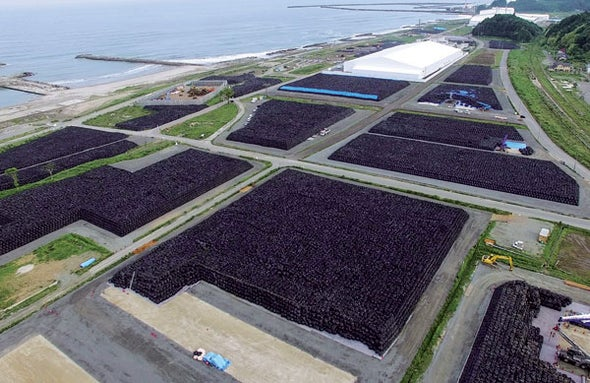
One-ton bags of cesium-contaminated waste full of cesium-contaminated waste scraped from areas around the Fukushima complex are now stacked in thousands of places, some near the ocean where the waste is vulnerable to being dispersed by storm surges and tsunamis. Today there are over 19 million such bags stacked in tens of thousands of locations. AP photo.
Wastewater accident contaminates five workers

Tepco has reported that five workers “accidentally” came in contact with radioactive “fluid” while cleaning discharge systems pipelines, and two of them were contaminated enough to be kept under medical observation, China Daily reported November 6. According to Tepco, a doctor said there was a possibility the two men sustained burns due to radiation exposure, and that the radiation levels in the bodies of the two men were above the company’s allowable threshold. The paper, which has been highly critical of Japan’s wastewater discharging, demanded to know: “[S]ince four of the five workers ‘were wearing protective gear and full-face masks, which prevented ingestion of the fluid,’ how could the ‘fluid’ splash and burn the ‘lower body and both arms’ of one of them, and why the other worker, whose ‘entire body was found to be exposed,’ was allowed to do the dangerous work without wearing any protective gear?” The Daily’s editors said the “Accident proved Japan’s toxic water plan dubious.”

Faulty editors paste “safety” over risky wastewater discharge

“IAEA confirms safe tritium levels in latest ALPS treated water release at Fukushima,” was the November 7 headline Nuclear Engineering International magazine used in its report on Tepco’s wastewater dumping. Yet the article itself had no such confirmation. IAEA experts monitoring the discharge only said that the concentration of radioactive tritium in the waste was “far below Japan’s operational limit.” Nowhere did the word “safe” appear. The article itself is factually accurate since there is no safe level of radioactive contamination, regardless of how small the amount. It was the editors that have put words into the IAEA’s mouth and turned the reporter’s story into a lullaby.

Area forests are a re-contamination source

Jim Smith, a Professor of Environmental Science at the University of Portsmouth, wrote in The Conversation, October 23, that “Radiocaesium [cesium-137], which is the most important long-lived radioactive element emitted by the accident in terms of radiation dose, adheres to soil particles very strongly. Consequently, the decontamination of agricultural land primarily involved removing the top 5cm [about 2 inches] of topsoil. In urban areas, decontamination efforts entailed the removal of soil from sports fields”, school yards and other public areas.

As much as 71% of Fukushima Prefecture is covered by forest, and most of it remains contaminated. “Restrictions on the consumption of forest products have lasted for decades following the 1986 Chernobyl incident. And they are expected to persist in many forested areas of Fukushima too,” Prof. Smith wrote. Rainwater runoff from these forests creates routine downstream re-contamination of previously decontaminated areas. Additionally, forest fires can redistribute radioactivity still on trees and the forest floor creating inhalation risks.

Japanese minister under fire for calling wastewater ‘contaminated’

In an August 31 “slip of the tongue,” Japan’s Fisheries Minister Tetsuro Nomura publicly said Tepco was dumping “contaminated water” into the Pacific. As the waste is poisoned with four dozen radioactive chemicals due to the failure of Tepco’s filtration system known as ALPS, the minister was merely stating a fact. He was attacked in the press and by politicians for the “error” in not referring to “treated” water, and had to publicly apologize for the “gaffe” after being scolded by Prime Minister Fumio Kishida.

Filed Under: Environment, Fukushima, Newsletter Archives, Nuclear Power, Quarterly Newsletter, Radioactive Waste

January 18, 2024 by Nukewatch Leave a Comment

Renowned Economist on Nuclear Power: “From a business perspective, it’s over. We don’t have the water.”

Photo: Wall Street Journal, “Europe’s Key Rivers Fall to Critical Levels, Aggravating Energy Crunch.”

Jeremy Rifkin is the economic and social theorist, writer, activist, public speaker, political advisor to the European Union, and author of 23 books about the influence of scientific and technological changes on the economy, the workforce, society, and the environment.

At an annual investors’ meeting of Germany’s Wermuth Asset Management Group in October 2013, Rifkin was asked his opinion of nuclear power in view of climate change.

Rifkin said, “Frankly, I think from a business perspective it’s over. Let me explain why …

“No. 1: … There are only 400 nuclear power plants [436 in 2023]. These are old nuclear power plants, but our scientists tell us [that] to have a minimum impact on climate change — which is the whole rationale for bringing this technology back — nuclear would have to be 20 percent of the energy mix to have the minimum, minimum impact on climate change, not six percent of the mix [10% in 2023]. That means we’d have to replace the existing 400 nuclear plants and build 1,600 additional plants — three nuclear plants have to be built every 30 days for 40 years to get to 20 percent — and by that time climate change will have run its course for us. So I think, from a business point of view, I just don’t see that investment. I’d be surprised if we replace 100 of the 400 existing nuclear plants which would take us down to 1 or 2 percent of the energy [mix].

“No. 2: We still don’t know how to recycle the nuclear waste and we’re 70 years in. We have good engineers in the United States. We spent 18 years and $8 billion building an underground vault in Yucca Mountain to store the waste for 10,000 years, but we can’t use it. It’s already no good because there are cracks in the mountain. But any geologist could have told them we live on tectonic plates and you can’t keep underground vaults secure.

“No. 3: We run into uranium deficits according to the IAEA [International Atomic Energy Agency] between 2025 and 2035 with just the existing 400 plants. So that means the price goes up.

“No. 4: We could do what the French generation of new plants is doing and recycle the uranium to plutonium. But then we have plutonium all over the world in an age of uncertainty and terrorism.

“No. 5: And this is the big one that people don’t realize: We don’t have the water. Over 40 percent of all the fresh water consumed in France each year goes to cooling the nuclear reactors. It’s almost 50 percent now. When it comes back [when reactor cooling water is returned to the lakes and rivers] it’s heated and it’s dehydrating our ecosystems, and threatening our agriculture. We don’t have the water, and this is true all over the world. We have saltwater nuclear plants but then you have to put them on coastal regions and you risk a Fukushima because of tsunamis.

“The last thing: nuclear power is centralized power, like fossil fuels. It doesn’t fit a new generation that’s moving with the kind of technologies that are distributed, collaborative, and laterally scaled. It’s an old technology. So it’s no accident Siemens [Corporation] is out [of the reactor business], Germany is out, Italy is out, Japan is now out, and I think with [French] President Holland’s election — I met with him in the spring — they’re moving to a Third Industrial Revolution Model in France. I’d be surprised if nuclear has much of a life left. I don’t think it’s a good business deal.”

— Video of Jeremy Rifkin at the Annual Investors Event of Germany’s Wermuth Asset Management Group, Oct. 8, 2013.


Filed Under: Environment, Newsletter Archives, Nuclear Power, Quarterly Newsletter, Radioactive Waste, Renewable Energy

January 18, 2024 by Nukewatch Leave a Comment

Nuclear Power’s Magical Thinking Debunked

By John LaForge, Source article by Amory Lovins

Stewart Brand, the writer best known as the co-founder and editor of Whole Earth Catalog, and the writer and physicist Amory Lovins, a former chair of the Rocky Mountain Institute who’s been awarded 12 honorary doctorates, have been friends for years. When Brand came out in support of nuclear power (Whole Earth Discipline, Viking 2009), Lovins demolished his arguments in a carefully reasoned article rebutting four main claims that nuclear advocates continue to use. The nuclear industry’s case is still pushed by Brand, Jim Hansen, the Nuclear Energy Institute, the International Atomic Energy Agency, and others, in spite of the fact that they have been thoroughly refuted.

Four claims reactor construction advocates continue to use include:

● Baseload: Wind and photovoltaics can’t keep the lights on because they can’t run 24/7.
● Footprint: Photovoltaics need about 150-175 times, and wind farms from 600 to nearly 900 times more acreage than nuclear reactors to produce the same amount of electricity.
● Portfolio: We need every tool for combating climate change, including nuclear power.
● Government role: The climate imperative trumps economics, so governments everywhere must and will do what France did — ensure that nuclear power gets built, regardless of economics or dissent.

These claims are unsupportable, Lovins explains, but are worth reviewing because the same lies continue to be touted by young climate activists, industry greenwash groups like Generation Atomic, and others.

Artwork from Hoodwinked in the Hothouse and nativemovement.org.

Lovins explains:

Baseload: The electricity system doesn’t rely on any plant’s ability to run continuously; rather, all plants together supply the grid, and the grid serves all loads. That’s necessary because no kind of power plant can run all the time, as Stewart says they must do to meet steady loads. I repeat: there is not and has never been a need for any particular plant or kind of plant to run all the time, and none can do so. All power plants fail, varying only in their failures’ size, duration, frequency, predictability, and cause. Solar cells’ and wind power’s variation with night and weather is no different from the intermittence of coal and nuclear, except that they affect less capacity at once, and more briefly, far more predictably, and are no harder and probably easier and cheaper to manage. In short, the ability to serve steady loads is a statistical attribute of all plants on the grid, not an operational requirement for one plant. Variability (predictable failure) and intermittence (unpredictable failure) must be managed by diversifying type and location, forecasting, and integrating with other resources. Utilities do this every day, balancing diverse resources to meet fluctuating demand and to offset outages. Even with a largely (or probably a wholly) renewable grid, this is not a significant problem or cost, either in theory or in practice — as illustrated by areas that are already 30-40% wind-powered.

Footprint: Brand understates nuclear power’s land-use by about 43-fold by omitting all land used by exclusion zones and the nuclear fuel chain. Conversely, he includes the space between wind and solar equipment — unused land commonly used for farming, grazing, wildlife, and recreation. That’s like claiming that two lampposts require a parking lot’s worth of space, even though 99% of the lot is used for parking, driving, and walking. Properly measured, per-kilowatt-hour produced, the land made unavailable for other uses is about the same for ground-mounted photovoltaics as for nuclear power, sometimes less — or zero, for building-mounted PVs sufficient to power the world many times over. Land actually used-per-kWh is up to thousands of times smaller for wind power than for nuclear power. If land-use were an important criterion for picking energy systems, which it’s generally not, it would thus reverse Stewart’s footprint conclusion.

Portfolio: The one paper he cites as proof that we need all energy options (Pacala & Socolow’s “Stabilization Wedges”) actually says the opposite. There is no analytic basis for his conclusion, and there’s strong science to the contrary. We can’t afford to stuff our energy portfolio indiscriminately with some of everything, and we shouldn’t: some options are less worthy and effective than others. The more you fear climate change, the more judiciously you should invest to get the most solution per-dollar and per-year. Nuclear flunks both these tests.

Government’s role: If nuclear power isn’t needed, worsens climate change (vs. more effective solutions) and energy security, and can’t compete in the marketplace despite uniquely big subsidies — all evidence-based findings unexamined in Stewart Brand’s chapter — then his nuclear imperative evaporates. Of course, a few countries with centrally planned energy systems, mostly with socialized costs, are building reactors: over two-thirds of all nuclear plants under construction are in China, Russia, India, or South Korea. But that’s more because their nuclear bureaucracies dominate national energy policy and face little or no competition in technologies, business models, and ideas. Nuclear power requires such a system. The competitors beating nuclear power thrive in democracies and free markets.

— This article first appeared in Grist.

Filed Under: Environment, Newsletter Archives, Nuclear Power, Quarterly Newsletter, Renewable Energy, Uncategorized

  • « Previous Page
  • 1
  • …
  • 42
  • 43
  • 44
  • 45
  • 46
  • …
  • 222
  • Next Page »

Stay Connected

  • Facebook
  • Twitter

Subscribe

Donate

Categories

  • B61 Bombs in Europe
  • Chernobyl
  • Counterfeit Reactor Parts
  • Depleted Uranium
  • Direct Action
  • Environment
  • Environmental Justice
  • Fukushima
  • Lake Superior Barrels
  • Military Spending
  • Newsletter Archives
  • North Korea
  • Nuclear Power
  • Nuclear Weapons
  • Office News
  • On The Bright Side
  • Photo Gallery
  • Protect the Water Close Xcel's Monticello Reactor
  • Quarterly Newsletter
  • Radiation Exposure
  • Radioactive Waste
  • Renewable Energy
  • Social Issues
  • Sulfide Mining
  • Through the Prism of Nonviolence
  • Uncategorized
  • Uranium Mining
  • US Bombs Out of Germany
  • War
  • Weekly Column

Contact Us

(715) 472-4185
nukewatch1@lakeland.ws

Address:
740A Round Lake Road
Luck, Wisconsin 54853
USA

Donate To Nukewatch

News & Information on Nuclear Weapons,
Power, Waste & Nonviolent Resistance

Stay Connected

  • Facebook
  • Twitter

© 2026 · Nukewatch