Nukewatch

Working for a nuclear-free future since 1979

  • Issues
    • Direct Action
    • Environmental Justice
    • Nuclear Power
      • Chernobyl
      • Fukushima
    • Nuclear Weapons
    • On The Bright Side
    • Radiation Exposure
    • Radioactive Waste
    • Renewable Energy
    • Uranium Mining
    • US Bombs Out of Germany
  • Quarterly Newsletter
    • Quarterly Newsletter
    • Newsletter Archives
  • Resources
    • Nuclear Heartland Book
    • Fact Sheets
    • Reports, Studies & Publications
      • The New Nuclear Weapons: $1.74 Trillion for H-bomb Profiteers and Fake Cleanups
      • Nuclear Power: Dead In the Water It Poisoned
      • Thorium Fuel’s Advantages as Mythical as Thor
      • Greenpeace on Fukushima 2016
      • Drinking Water at Risk: Toxic Military Wastes Haunt Lake Superior
    • Nukewatch in the News
    • Links
    • Videos
  • About
    • About Nukewatch
    • Contact Us
  • Get Involved
    • Action Alerts!
    • Calendar
  • Donate

January 18, 2024 by Nukewatch 1 Comment

Tritium Leaks at Monticello Nuclear Reactor: It Ain’t Just Hydrogen

Concentrations 1, 2, 3, and 4 according to Xcel website. Concentration 5 according to Minn. Public Radio, Apr. 24. Concentrations 6, 7 according to USGS.
By Kelly Lundeen

The word ‘tritium’ dotted regional headlines this year, accompanied by misleading information about the radioactive substance. The March 17, 2023 weekly edition of Monticello Times announced, “400,000 gallons of water contaminated with radioactive tritium leaked from Monticello nuclear power plant.” Again on March 23, the Times followed up, “Xcel, regulators knew of tritium leak four months before notice.” On March 16, the St. Paul Pioneer Press assured the public that “Regulators monitor tritium leak at Xcel Energy’s Monticello nuclear plant.”

The large radioactive water leak at a concentration of 5 million picocuries-per-liter (pCi/L) of tritium was discovered one year ago by the Monticello reactor’s operator, Northern States Power. Four months later a second leak appeared when the fix failed. This forced the reactor to be shut down for a week, prompting regulators to finally release information about the leak to the public.

Xcel claims to have fixed the leak and continues pumping and collecting the radioactive groundwater to store onsite for reuse. The firm is also building a 600-foot underground wall 20 feet from the Mississippi River to prevent the radioactive groundwater from entering the River, even though, on July 20, Minnesota Public Radio warned, “Xcel: Leaked groundwater containing tritium may have reached Mississippi River in Monticello.”

Xcel has dodged questions about how far the radioactive water could have spread. The company claims that no tritium has been detected beyond the reactor facility boundaries, nor entered the Mississippi River, yet it has never specified where its testing is being done. Groundwater moves between 1 foot-per-day and 1 foot-per-decade, but the Mississippi River in Minnesota flows about 12,000 cubic feet-per-second, which could quickly disperse the tritiated water. Groundwater typically provides about 40-50 percent of the surface water to rivers, meaning the contaminated groundwater could have entered the Mississippi without being detected depending on where water is tested.

What is tritium?

What is this radioactive isotope that made headlines in mainstream newspapers? Tritium is a radioactive isotope of hydrogen. Much of the news coverage about the tritium leak at the Monticello reactor is deceptively reassuring. Mainstream media parrot misleading myths about tritium peddled by industry and the Nuclear Regulatory Commission (NRC).

Myth # 1

“Tritium is safe because it is ‘naturally occurring’ in the environment,” Pioneer Press, March 16

While it is true that tritium occurs in nature, its only natural source is in the upper atmosphere. In the chart below you can see that estimated naturally occurring tritium in groundwater — deposited from the upper atmosphere — ranges from 6 to 26 pCi/L. Additional tritium has been dispersed due to atmospheric nuclear weapons tests and routine or accidental nuclear reactor discharges.

Myth #2

“Tritium emits a weak form of radiation, a low-energy beta particle,” NRC

Radiation from tritium is not low-energy, but rather low-range, and its emissions are concentrated in a small space. It can be eight times more biologically damaging than other types of radiation if ingested or inhaled, and can even incorporate into DNA molecules affecting chromosomes.

Myth #3

“Tritium is a mildly radioactive form of hydrogen that occurs naturally,” Minnesota Public Radio, August 17

Tritium atoms replace hydrogen atoms in water molecules making the water itself radioactive. It is not simply water with tritium, it is tritiated water. Once it is part of water it follows the water cycle, traveling through groundwater, absorbed by roots of plants and into our food, or evaporated into the atmosphere and returned to the Earth through precipitation.

The body cannot distinguish clean water from tritiated water, making it more dangerous than other radionuclides. Its capacity to be exchanged with hydrogen gives it the special ability to bind with organic materials in plants, food, humans, and other animals.

Hydrogen is one of the building blocks of the human body and of all life. Humans are about 60 percent water. Tritium, disguised as hydrogen, is therefore more dangerous due to its similarity to hydrogen, not less dangerous. When a fetus is growing, its tissue collects tritium at twice the concentration of maternal tissue.

Around nuclear power facilities, children are the ones who suffer the most. They are about one and a half times more likely to be born with embryonal cancer and have over double the likelihood of childhood leukemia, caused by standard operation alone. That doesn’t include the accidents.

Myth #4

“The tritium radiation does not travel very far in air and cannot penetrate the skin,” NRC

Soil, plants, and food grown near nuclear reactors have been found to be contaminated up to 60 miles from the reactor site. In the case of Monticello, this includes the entire Minneapolis/St. Paul metro area, a population of 4 million people.

Tritium is created as a byproduct in the coolant inside the reactor core. While it may not be able to penetrate skin, there are other points of exposure that make a protective layer of skin irrelevant. Tritium is released legally by regular operation of all nuclear reactors in the form of radioactive water vapor. As long as people living around the reactor breath, the tritium will be inhaled, easily bypassing the skin. It can also be ingested through consumption of food grown around the reactor.

This article would not have been possible without information collected from radiation classes offered by the Gender & Radiation Information Project and Beyond Nuclear. (genderandradiation.org/classes)

— Sources include: Xcel Energy Monticello Groundwater Status and Background, Nov. 21, 2022; Minn. Public Radio, April 24, 2023; United States Geological Society (USGS) National Ground-Water Monitoring Network 2008, 1998; “Treatise on Geochemistry,” Volume 5, 2003, Pages 319-364, published by USGS, 2003

Filed Under: Environment, Newsletter Archives, Nuclear Power, Protect the Water Close Xcel's Monticello Reactor, Quarterly Newsletter, Radiation Exposure

January 18, 2024 by Nukewatch Leave a Comment

Nukewatch at UN Nuclear Ban Treaty Meetings

By Nukewatch Staff

Three years have passed since the United Nations Treaty on the Prohibition of Nuclear Weapons (TPNW) received its 50th ratification, triggering its entry into force. In online meeting after online meeting, Nukewatch has collaborated with comrades to rally support for the nuclear ban treaty in the United States. Last summer, Nukewatch’s John LaForge met with nuclear abolitionists in Vienna for the first Meeting of States Parties. This November, Nukewatch gathered in person with even more friends from over a hundred civil society organizations and at least 30 countries for the second Meeting of States Parties that took place in New York City. Nukewatch staff Kelly Lundeen and John LaForge organized and participated in events inside and outside of the United Nations.

(L-R) Hinamoeura Cross, Petuuche Gilbert, Elizabeth Minor, Nukewatch’s Kelly Lundeen, and Mari Inoue spoke at a United Nations civil society event highlighting voices from nuclear-impacted communities Nov. 28 in New York. Photo by Tony Sahara.

Inside the UN headquarters, the Affected Communities and Allies Working Group, along with Nukewatch, Manhattan Project for a Nuclear-Free World, International Campaign to Abolish Nuclear Weapons (ICAN), and Article 36 co-hosted a side event titled “Perspectives on Ongoing Harm to Affected Communities and Next Steps with the TPNW,” which highlighted the impacts of nuclear imperialism by three nuclear powers, the U.S., France, and the U.K.

Tina Cordova of the Tularosa Basin Downwinders Consortium spoke about the health consequences of the Trinity Test as a member of the fourth generation in her family to be diagnosed with cancer. The U.S. government has denied Trinity’s impacts, which are partially at fault for New Mexico’s status as the U.S. state most dependent on Medicaid. Hinamoeura Cross, mother and French Polynesian parliamentarian, lives with leukemia and is also among the fourth generation in her family to have cancer. She shared the experiences of young French Polynesian women who have deliberately chosen not to have children to avoid the fate of French nuclear test survivors who have endured raising children with malformations, diseases, or losing their babies. Both Cordova and Cross were recipients of the Nuclear Free Futures Award given by Beyond Nuclear and International Physicians for the Prevention of Nuclear War.

Petuuche Gilbert, of Multicultural Alliance for a Safe Environment, reminded those present that uranium mining and milling are necessary for weapons production and have left irreparable environmental and intergenerational health consequences. However, mining and abandoned uranium mining communities, like the Grants district of New Mexico in his home of Acoma Pueblo, have been neglected by the TPNW. Mere Tuilau of Youngsolwara Pacific in Fiji brought to light the struggle of Fijian veterans, some as young as 15 when they were deployed to Kiribati, also known as Christmas Island. There they were exposed to U.K. nuclear testing in the 1950s and are now in dire need of access to health care and compensation.

Mari Inoue of Manhattan Project for a Nuclear-Free World and Affected Communities and Allies Working Group spoke about the importance of a victim-centered approach, adopting stricter radiation protection standards, and affected communities’ disagreement with language in the TPNW that supports nuclear energy.

Nukewatch also attended the UN meetings of 90 nations. More than 65 civil society events took place in New York, and there were dozens of solidarity actions worldwide for the Global Day of Action against Nuclear Weapons. During the week, a delegation of 23 parliamentarians, from 14 countries not yet party to the TPNW, met calling for governments to sign and ratify the treaty. The UN meetings concluded with a declaration reaffirming commitments to getting more countries to join the ban, denouncing nuclear deterrence as policy, and unfortunately restating nations’ so-called “inalienable” right to nuclear energy. The Third Meeting of States Parties to the treaty will take place March 3-7, 2025 in New York.

Outside of the United Nations, Nukewatch brought the message of hope of the nuclear ban treaty to the nuclear-armed states that boycotted the meetings. At the Rally and March to Abolish Nuclear Weapons, Nukewatch’s Kelly Lundeen read a letter urging the U.S. and Russia to join the TPNW and work toward the elimination of nuclear weapons. When she tried to deliver the letter to the U.S. Mission to the United Nations it was rejected by security at the door, despite several prior attempts to alert them of the visit.

Kelly and John returned to the U.S. Mission two days later on November 30 with Catholic Workers, New York War Resisters League, and Raging Grannies to make sure their message was heard inside. Kelly was part of a blockade of all three entrances that shut down the Mission offices for two hours resulting in the arrest of 18 people. She said, “Nuclear weapons have been banned. The world has spoken. As a U.S. citizen ashamed of what my country has done, I’m here to stand in solidarity.” All 18 were released from jail later that afternoon with a ticket for a court appearance.

Resources and further reading:

  • Nuclear Ban Daily
  • Tularosa Basin Downwinders Consortium 
  • Laguna-Acoma Coalition for a Safe Environment 
  • Manhattan Project for a Nuclear-free World
  • Revised draft declaration of the second Meeting of States
    Parties to the Treaty on the Prohibition of Nuclear
    Weapons

Filed Under: Direct Action, Environmental Justice, Newsletter Archives, Nuclear Power, Nuclear Weapons, Office News, Quarterly Newsletter, Radiation Exposure

January 18, 2024 by Nukewatch Leave a Comment

Study Finds Low- Level Radiation Deadlier than Previously Thought Nuclear Industry Pushes Deregulation

By John LaForge

The Nuclear Regulatory Commission (NRC) is being pushed by the industry to “drastically weaken its safety and security regulations,” writes Edwin Lyman, director of nuclear power safety at the Union of Concerned Scientists, in The Hill.

Industry lobbyists claim that proposed new, experimental, untested, and unlicensed “micro” or “small modular” reactor designs will be so much safer than today’s faulty units, that they will need less oversight and regulation.

Lyman points out that these design plans, which have “new safety and security risks,” exist only on paper or have a limited or mostly irrelevant practical record.

Still the nuclearists have convinced many in Congress that NRC rules and regs are to blame for the collapse of new reactor licensing and construction in the U.S.

The current NRC is drafting a new “Part 53” rule that requires applicants to provide ‘experimental evidence’ that demonstrates an achievable high level of reactor safety. NRC Chair Christopher Hanson has pointedly demanded that the industry “show [their] work.”

But the industry meddled deeply in the rule-making process because it wants to delete any requirement for “probabilistic risk assessments” — technical analyses of all the things that could go wrong with new reactors and how well safety systems might work during emergencies. As Lyman writes, “it is hard to imagine a ‘risk-informed’ licensing process that does not require applicants to quantify risks.”

While the industry promotes the weakening of worker protections, new evidence suggests that radiation exposure standards should be toughened. The British Medical Journal for August 16, 2023, published a major new study of over 300,000 nuclear industry workers. The principle finding was that prolonged exposure to low doses of ionizing radiation is associated with a higher risk of death from cancer than previously thought.

The international team analyzed deaths among a huge cohort of 309,932 workers in nuclear industries in the U.K., France, and the United States. They calculated that for every cumulative unit of radiation (or “Gray”) that workers were exposed to, the risk of death from solid cancer increased by 52%.

Matthew Dunn, vice president of Medical Physics at the Institute of Physics and Engineering in Medicine, said, “This study provides good evidence that even low doses of radiation in medical, occupation, or environmental settings have the potential to cause cancer.”

Paul Pharoah, professor of Cancer Epidemiology at Cedars-Sinai Medical Center, said, “The researchers found a 50% increase in risk per Gray of ionizing radiation with evidence that the increase in risk per Gray is greater at lower doses — for 0 to 20 mGy there was a 130% increase in risk per Gray.”

“People often assume that low dose rate exposures pose less carcinogenic hazard than the high dose rate exposures experienced by the Japanese atomic bomb survivors,” the team wrote in the BMJ. “Our study does not find evidence of reduced risk per unit dose for solid cancer among workers typically exposed to radiation at low dose rates.”

—The Hill, July 25; The Independent, Aug. 17; Technology Networks, Aug. 18, 2023

The National Cancer Institute is studying cancers and other risk factors resulting from the dramatic increase among the U.S. population of exposure to radiation through medical diagnostic tools involving radiation. Photo: National Cancer Institute.


Filed Under: Newsletter Archives, Nuclear Power, Quarterly Newsletter, Radiation Exposure

January 18, 2024 by Nukewatch Leave a Comment

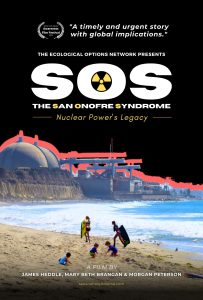
Documentary on Radioactive Waste Wins Prize


Photo:sanonofresyndrome.com/press-kit


By John LaForge

The new documentary film from producer/director Mary Beth Brangan, “SOS – The San Onofre Syndrome: Nuclear Power’s Legacy” [https://sanonofresyndrome.com/], has won the Awareness Film Festival’s Documentary Feature Grand Jury Award — beating the festival’s 100 other documentary entries. Brangan says that the film “chronicles a community’s victory over leaking reactors, only to confront a chilling reality — deadly radioactive waste stranded next to a rising sea. As temporary containers decay, a nationwide crisis emerges, and the race to avert catastrophe becomes a stark countdown against time.” Haled as “a timely and urgent story with global implications,” the film was recently accepted into the next International Uranium Festival to be screened in Rio de Janeiro, Berlin, and eighteen U.S. cities in 2024.

— SOS: info@sanonofresyndrome.com; https://sanonofresyndrome.com

Filed Under: Environment, Environmental Justice, Newsletter Archives, Nuclear Power, Quarterly Newsletter, Radiation Exposure, Radioactive Waste

November 14, 2023 by Nukewatch Leave a Comment

Project confronts the risks of United States’ land-based nuclear missiles

Map by Nukewatch, from Nuclear Heartland: a Guide to the Land-based Missiles of the United States

Reaching Critical Will reports: Project confronts the risks of United States’ land-based nuclear missiles

The Program on Science & Global Security (SGS), Columbia University’s School of Journalism, Scientific American, and Native Princeton are launching a project looking at the human and environmental risks associated with the new US Sentinel nuclear-armed land-based intercontinental ballistic missiles.

The MISSILES ON OUR LAND aims to provide information that everyone in the United States, and especially the communities living closest to the missile fields, need to know so that they can understand and be part of the discussion as to the full extent of the risks associated with deploying the new Sentinel nuclear-armed missiles. (Picture credit: Nina Berman)

The researchers performed hundreds of nuclear war simulations to understand what would happen if the missile silos were attacked. They reviewed thousands of pages of Air Force documents, including the recent Sentinel Environmental Impact Statement, and conducted dozens of interviews in Washington DC, North Dakota, Montana, Wyoming, Colorado, Nebraska, and New Mexico with nuclear weapons experts, military officials, and members of the public, including those living amid the nuclear missile silo fields.

The project includes a special issue of Scientific American, a documentary film, a podcast series, and a website with interactive maps.

[SPECIAL REPORT in SCIENTIFIC AMERICAN: 
“The New Nuclear Age: The U.S. is beginning an ambitious, controversial reinvention of its nuclear arsenal. The project comes with incalculable costs and unfathomable risks”]

Filed Under: Military Spending, Nuclear Weapons, Radiation Exposure, War

  • « Previous Page
  • 1
  • …
  • 9
  • 10
  • 11
  • 12
  • 13
  • …
  • 62
  • Next Page »

Stay Connected

  • Facebook
  • Twitter

Subscribe

Donate

Categories

  • B61 Bombs in Europe
  • Chernobyl
  • Counterfeit Reactor Parts
  • Depleted Uranium
  • Direct Action
  • Environment
  • Environmental Justice
  • Fukushima
  • Lake Superior Barrels
  • Military Spending
  • Newsletter Archives
  • North Korea
  • Nuclear Power
  • Nuclear Weapons
  • Office News
  • On The Bright Side
  • Photo Gallery
  • Protect the Water Close Xcel's Monticello Reactor
  • Quarterly Newsletter
  • Radiation Exposure
  • Radioactive Waste
  • Renewable Energy
  • Social Issues
  • Sulfide Mining
  • Through the Prism of Nonviolence
  • Uncategorized
  • Uranium Mining
  • US Bombs Out of Germany
  • War
  • Weekly Column

Contact Us

(715) 472-4185
nukewatch1@lakeland.ws

Address:
740A Round Lake Road
Luck, Wisconsin 54853
USA

Donate To Nukewatch

News & Information on Nuclear Weapons,
Power, Waste & Nonviolent Resistance

Stay Connected

  • Facebook
  • Twitter

© 2026 · Nukewatch