Nukewatch

Working for a nuclear-free future since 1979

  • Issues
    • Direct Action
    • Environmental Justice
    • Nuclear Power
      • Chernobyl
      • Fukushima
    • Nuclear Weapons
    • On The Bright Side
    • Radiation Exposure
    • Radioactive Waste
    • Renewable Energy
    • Uranium Mining
    • US Bombs Out of Germany
  • Quarterly Newsletter
    • Quarterly Newsletter
    • Newsletter Archives
  • Resources
    • Nuclear Heartland Book
    • Fact Sheets
    • Reports, Studies & Publications
      • The New Nuclear Weapons: $1.74 Trillion for H-bomb Profiteers and Fake Cleanups
      • Nuclear Power: Dead In the Water It Poisoned
      • Thorium Fuel’s Advantages as Mythical as Thor
      • Greenpeace on Fukushima 2016
      • Drinking Water at Risk: Toxic Military Wastes Haunt Lake Superior
    • Nukewatch in the News
    • Links
    • Videos
  • About
    • About Nukewatch
    • Contact Us
  • Get Involved
    • Action Alerts!
    • Calendar
  • Donate

August 6, 2024 by Nukewatch 1 Comment

NRC Apologizes, Admits: Monticello’s Leaked Tritium Reached the Mississippi River

The blue outlined area is the “extent of tritium-impacted groundwater as of August 2023,” from the leaked, radioactive coolant water at Xcel Energy’s Monticello nuclear reactor. The blue shaded area marks tritium concentrations above the EPA safe drinking water limit, extending to the Mississippi River bank. Source: Xcel Energy, NRC Draft Environmental Impact Statement
By Nukewatch Staff

At a public hearing in Monticello, Minnesota, on May 15, the U.S. Nuclear Regulatory Commission (NRC) apologized for public claims made by its staff that radioactive tritium in a massive 2022 leak of cooling water from the Monticello reactor, had not reached the Mississippi River. The river is the drinking water source for 20 million people including the Minneapolis/St. Paul metro area.

In opening remarks to the NRC-sponsored hearing at the Monticello Community Center, Senior Environmental Project Manager Stephen Koenick apologized for the NRC’s often-repeated assurances that the leaked tritium from the 53-year-old reactor had not been detected in the Mississippi.

In his shocking yet underreported public apology, Koenick said: “I would like to take a moment to address and clarify some miscommunication regarding the presence of detectable tritium in the Mississippi River. I know we … reported there were no indication[s] of [a] tritium leak [which] made it to the Mississippi. However … in our Draft Environmental Impact Statement, we … conclude there were some very low concentrations of tritium in the Mississippi River.” Koenick went on to say, “So we apologize for this miscommunication.”

As far as Nukewatch can tell, only the weekly Monticello Times reported on the rare public apology and the eyebrow-raising admission that radioactive tritium from the plume caused by the 2022 leak had contaminated the Mississippi. The paper published a report by Nukewatch’s Kelly Lundeen and John LaForge on the front page of its June 6 issue under the headline “NRC apologizes, changes its stance on tritium leak: Now says low concentrations got into Mississippi River.”

Xcel Energy’s 2023 “Annual Radioactive Effluent Release Report” says on page two, “Tritium was detected in newly developed MW-33A [monitoring well-33A] and MW-37A which resulted in MNGP [Monticello Nuclear Generating Plant] reporting an abnormal discharge to the Mississippi River.”

What Koenick meant by “miscommunication” were claims repeatedly made to the press that no tritium had been found by Xcel’s testing of the river. On March 18, 2023, NRC spokesperson Victoria Mitlyng even told the press, “There is no pathway for the tritium to get into drinking water.” As recently as May 7, 2024, NRC presenters at an NRC-sponsored public hearing, also held in Monticello, said on the record that Xcel had found “no detectable levels” of tritium in the Mississippi. Xcel Energy, which owns the reactor, made many similar misstatements. A company website posting still online says, “We test the river regularly for tritium and have not found any, indicating that if it is present, it is at such low levels, and is dispersing so quickly, that it cannot be detected by highly sensitive instruments.” This directly contradicts well test results that Xcel submitted to the NRC on December 18 proving they found detectable tritium levels in the Mississippi River at several points over the summer of 2023. Xcel has applied for a second operating license extension which, if granted, would allow the Monticello reactor to run until the age of 80.

Filed Under: Environment, Newsletter Archives, Nuclear Power, Protect the Water Close Xcel's Monticello Reactor, Quarterly Newsletter, Radiation Exposure

August 6, 2024 by Nukewatch Leave a Comment

Fukushima’s Endless Quagmire of Radiation Hazards

“The final issue that remains is how to deal with radioactive waste that continues to be produced even as decommissioning of the plant progresses.” — Tepco Representative, January 2024

By John LaForge
Japan’s Ocean Dumping Violates IAEA Rules

The International Atomic Energy Agency (IAEA) has given its stamp of approval to Japan’s ocean dumping of Fukushima wastewater, claiming that its effects would be “negligible” and declaring that the practice complies with international norms.

Arjun Makhijani is president of the Institute for Energy and Environmental Research and a member of the Pacific Islands Forum Independent Expert Panel on Tepco’s Fukushima radioactive water dumping proposals. In June 2023, Makhijani published a scathing critique of the IAEA’s approval of Japan’s dumping. The report discloses that Japan’s dumping of treated radioactive water violates essential provisions of the IAEA’s own General Safety Guide.

After describing Japan’s system of processing and diluting the radioactive wastewater, Makhijani reports, “At that point the water would contain mainly tritium, but also small concentrations of other radionuclides like carbon-14, strontium-90, cesium-137, and iodine-129.”

The IAEA’s statutory General Safety Requirements demand that: “Facilities and activities that give rise to radiation risks must yield an overall benefit.” Proof of “overall benefit” is required, Makhijani found, because, “There will be some radiation dose, even if small. … Tepco estimates that … the main radiation exposure is estimated to come from ingestion of fish.”

Yet there is no identifiable benefit to dumping 1.3 million metric tonnes of radioactive wastewater in the ocean. As Makhijani wrote, “Countries in the Pacific region, such as members of the Pacific Islands Forum, South Korea, China, and the Philippines, will receive no benefit from the proposed dumping.”

Because “radiation doses will not be zero,” and because “every increment of radiation dose produces an excess cancer risk with no threshold below which the risk is zero,” Makhijani wrote, “countries and people in the Pacific region will suffer some radiation harm. … Some of that harm will go on for decades (e.g., tritium), some for centuries (e.g., strontium-90 and cesium-137), and some essentially forever (iodine-129).

“As a result of the above considerations, the harm to Pacific region countries will outweigh the benefits; indeed, there are no benefits to them. This means that, from a transboundary perspective, the proposed Tepco dumping plan is not justified.”

The IAEA is also violating its binding mandate regarding the required “justification” for potentially harmful actions. Makhijani reported, “During the 8/9 June 2023 virtual meeting with the Pacific Islands Forum and its Expert Panel, at which [I] was present, the IAEA explicitly stated that ‘we are not involved in the justification’ and ‘we are not reviewing any justification.’

“By rejecting its responsibility for key parts of [General Safety Guides and General Safety Requirements] the IAEA is also rejecting the corresponding requirements … and the related fundamental safety principles … on justification.”

In his critique, Makhijani emphasizes: “The rejection means that the IAEA has effectively abandoned the safety and protection interests of the countries of the Pacific region, including the many IAEA member states in the region.

“The IAEA should declare officially that the Tepco plan does not meet key protection and safety requirements and therefore cannot be declared safe. [T]he IAEA has basically jettisoned the interests of Pacific region countries, including non-Japanese IAEA member countries, in favor of Tepco and the government of Japan.”
Earthquakes Routinely Threaten Reactor Site

The dumping of radioactive wastewater from the rubbished Fukushima nuclear reactor site was suspended for a day last March 15 after a 5.98-magnitude earthquake struck off the coast of Fukushima, the Malaysia Star and Arab News Japan report. Tepco said through a spokesperson that it halted operation of its liquid waste filtering system (“ALPS”), but that “no abnormalities were detected,” and no leak of radiation “was detected.” The comic choice of words implies that dumping of radiation-emitting wastewater into the Pacific Ocean is not abnormal and that its radioactive tritium, strontium, carbon, and cesium can’t be detected. The dumping system was restarted later the same day after Japan’s Meteorological Agency said there was no threat of a tsunami. The shutdown was the first time Tepco’s radioactive waste dispersal was interrupted by earthquake activity.

Radioactive Wastewater Leaks and Promises of Improvement

On Feb. 7, 2024, the faulty wastewater filtering system at Fukushima leaked more than 1.5 tons of highly radioactive cooling water. The worker-caused blunder forced Tepco to promise in April that it will install new piping and ventilation intended to direct any future wastewater spills to fall inside the building. The plan puts workers in danger, and the vent ports would release radioactive gases to the open air. Last October, an accident at the same liquid processing site sprayed five workers, directly exposing them to radioactive materials in the water likely including tritium, carbon-14, strontium, cesium, iodine, cobalt, and other deadly radionuclides. China’s Xinhjua News Agency reported: “Amid raging credibility and safety concerns among the Japanese public following a series of accidents at the crippled plant, Tepco and the Japanese government have been frequently challenged for the ocean discharge as the decommissioning process remains ambiguous.” — Xinhua News Agency, https://english.news.cn/20240407/25ce21ee4ba042f1bf4ab348bff8aca7/c.html

Extracting Melted Fuel and Wreckage from Radioactive Hellscape

Reactors 1, 2, and 3 at Fukushima-Daiichi in Japan — wrecked in 2011 by Japan’s worst-ever recorded earthquake, a devastating tsunami, and a string of explosions — have about 880 tons of melted fuel either burned into or through the three reactors’ foundations. Tepco and Japan’s government intend to remove this fiercely radioactive wreckage and abandon it somewhere else. The melted fuel and the surrounding irradiated structures are so ferociously hot and radioactive that remote-controlled robots have repeatedly broken down in the harsh, underwater environment. (Water is continually poured over the fuel melt to keep it from overheating further.) Last March, Japan’s Nuclear Damage Compensation and Decommissioning Facilitation Corporation came forward with three ideas for removing the wrecked fuel, etc., something never before attempted at a site smashed by the earthquake-tsunami-meltdown. Japan’s formal “wrecking crew” has recommended: 1) removing debris while exposed in the air, and 2) solidifying debris in place using a “filler” like concrete. The suggestions also included a plan to submerge entire reactor systems under water after constructing a giant pool-like structure around them. Robots would theoretically then approach, grasp, and withdraw the debris while the water partially shielded workers from radiation. — Arab News, 9 Mar 2024, https://www.arabnews.jp/en/japan/article_117203/

G-7 Leaders Offer Political Cover for Dumping

The Group of Seven colonial corporatist states (Canada, France, Germany, Italy, Japan, the U.K., and the U.S.) endorsed Japan’s dumping of radioactive water into the ocean at their summit in Italy on June 15, 2023, in an off-agenda move widely seen as a winking promise to protect the global nuclear reactor industry. “We support Japan’s safe, transparent, and science-based process to responsibly manage the discharge,” the G-7 statement said. Millions of people and more than 20 countries around the Pacific Rim have objected to Japan’s dumping over the next 40 years. The discharge is so patently unsafe, so shrouded in long-term unknowns, and so clearly in violation of the IAEA’s own scientific guidelines, that the G-7’s nod can be seen as industrial push-back against the protests in Japan, China, Russia, South Korea, and the Pacific Island Forum of 17 states. — Nippon News Agency, June 15, 2024, https://www.nippon.com/en/news/yjj2024061500119/

Landslide Threat Endangers Cooling Pool

Earthquakes routinely strike the Fukushima area, threatening 1,000 large tanks holding 1.3 million metric tonnes of contaminated wastewater, and endangering the structural integrity of cooling pools holding extremely radioactive used fuel rods (called “spent fuel” by the industry). In January 2024 alone, there were over 18 earthquakes in the Fukushima region with magnitudes of between 2.8 and 3.7. In February there were at least 23, with one measuring magnitude 6.1.

Quakes pose another threat to the devastated reactor site. According to Nuclear Engineering International, a landslide from a massive mountain slope could shut down the adjacent large waste fuel cooling pond. The pool holds 5,197 waste fuel assemblies, and Akira Ishiwatari, a geologist and federal Nuclear Regulation Authority commissioner, told the magazine, “A landslide could occur on the slope in the event of a minor earthquake or even without any tremor.” The authority “is concerned that if sediment from a landslide flowed into the pool, the nuclear fuel would no longer be cooled and, in the worst-case scenario, could eventually melt,” the magazine said.

Tepco said a landslide would not affect the cooling pond but, to avert the danger, announced plans to excavate 100,000 cubic meters from the slope over the next ten years. — Nuclear Engineering Int’l, 17 April 2024, https://www.neimagazine.com/news/newstepco-to-excavate-major-slope-near-fukushima-daiichis-used-fuel-pool-11688881

Far-Off Prefecture Wants Halt of Wild Food Shipments after Radioactive Cesium Found

Another prefecture in Japan has asked for a halt to shipments of a popular edible wild food after it was found contaminated with high levels of cesium-137, a radioactive toxin dispersed in large quantities by the triple Fukushima meltdowns of March 2011. Cesium-137 stays in the environment for 300 years and was spread long distances from the disaster site. Kitaibaraki village in Ibaraki prefecture is 134 miles from Fukushima, yet the government found cesium contamination in popular angelica tree shoots at twice the level allowed by Japanese authorities. Restrictions on shipping wild mushrooms and koshiabura, a species of edible flowering plant, are still enforced across wide areas of the prefecture. Cesium testing began after the meltdowns that followed the 2011 Great East Japan Earthquake and tsunami. In the Spring 2024 Quarterly we reported that edible foods up to 292 miles from Fukushima were still being found highly tainted with cesium. — Mainichi Japan, April 13, 2024, https://mainichi.jp/english/articles/20240413/p2a/00m/0na/002000c

— On Aug. 17 at 8pm Eastern/5pm Pacific, Nukewatch is co-sponsoring the “Don’t Nuke the Pacific, Protect Our Ocean” webinar to stop the Fukushima wastewater dumping. Register at mp-nuclear-free.com.

Filed Under: Environment, Fukushima, Newsletter Archives, Nuclear Power, Quarterly Newsletter, Radiation Exposure, Radioactive Waste

August 6, 2024 by Nukewatch Leave a Comment

Nuclear Justice in Maohi Nui

By Hinamoeura Morgant-Cross

Part I of “Nuclear Justice in Maohi Nui” can be found at nukewatchinfo.org/nuclear-justice-in-maohi-nui and in the Spring 2024 Quarterly.

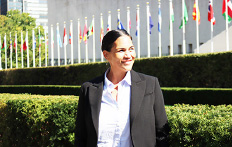
Hinamoeura Morgant-Cross, pictured in front of the United Nations, is a young French Polynesian whose realization that her own leukemia was a legacy of the French atomic tests in the South Pacific led her into activism. She works to pressure the French government to acknowledge responsibility and provide medical and financial support.


Morgant-Cross was elected to the Polynesian Assembly of Representatives in May 2023 and shepherded a unanimous Assembly vote supporting the Treaty on the Prohibition of Nuclear Weapons.My grandparents and parents were anti-nuclear activists, but it wasn’t a topic of family discussion during my childhood. There are several reasons for this. One was that they didn’t think they knew enough. There was also a clash in beliefs about the consequences of France’s nuclear testing in Maohi Nui, also known as its colonized name French Polynesia. There was the knowledge that the nuclear bomb had health consequences versus the powerful rhetoric of the French government, which emphatically stated that French nuclear tests were “clean.” You could sense that the elders didn’t want to talk about it because of the trauma it caused them. And finally, there was a fear of speaking out: a fear of reprisals if you talked about nuclear power and opposed the French government. Indeed, our population still bears the scars of the arrest and exile of Mr. Pouvana’a a O’opa, who advocated for independence from France. He was targeted by the French colonial justice system for “terrorist acts,” which were fabricated by agents of the French state.

French nuclear weapons testing continued until 1996 when I was seven years old. Between 1966 and 1996, France detonated 193 nuclear bombs on our islands in the South Pacific. Maohi Nui belongs to France as a collectivity, a status that compromises our sovereignty on nuclear and other issues.

As a collectivity, Maohi Nui has been forced to accept France’s policies regarding the effects of testing. In 1977, under the guise of giving Maohi Nui greater autonomy, France handed over responsibility for health, leaving the territory to bear the heavy financial burden of all the radiation-induced diseases. After repeating for decades that nuclear bombs were clean, it wasn’t until 2006 that France was forced to recognize that there had been radioactive contamination.

Since 2011, there has been a French compensation program for health affects related to the testing, but it’s very complex and not at all impartial. People have to assemble a multitude of medical documents. Some of these documents are inaccessible, under control of the French army since the time when the army managed medical care. The application procedure is biased because it’s the French who decide who is compensated, the same people who talk about “clean” nuclear testing. Many Polynesians are treated in Paris, 10,000 miles from their island, after a 24-hour plane journey. Those treated abroad are the luckiest, because Polynesia can pay for their travel.

With a medical system thirty years behind the U.S., Maohi Nui just can’t manage the health care for those suffering as a result of the radioactive contamination. There are some people that decide not to have kids because they don’t want them to end up with leukemia.

My own diagnosis of leukemia led me into activism. Despite oppression and misinformation, the grassroots anti-nuclear movement in Maohi Nui has gained some strength among the population. It started with the anti-nuclear association Moruroa e Tatou, founded in 2001. Other organizations are Association 193, which helps people put together compensation files, and the pro-independence movement, led by Mr. Oscar Temaru. In October 2018, Mr. Temaru filed a complaint against the French Republic before the International Criminal Court for crimes against humanity for the 193 nuclear bombs detonated on Polynesian territory. However, the ICC is only concerned with crimes committed after 2002 and, above all, complaints must be brought by a State, while French Polynesia is a collectivity. The complaint was therefore inadmissible.

The national and international anti-nuclear movement have led to some advances. I presented a motion in support of the United Nations Treaty on the Prohibition of Nuclear Weapons (TPNW) to the Polynesian Assembly of Representatives, which voted unanimously in favor of the resolution in September 2023. On a local level, the fight consists of properly educating the population about our nuclear history, which has been concealed by France and played down for too long. Internationally, the movement is denouncing the environmental and health consequences of France’s 193 nuclear weapons tests, in the hope that France will pay this debt and also with the wish to benefit from cooperation and aid from other states.

Filed Under: Environmental Justice, Newsletter Archives, Nuclear Weapons, Quarterly Newsletter, Radiation Exposure

July 23, 2024 by Nukewatch Leave a Comment

NRC Froze Data Gathering Same Day Tritium Tests Near Mississippi River Topped Drinking Water Limits

By Nukewatch Staff

To prepare its Draft Environmental Impact Statement (DEIS) regarding Xcel Energy’s license extension application for its Monticello reactor, the Nuclear Regulatory Commission had to establish a formal information-gathering period. The data collection time-frame officially ended on August 18, 2023.

According to Xcel Energy and NRC documents reviewed by Nukewatch, the NRC seems to have coincidentally picked for its end date the very day that radioactive tritium contamination in a groundwater test well near the Mississippi River exceeded the federal EPA safe drinking water limit.

In Xcel’s December 18, 2023 response to an NRC information request on its relicense application, Xcel submitted a table documenting the results of monitoring well tests between November 21, 2022 and August 18, 2023. Xcel’s table notes that the level of tritium in monitoring well (MW)-37A between July 27, 2023 and August 18, 2023 grew five-fold until, on August 18, it exceeded the EPA safe drinking water limit of 20,000 pico-curies-per-liter (pCi/L).

The NRC is currently considering Xcel’s application for a second 20-year license extension which, if granted, would allow the Monticello reactor in Minn., to run until 2050, when it would be 80 years old.

The classic Scream, by Edvard Munch, visits the Monticello nuclear reactor.

The NRC’s data collection cut-off date omits the critical time-frame immediately after August 18, when tritium levels near the Mississippi River were still increasing.

Similarly, Xcel’s “2023 Annual Radioactive Effluent Release Report” fails to provide precise data on monitoring well test results following August 18, 2023, noting only in general terms that tests done after that date found no unsafe levels of contamination. “The NRC should demand that Xcel provide well test results from August 18, 2023, through December 31, 2023, and should then enter these into the Federal Register for public consideration,” said Nukewatch’s Lindsay Potter, who discovered the coincidence. “The DEIS and license renewal process is incomplete without this information and should not move forward without it,” she said.

The reactor caused a leak to onsite groundwater of some 829,000 gallons of tritium-contaminated cooling water beginning in November 2022. In the same reply to the NRC December 18, 2023, Xcel reported that it had doubled its estimated volume of tritium-contaminated cooling water that had leaked to 829,000 gallons, not 400,000 gallons as it first reported.

The NRC acknowledges in its DEIS: “From available sampling data … tritium activity in wells MW-29A and MW-37A, which are near the river, were above the 20,000 pCi/L drinking water standard and trending in an upward direction as of August 2023.”

Tritium is a radioactive form of hydrogen — impossible to remove from water — which crosses the placenta and can cause cancer if ingested or inhaled.

Filed Under: Environment, Environmental Justice, Newsletter Archives, Nuclear Power, Protect the Water Close Xcel's Monticello Reactor, Quarterly Newsletter, Radiation Exposure

July 22, 2024 by Nukewatch Leave a Comment

Radiation-Exposed Communities Vow to Fight On

By Kelly Lundeen

The federal program compensating radiation-exposed community members since 1990 expired June 10. Although the Radiation Exposure Compensation Act (RECA) assisted many people, it always excluded several communities, including uranium workers after 1971, New Mexico downwinders of the Trinity nuclear test, and other communities in Guam, Arizona, Colorado, Idaho, Missouri, Montana, and Utah.

For years these communities led the struggle for RECA’s expansion to include them. For now, hopes for both the extension of the timeline and the expansion of the program’s eligible recipients have been dashed.

After receiving unprecedented support in the Senate, the extension and expansion failed in the House when Speaker Mike Johnson refused to bring it to the floor for a vote, which if taken, was expected to pass. Republican opposition to expand RECA has focused on the cost to the federal government.

Dark blue: cost of U.S. nuclear weapons programs 1942-2022 ($9.55 trillion). Light blue: 2023-2033 projected U.S. nuclear weapons spending ($791.5 billion). Red: RECA costs to date ($2.67 billion). Graphic: NuclearWatch NM.

Tina Cordova is one of the Trinity downwinders and co-founder of Tularosa Basin Downwinders Consortium (TBDC). She told KOB4 News, “I’m the fourth generation in my family to have cancer since 1945. And unfortunately, now I have a 24-year-old niece who’s diagnosed with thyroid cancer.” In response to issues of cost, Cordova wrote on the TBDC website,“ See the pie chart that shows how the cost of RECA [so far $2.67 billion] compares to the cost of the U.S. nuclear programs [$791.5 billion for 2023-2033]. RECA has been a pittance in comparison.” She said, “While they play politics, we’re gathering up our resources for someone to have cancer treatment. We’re having bake sales and car washes and selling cattle so we can meet our health care needs.”

Despite the end of RECA, there are other legislative opportunities to extend and expand the program. Grassroots advocates and allied legislators are committed in the struggle for recognition and compensation for the communities that were never included in RECA in the first place. Cordova said, “We will continue to fight for everyone who has been harmed by nuclear tests, mining, and waste, and we will leave no one behind.”

— KOB4 News and Source NM, June 7; Nuclear Watch New Mexico, March 20, 2024

Filed Under: Environmental Justice, Newsletter Archives, Nuclear Weapons, Quarterly Newsletter, Radiation Exposure

  • « Previous Page
  • 1
  • …
  • 7
  • 8
  • 9
  • 10
  • 11
  • …
  • 62
  • Next Page »

Stay Connected

  • Facebook
  • Twitter

Subscribe

Donate

Categories

  • B61 Bombs in Europe
  • Chernobyl
  • Counterfeit Reactor Parts
  • Depleted Uranium
  • Direct Action
  • Environment
  • Environmental Justice
  • Fukushima
  • Lake Superior Barrels
  • Military Spending
  • Newsletter Archives
  • North Korea
  • Nuclear Power
  • Nuclear Weapons
  • Office News
  • On The Bright Side
  • Photo Gallery
  • Protect the Water Close Xcel's Monticello Reactor
  • Quarterly Newsletter
  • Radiation Exposure
  • Radioactive Waste
  • Renewable Energy
  • Social Issues
  • Sulfide Mining
  • Through the Prism of Nonviolence
  • Uncategorized
  • Uranium Mining
  • US Bombs Out of Germany
  • War
  • Weekly Column

Contact Us

(715) 472-4185
nukewatch1@lakeland.ws

Address:
740A Round Lake Road
Luck, Wisconsin 54853
USA

Donate To Nukewatch

News & Information on Nuclear Weapons,
Power, Waste & Nonviolent Resistance

Stay Connected

  • Facebook
  • Twitter

© 2026 · Nukewatch