Nukewatch

Working for a nuclear-free future since 1979

  • Issues
    • Direct Action
    • Environmental Justice
    • Nuclear Power
      • Chernobyl
      • Fukushima
    • Nuclear Weapons
    • On The Bright Side
    • Radiation Exposure
    • Radioactive Waste
    • Renewable Energy
    • Uranium Mining
    • US Bombs Out of Germany
  • Quarterly Newsletter
    • Quarterly Newsletter
    • Newsletter Archives
  • Resources
    • Nuclear Heartland Book
    • Fact Sheets
    • Reports, Studies & Publications
      • The New Nuclear Weapons: $1.74 Trillion for H-bomb Profiteers and Fake Cleanups
      • Nuclear Power: Dead In the Water It Poisoned
      • Thorium Fuel’s Advantages as Mythical as Thor
      • Greenpeace on Fukushima 2016
      • Drinking Water at Risk: Toxic Military Wastes Haunt Lake Superior
    • Nukewatch in the News
    • Links
    • Videos
  • About
    • About Nukewatch
    • Contact Us
  • Get Involved
    • Action Alerts!
    • Calendar
  • Donate

February 4, 2026 by Nukewatch Leave a Comment

The Double-Threat: New Nuclear Power and the Data Center Boom

Graphic by Rise and Repair Alliance, riseandrepair.org

By Lindsay Potter

Small modular and so-called “advanced” nuclear technology is riding the coat tails of yet another capitulation to the seemingly unstoppable march of
“progress.” Progress not in feeding or housing families, lighting or heating homes, or providing jobs and education, but in the unchecked development of computer technology and artificial intelligence.

In the face of soaring cancer rates over the last five decades, despite consistent proof of the connection between nuclear power and nuclear weapons proliferation, despite the generations-long objections of indigenous communities bearing the burden of uranium mining, and the more than seventy years of reactor operations without a true high-level radioactive waste storage solution — tech billionaires are personally financing the next wave of nuclear energy infrastructure.

But why? Renewable energy sources are growing at a remarkable rate. Scientists and researchers have shown that current and projected grid loads through 2030 and 2050 can be met using renewable sources without nuclear. Renewable energy costs less. According to Forbes, nuclear is the most expensive way to generate electricity. Renewable sources can be built in a fraction of the time it takes to construct new nuclear. However, the goliaths of computer and technology innovation insist small modular nuclear reactors (SMNRs) are the only way to generate enough power for their coming wave of new data centers.

What are SMNRs?

There are many different reactor designs out there, with different fuel sources and parent companies, but a small modular nuclear reactor is typically any reactor producing between 20-300 megawatts of electricity. There are no commercially operational SMNRs in the United States. Many SMNR designs require fuel different from conventional reactors and those experimental fuel sources are still under development and not scaled commercially. Companies such as Oklo, already permitted to proceed with a SMNR design at the Idaho National Lab site, would be unable to produce fuel until at least 2030. According to Reuters, the U.S. Department of Energy estimates the domestic demand for certain new types of SMNR fuel could reach 50 metric tons per year by 2035. However, the only U.S. maker of the fuel produced 900 kilograms in 2024. All of this takes enormous amounts of funding to develop and test. This fuel processing infrastructure still requires mining of new uranium and leaves additional radioactive waste — from the reprocessing of waste fuel into new fuel.

The first SMNR project approved in the U.S. was cancelled when the cost per megawatt hour ballooned 53% and subscribers pulled out. The four SMNRs that are operating — in China, Russia, and Argentina — cost 3-7 times more than predicted. The capital costs per kilowatt hour for SMNRs are 41% higher than for large reactors. A 2022 study found that SMNRs increase the volume of nuclear waste by a factor of 2-30 times over conventional reactors.

In nuclear reactor operator Xcel Energy’s current 2024-2040 resource plan, its own modeling EnCompass software did not choose an SMNR when given the option to select one among future sources of energy generation. This proves even Xcel’s own software, when confronted with projected energy demands, cannot justify the cost of new nuclear infrastructure.

The data center connection

Nukewatch joins other water protectors and environmental groups at the Rise and Repair Rally Day at the Minnesota capitol to protest the proposed repeal of the state’s 31-year-old nuclear moratorium.

Data centers, used to power A.I. computing technology, can require an entire large-scale commercial reactor’s output equivalent. New nuclear reactors are not necessary to address the climate crisis, to cut out fossil fuels, or to meet the needs of the average person. New nuclear is being green washed and promoted because it is the silver bullet for the data center boom’s astronomical energy appetite.

The largest data centers can use as much electricity as the entire city of Minneapolis. If the total number of data centers proposed in Minnesota are built, they would require as much electricity as every home in Minnesota, or roughly 2.3 million houses. Many regulators and local governments do not have oversight in place for how to track and vet these data center projects. Georgia Power anticipates that data center growth will cause electricity demands to triple in the next decade.

But some communities are fighting back. In Tucson, Arizona, local leaders voted down Amazon’s Project Blue data center proposal. In Missouri, the St. Charles City Council unanimously adopted a year-long moratorium for data center proposals in the area. In Denver, local resistance and the city council halted a SMNR 48 hours after it was proposed.

Hundreds of millions of taxpayer dollars are being handed out as subsidies to experimental SMNR developers. Additionally, Amazon, Google, Meta, and Microsoft are directly investing in or are in negotiations to purchase power from SMNR startups. Such tech figureheads as Bill Gates, OpenAI’s Sam Altman, Peter Thiel (a co-founder of PayPal and Palantir Technologies), Unity software’s David Helgason, and Amazon’s “Climate Pledge Fund” are privately funding SMNR research and development.

Why the moratorium matters

Despite opposition from the Prairie Island Indian Community — the closest reservation to a nuclear reactor and temporary waste storage in the U.S. — and environmental groups, the 1994 Minnesota state legislature passed a law permitting nuclear waste storage onsite at the Prairie Island reactors. This 1994 law included the nuclear moratorium — which bans consideration of proposed new nuclear reactors. Xcel requested additional waste storage at Prairie Island in 2003, 2005, 2008, 2023, and 2024. Over the last 55 years, the Prairie Island Indian Community has received only a fraction of the hundreds of millions of dollars given to other towns or communities near the reactors.

A few stalwart pro-nuclear legislators have tried over the last thirty years to repeal the moratorium. Several bills failed in 2025 and are likely to be introduced in the next session. The moratorium is a crucial point in keeping SMNRs and more data centers out of the state of Minnesota and protecting fresh water. While a hyperscale data center can require millions of gallons of water a year, a small modular reactor can consume on average 1.5 billion gallons of water per-year for cooling, depending on the design and size of the reactor.

The severe health and environmental risks posed by highly radioactive nuclear fuel waste was at the heart of the creation of the moratorium in
Minnesota, and that problem remains unresolved, especially in the face of a new nuclear boom.

The U.S. has more than 95,000 metric tons of high-level radioactive used nuclear fuel and has no long-term storage solution. The only attempted storage site at Yucca Mountain, Nevada had an estimated cost of $96 billion. After spending $8 billion and eighteen years, the project failed. Any repository would need to isolate radioactive waste from the environment for hundreds of thousands of years, requiring engineering beyond anything existing today and incurring maintenance costs generations beyond the operational life of any nuclear reactor.

According to Brice Smith, in his report for the Institute for Energy and Environmental Research, in the scenario of proposed expansion of nuclear power through 2050, in order to keep up with the production of high-level radioactive nuclear waste fuel, a new Yucca Mountain repository would need to open every three to six years to store the waste.

It is crucial now, more than ever, that states such as Minnesota maintain their nuclear moratoriums. These are the only guardrails to slow down data centers and the wholesale deployment of untested new nuclear technology. Without the moratoriums, there is an imminent threat that much of the funding meant to help transition the grid to renewable energy will be spent on nuclear infrastructure that is designed to serve the needs of tech giants, not the needs of the people.

Some, such as Minnesota Senator Spencer Igo, sponsoring legislation to repeal the moratorium, have suggested that the moratorium is impeding innovation in the nuclear power sector. To the contrary, according to a Congressional Budget Office report examining funding from 1948-2018, nuclear received three times more research and development funding than renewables and twice as much as fossil fuels. With the wealthiest and most technologically resourced people on the planet — and the federal government and U.S. military backing this industry it is hard to imagine any impediment.

Igo and others insist that removing the moratorium would only be in the service of using ‘all the tools in the toolbox’ and that regulators can be trusted to ensure only infrastructure that serves the public interest will be built. But time and again the NRC and Minn. Public Utilities Commission have been found to cater to the wealth of corporate utility shareholders who heavily lobby regulators. These regulators almost never deny applications.

Those who stand to gain from new nuclear deployment will scheme to see data centers and small reactors in towns across the country ahead of any large movement to stop them. Communities have already risen up to protect local water, the right to affordable energy, and the right to fight further consolidation of wealth. People everywhere must join the call to keep nuclear moratoriums, in fact to increase the number of them nationwide, in a stand against the railroading of the public by the wealthiest few. Just as Exxon lied about climate change science, the Silicon Valley influencers have been pushing nuclear as green in order to stage this very play, and now their aims are being laid bare.

Sources: U.S. Dept. of Energy; TechCrunch; Sierra Club; Forbes; Arjun Makhijani and Brice Smith, Institute for Energy and Environmental Research; Ed Lyman, Union of Concerned Scientists; Mark Jacobson, Stanford University; Reuters; National Academy of Sciences; Scientific American; S.F. No. 1706, Minnesota Session Laws; MPR News; KJZZ News; KCUR News, NRDC

Filed Under: Environment, Newsletter Archives, Nuclear Power, Protect the Water Close Xcel's Monticello Reactor, Quarterly Newsletter, Radiation Exposure, Radioactive Waste, Renewable Energy, Uncategorized

February 4, 2026 by Nukewatch Leave a Comment

Wisconsin: Ten Years without a Nuclear Moratorium

The Kewaunee nuclear power station, that recently applied to the NRC for permitting to build new nuclear reactors at its site in Wisconsin. (Photo: EnergySolutions)

By Kelly Lundeen

The pendulum has come full swing in the ten short years since the dairy state went from guarding against further radioactive waste production to actively promoting nuclear power with taxpayer money. Between 1983 and 2016 Wisconsin was shielded from any new commercial nuclear reactors by a moratorium against reactor construction. Without the moratorium the red carpet has been laid down for a nuclear industry gala. The year 2025 saw state approval of pro-nuclear legislation and the first application to the Nuclear Regulatory Commission (NRC) for a small modular nuclear reactor, not to mention a license extension for the state’s only operating nuclear power facility (see “Wisconsin Reactors Approved to Run Til 80” on p.6).

Over the last five years Wisconsin has seen proposals for small modular nuclear reactors (SMNR) come, go, and pop up again. In 2021 Wisconsin-based Dairyland Electric Cooperative signed an agreement with NuScale Power to explore the potential deployment of NuScale’s so-called “advanced” reactor design. A similar proposal failed in Idaho when projected costs doubled and local stakeholders called off the deal. Policy director of Columbia Riverkeeper Kelly Campbell commented, “After losing their customer, NuScale’s stock plunged, it laid off nearly a third of its workforce, and it was sued by its investors and investigated for investor fraud. Then its CEO sold off most of his stock shares.” Even though the Wisconsin Dairyland-NuScale agreement has yet to be formally rescinded, the plan has faded away.

Other optimistic SMNR developers apparently don’t expect the same failure. Along the Lake Michigan shoreline sits the Kewaunee Power Station, Wisconsin’s most recently shuttered nuclear reactor. It closed in 2013 and is now undergoing decommissioning. A new plan could see a return to production of radioactive waste on Kewaunee grounds, along with a little electricity, potentially to be gobbled up by an adjacent data center. A SMNR has been proposed at the site after its owner EnergySolutions signed an agreement with the Canadian company Terrestrial Energy in December 2024 to explore deployment of its Integral Molten Salt nuclear reactor design. Molten salt explodes when exposed to air and reactors cooled with it have all failed. In April 2025, EnergySolutions submitted an early site permit to the NRC for a SMNR in partnership with WEC Group, parent company of WE Energies. The earliest projections for producing a bit of electricity are for 2038.

The future of incredibly expensive nuclear power depends on enormous government taxpayer handouts. Wisconsin’s legislature and governor have put bipartisan support behind this corporate welfare. Last summer the state approved “two bills to advance the state’s nuclear energy innovation by requiring a study of nuclear energy opportunities and potential nuclear power and fusion sites in Wisconsin and creating a Nuclear Power Summit Board designed to help advance nuclear power… and showcase Wisconsin’s leadership in the nuclear industry,” according to a press release from the office of Democratic governor Tony Evers. That means more subsidies to create a supply of unnecessary energy that will arrive to the market too expensive and too late when alternatives to fossil fuels are needed now.

The nuclear moratorium was a protection from the onslaught of radioactive threats facing the state today. Without a moratorium, states across the country like Wisconsin are left fighting on multiple fronts. Currently under review in the state legislature is a bill that would funnel taxpayer funds into building a new nuclear reactor. This kind of taxpayer bailout for the nuclear industry would have been impossible in Wisconsin a decade ago.

— WMTV15, Oct. 15; Wisconsin Public Radio, May 14; EnergySolutions, May 13, 2025; Oregon Capital Chronicle, Oct. 29, 2024

Filed Under: Environment, Newsletter Archives, Nuclear Power, Quarterly Newsletter, Uncategorized

February 4, 2026 by Nukewatch Leave a Comment

Harvard Study Confirms Reactor Radionuclides in Soil and House Dust Near Pilgrim Reactor

A recently published study by the Harvard School of Public Health and Dr. Marco Kaltofen looked at samples of soil and house dust from within 8.1 miles of the Pilgrim nuclear reactor, now closed, on Cape Cod Bay in Mass. The study found radionuclides only produced by reactor operations — such as cesium-137. At 0.6 miles from the reactor, cesium-137 and lead-210 were at 20 times the so-called ‘background’ levels. These findings are not surprising after decades of reactor operations and the spread of contamination from decommissioning, yet this may prompt a larger study. In 1996, the Mass. Dept. of Health documented rates of adult leukemia were four times higher in people living or working closer to Pilgrim. The study is available from Environmental Engineering Science at the following link: https://www.liebertpub.com/doi/abs/10.1177/15579018251371131. — Southeastern Mass. Health Study, Archives of Environmental Health, Vol. 51, July-August 1996

(Robin Lubbock/WBUR)

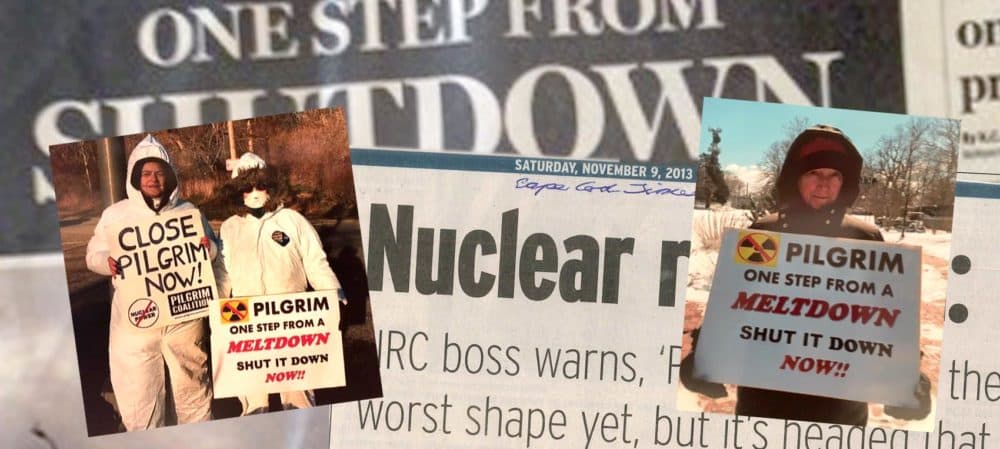
Decades of resistance to the Pilgrim Reactor. Photo and story: WBUR.

Filed Under: Environment, Newsletter Archives, Nuclear Power, Quarterly Newsletter, Radiation Exposure, Radioactive Waste, Uncategorized

February 4, 2026 by Nukewatch Leave a Comment

Mystery Test of Submarine-Launched Missile Raises Questions

The Navy's Columbia-Class Ballistic Missile Submarine Has a Very ...

In September, the Caribbean Astronomy Society detected an unattributed “military test” when either a U.S. or U.K. nuclear-powered submarine fired a 130,000-pound Trident missile from near Puerto Rico. The missile, a Trident II D5, is an intercontinental-range ballistic missile with a yield of 7 to 95 kilotons. Regularly, the U.S. military publicly announces its missile tests in advance. In January, Lockheed Martin won a $383 million contract for the Trident II D5 Life Extension program to “modernize” the Trident arsenal, providing missiles for the Navy’s new Columbia-class submarines and the U.K.’s Dreadnought-class submarines. Each of the Trident II D5 missiles currently built by Lockheed Martin costs about $30.9 million and each missile can carry up to 12 independently targeted warheads. The Trident II D5 is described by the U.S. Navy as “the planet’s most lethal, accurate, and reliable sea-based strategic deterrent.” Fourteen Ohio-class submarines in the U.S. Navy and four Vanguard-class British submarines each carry 20 and 16 of these missiles per sub respectively. — Interesting Engineering, Sept. 22, 2025; Hans Kristensen & Matt Korda, “United States nuclear forces, 2019,” Bulletin of the Atomic Scientists, April 29, 2019, https://nuclearcompanion.com/data/trident-ii-d-5-missile/

Photo: The National Interest

Filed Under: Military Spending, Newsletter Archives, Nuclear Weapons, Quarterly Newsletter

February 4, 2026 by Nukewatch Leave a Comment

German Government to Weaken Criticism of Nuclear Power

At a Ministerial Council meeting in France last August, French and German delegates declared support for the “equal treatment” of both nuclear power and renewable electricity sources within the European Union (EU). The news came as a shock to environment and policy observers, because Germany has strenuously opposed nuclear power for years. The reversal was noticed in May when German Chancellor Merz and French President Macron agreed to “end discrimination” against nuclear power at the EU level, and in June when German Energy Minister Katherina Reiche attended a meeting of pro-nuclear states. Ms. Reiche, a former gas industry lobbyist, said she intends to slow the pace and reduce promotion of renewable energy expansion. Even Germany’s anti-nuclear Environment Minister Carsten Schneider has been silent on the turnaround.

EU negotiations on its multi-annual financial “framework” (for the years 2028 to 2034) are ongoing, but in June a first draft was issued which, for the first time, allows the funding of research on mini reactors, and permits the construction of new nuclear reactors to be directly eligible for funding. Such funding would reverse the EU’s current policy, and, in Germany, taxpayers’ money would flow to international nuclear power projects in spite of the country’s complete reactor phase-out. Without clear opposition from Germany, support for nuclear power will increase, and investments in wind and solar projects will become less attractive. — Broadcast, newsletter of Together Against Nuclear Energy, Germany, October 2025, https://www.ausgestrahlt.de/

Photo: Clean Energy Wire

Filed Under: Environment, Newsletter Archives, Nuclear Power, Quarterly Newsletter, Renewable Energy

  • « Previous Page
  • 1
  • …
  • 11
  • 12
  • 13
  • 14
  • 15
  • …
  • 266
  • Next Page »

Stay Connected

  • Facebook
  • Twitter

Subscribe

Donate

Categories

  • B61 Bombs in Europe
  • Chernobyl
  • Counterfeit Reactor Parts
  • Depleted Uranium
  • Direct Action
  • Environment
  • Environmental Justice
  • Fukushima
  • Lake Superior Barrels
  • Military Spending
  • Newsletter Archives
  • North Korea
  • Nuclear Power
  • Nuclear Weapons
  • Office News
  • On The Bright Side
  • Photo Gallery
  • Protect the Water Close Xcel's Monticello Reactor
  • Quarterly Newsletter
  • Radiation Exposure
  • Radioactive Waste
  • Renewable Energy
  • Social Issues
  • Sulfide Mining
  • Through the Prism of Nonviolence
  • Uncategorized
  • Uranium Mining
  • US Bombs Out of Germany
  • War
  • Weekly Column

Contact Us

(715) 472-4185
nukewatch1@lakeland.ws

Address:
740A Round Lake Road
Luck, Wisconsin 54853
USA

Donate To Nukewatch

News & Information on Nuclear Weapons,
Power, Waste & Nonviolent Resistance

Stay Connected

  • Facebook
  • Twitter

© 2026 · Nukewatch