Nukewatch

Working for a nuclear-free future since 1979

  • Issues
    • Direct Action
    • Environmental Justice
    • Nuclear Power
      • Chernobyl
      • Fukushima
    • Nuclear Weapons
    • On The Bright Side
    • Radiation Exposure
    • Radioactive Waste
    • Renewable Energy
    • Uranium Mining
    • US Bombs Out of Germany
  • Quarterly Newsletter
    • Quarterly Newsletter
    • Newsletter Archives
  • Resources
    • Nuclear Heartland Book
    • Fact Sheets
    • Reports, Studies & Publications
      • The New Nuclear Weapons: $1.74 Trillion for H-bomb Profiteers and Fake Cleanups
      • Nuclear Power: Dead In the Water It Poisoned
      • Thorium Fuel’s Advantages as Mythical as Thor
      • Greenpeace on Fukushima 2016
      • Drinking Water at Risk: Toxic Military Wastes Haunt Lake Superior
    • Nukewatch in the News
    • Links
    • Videos
  • About
    • About Nukewatch
    • Contact Us
  • Get Involved
    • Action Alerts!
    • Calendar
  • Donate

February 4, 2026 by Nukewatch Leave a Comment

NATO’s Nuclear Attack Threats on Display in Europe

Commentary by John LaForge

NATO’s standing threat to attack Russia with nuclear weapons is put on parade every autumn. This year’s thermonuclear dry run — dubbed Steadfast Noon — got started October 13 according to NATO’s press office and the Supreme Headquarters Allied Powers Europe, or SHAPE, in Mons, Belgium.

NATO’s euphemism for its yearly doomsday rehearsal is “exercise,” and this year’s dress Armageddon included warplanes from fourteen of NATO’s 32 states, 71 aircraft (11 more than last year), and 2,000 military personnel.

In the words of NATO’s Secretary-General Mark Rutte, the run-through is “to make sure that our nuclear deterrent remains as credible … and as effective as possible.” Translation: We’re testing our readiness to commit mass destruction.

NATO forces gather for the annual Steadfast Noon war games, including coordinating and rehearsing for nuclear operations.
Photo: zuercher-presse.com.

NATO’s Oct. 13 announcement had more gibberish: “Service members will rehearse the procedures related to the deployment of dual-capable [nuclear & non-nuclear] aircraft and the employment of conventional support assets in nuclear operations, ensuring all participating forces can coordinate effectively in a nuclear scenario.” Translation: We’re going to prepare for war using thermonuclear blasts, firestorms, and radiation.

Col. Daniel Bunch, Chief of Nuclear Operations at SHAPE, said to the press: “There is focus in … getting the strikes planned, … getting … all of those elements synchronized to deliver…” Translation: Steadfast Noon’s purpose is to plan a complex, coordinated radioactive mass attack.

As if to put readers at ease, NATO said, “No live nuclear weapons will be used.” Evidently only dummies would be in the fighter jets.

The nuclear attack drill took place at Volkel Air Base in the Netherlands, Lakenheath base in
England, Kleine-Brogel in Belgium, and Skrydstrup in Denmark, while Finland, Poland, the U.S., Germany, and others also dressed up as executioners.

The Netherlands Air Force recently debuted its newly purchased F-35A jet fighter-bombers which have been “certified” to carry the new U.S. B61-12 air-dropped H-bombs, which have reportedly now been stationed in Belgium, Netherlands, Italy, England, and Germany.

NATO’s annual exercise includes the use of non-nuclear aircraft, like surveillance planes, reconnaissance planes, refueling planes (for the long haul to Moscow), and giant KC-135 Stratotankers, all of which, according to NATO, “serve in a conventional support to nuclear operations.” Translation: “Nuclear operations” means attacking with uncontrollable, indiscriminate, poisoned warheads.

NATO’s inclusion of non-nuclear “support” personnel means the whole Air Force can share the ethical burden of risking the obliteration of civilization, so it isn’t carried only by the trigger men and pilots.

Is the planning and preparing of nuclear attacks sane, or is it suicidal ideation and madness?

No less an authority than Gen. George L. Butler (USAF Ret.), a former head of Strategic Air Command — which controls all U.S. nuclear weapons — has condemned all such nuclear attack preparedness, which he himself molded and rehearsed for years. Gen. Butler is the first SAC commander to reject and abandon nuclear “deterrence” — in dozens of speeches, articles, and a memoir Uncommon Cause — and to call for abolition.

Lambasting “the obscene power of a single nuclear weapon,” Gen. Butler wrote in the Fall 1996 and Spring 1999 journal of the Nuclear Age Peace Foundation that the military’s nuclear attack plans are “a pernicious anachronism.”

Gen. Butler wrote, “Nuclear weapons are not weapons at all. They are insanely destructive agents of physical and genetic terror… They’re some species of biological time bombs whose effects transcend time and space, poisoning the Earth and its inhabitants for generations to come.”

NATO’s ceaseless nuclear attack threats were on parade in Europe, and its ring leaders talk as if they are rational. Gen. Butler, who is one of dozens of retired nuclear war planners who disagree, says, “Deterrence suspended rational thinking in the Nuclear Age.”

The commander denounced deterrence, in theory and practice, using words that could still stir desertion or mutiny among the nuclearists: “The likely consequences of nuclear war have no politically, militarily, or morally acceptable justification, and therefore the threat to use nuclear weapons is indefensible.”

Filed Under: B61 Bombs in Europe, Newsletter Archives, Nuclear Weapons, Quarterly Newsletter, War

February 4, 2026 by Nukewatch Leave a Comment

Declaration of Rights of Nuclear Victims Adopted in Hiroshima

Correction: The print version of this article that appeared in the Winter 2025 Nukewatch Quarterly included an outdated definition of nuclear perpetrators. It has been corrected below.

Editor’s Note: This October the World Nuclear Victims’ Forum in Hiroshima, Japan welcomed global hibakusha (nuclear victims) from nine different countries “to create a place of international solidarity… for nuclear victims and their allies, aiming for the elimination of the nuclear cycle and a world in which no more hibakusha are created.” Forum participants joined organizers from Hiroshima Alliance for Nuclear Weapons Abolition and Manhattan Project for a Nuclear-Free World adopting the “Hiroshima Declaration” and “Declaration on the Rights of World Nuclear Victims.” Updated from a 2015 declaration, the new statement is more inclusive, intersectional, and comprehensive than any other previous declaration adopted on the rights of nuclear victims. Selected excerpts of the “Hiroshima Declaration” follow.

“We define nuclear victims (hibakusha) as follows: All victims of radiation exposure and radioactive contamination, including victims of the atomic bombings in Hiroshima and Nagasaki; victims of nuclear testing; victims of human experiments using nuclear materials; not distinguishing between victims of military and civilian nuclear use, those impacted by uranium mining, milling, and enrichment activities and those impacted by radioactive contamination from nuclear labor and environmental contamination of nuclear weapons-related activities and entire processes of nuclear energy and nuclear fuel such as nuclear development, use and waste; victims of nuclear power plant disasters; and victims of depleted uranium weapons that are produced from radioactive waste….

“As long as war persists, the urge to use nuclear weapons and the risk of nuclear war will only increase…. We recognize that unless we end the nuclear age, humanity could become a nuclear victim (hibakusha) at any time, and we reaffirm that nuclear and humanity cannot coexist.

Hiroshima Declaration and Declaration on the Rights of Nuclear Victims ...
Graphic: NuclearNews.net

“We acknowledge that uranium mining and milling, nuclear testing, and nuclear waste disposals have been conducted under ongoing colonial rule, discrimination, and oppression. We also acknowledge that use of nuclear technology is based on the social structure of inequality, discrimination, oppression, and exploitation, such as building nuclear power plants and nuclear fuel facilities in rural areas and forcing radiation exposure onto subcontracted workers at nuclear power plants. In particular, we acknowledge the history and current state of “nuclear colonialism” against Indigenous Peoples around the world, which excludes them from policy- making processes, violates their rights (including those related to their ancestral lands), oppresses them when they assert their individual or collective rights, and inflicts upon them the violence of radiation exposure, which can be considered a form of genocide.

“We define nuclear perpetrators as follows: This includes nuclear-armed countries and those who, through the use of nuclear weapons, have destroyed the foundations of human existence and created conditions that threaten the survival of all living things; the military-industrial-government-academia complex and its members, as well as the three nations that support it; United Nations organizations such as the International Atomic Energy Agency (IAEA) and the United Nations Scientific Committee on the Effects of Atomic Radiation (UNSCEAR) as well as institutions that have previously downplayed the effects of radiation exposure and concealed the true impacts of nuclear disasters, such as the International Commission on Radiological Protection (ICRP) led by pro-nuclear scientists; countries that promote nuclear energy policies; and shareholders and creditors of operators that caused radioactive contamination and manufacturers of nuclear power plants and other nuclear facilities. We strongly demand that nuclear perpetrators be held accountable for their actions and be required to pay compensation to victims. We also call for the acknowledgement that the promotion, support, and investment of nuclear-related industries, including the export of nuclear power plants and the import of uranium, have the risk of violating human rights and destroying the environment….”

See the full Hiroshima Declaration and Declaration on the Rights of Nuclear Victims 2025.

Filed Under: Newsletter Archives, Nuclear Weapons, Quarterly Newsletter, Radiation Exposure

February 4, 2026 by Nukewatch Leave a Comment

Radioactive Contamination of Shrimp, Cloves, Shoes, Zinc Powder

The U.S. Food and Drug Admin. issued a recall of shrimp contaminated with cesium-137 but the radioactive trail extends further. Photo: FDA.
Ultimate Source of Cesium-137 in Consumer Goods Still Unclear, Criminal Charges Pending

By John LaForge

The widespread cesium-137 contamination that spread far beyond an industrial area in Indonesia has led to radioactive contamination of exported shrimp, cloves, shoe parts, and concentrated zinc powder. The contaminated products were exported to the United States, the Netherlands, and possibly elsewhere.

The discovery of shipping containers contaminated with cesium-137 at several U.S. seaports last August led the U.S. Food and Drug Administration (FDA) to urge a recall of tons of the frozen shrimp. Recalls were then ordered by Walmart, Kroger and dozens of other grocers in as many as 29 states. At that time the source of the radioactivity was unknown and a matter of intense investigation.

Natural News reported Sep. 29 that “millions of pounds of contaminated shrimp were sold at major retailers before recalls, exposing a systemic failure in food safety.”

Cesium-137, or Cs-137 for short, is a dangerous, cancer-causing form of radioactive waste not found in nature. It is only produced inside operating nuclear reactor cores, bz the detonation of nuclear weapons, or in the processing of waste reactor fuel. If ingested, cesium 137 tends to concentrate in soft tissue and muscles where hot particles irridate surounding tissue.

Laboratory testing has found that the contaminated shrimp in the United States contained an Cs-137 activity concentration of 68.48 becquerels per kilogram (Bq/kg), well below the U.S. FDA’s arbitrary permitted maximum of 1,200 Bq/kg in general foodstuffs.  (Food Safety magazine, Oct. 6, 2025,

https://www.food-safety.com/articles/10757-indonesian-officials-find-cause-of-cs-137-contamination-behind-radioactive-shrimp )

The FDA’s allowable level Cs-137 in food is controversially 12 times higher than what’s permitted in Japan. Today the U.S. cesium contamination limit of 1,200 Bq/kg compares to Japan’s limit of 100 Bq/kg.  http://www.japanprobe.com/2011/12/27/japans-new-limits-for-radiation-in-food-20-times-stricter-than-american-and-eu-standards/

Cesium-137 emits harmful ionizing beta and gama radiation. When particles of Cs-137 are ingested they can spread through the bloodstream and distribute across muscle and other soft tissues where the radiation will bombard surrounding tissue. Interviewed by Tempo English, Professor of Nuclear Medicine at Padjadjaran University, Dr. Achmad Hussein Kartamihardja sais the radioactive half-life of Cs-137 is 30-years, so “It takes 30 years for half of the cesium to disappear from the body.” (https://en.tempo.co/read/2055242/what-happens-inside-the-body-contaminated-with-cesium-137)

Investigations and declarations of decontamination

Last September, investigators with Indonesia’s hastily assembled “Cesium-137 Radiation Hazard Management Task Force” reported that the Cs-137 contamination came from inside the 12-square-mile Modern Cikande Industrial Estate, or MCIE, on west end of the island of Java, 40 miles west of Jakarta (the world’s most populous city with 42 million). The  HYPERLINK “https://www.businesstimes.com.sg/international/asean/indonesia-races-determine-extent-radioactive-contamination-industrial-zone”  The complex includes 270 companies involved in everything from food processing and automitive components, to scrap metal smelting and materials production for construction and manufacturing.

The Asean Business Times reported Oct. 3 that Indonesian inspectors found ten spots of cesium-137 contamination inside the MCIE “with high levels of exposure.” Environment Minister Hanif Faisol Nurofiq said then, “We have declared PT PMT (Peter Metal Technology) as the epicenter [sic] with a 5 kilometer perimeter.”

On Oct. 15, Al Jazeera reported that the government’s investigation found cesium “contamination was spread through airborne dust from a smelting plant” and that authorities suspect it might “have been caused by scrap metal imports.” Tempo English noted Nov. 17  that the while the Cs-137 contamination originated from radioactive scrap metal used in PT PMT’s smelting process, and that “radioactive particles” were dispersed, it claimed in error that the Cs-137 was blown to other points “within the industrial area.”

The Indonesian news agency Antara reported Oct. 15 that Bara Hasibaun, head of communications for the cesium task force, confirmed that “Cs-137 contamination spread through the air from PT PMT’s facility.” Radiation levels at one site in the MCIE were recorded to be 875,000 times routine background (https://cbrneworld.com/news/cesium-137-contamination-spreads-with-levels-thousands-of-times-higher-than-normal ) radiation, and Indonesia’s Ministry of Industry identified a total of 24 factories in the MCIE that had been contaminated with the Cs-137.

Tempo news service in Indonesia reported that by Nov. 17 (HYPERLINK “https://en.tempo.co/read/2066429/all-22-cikande-factories-exposed-to-cesium-137-have-been-fully-decontaminated ) some 22 of the factories and 13 junkyards in the MCIE had been “decontaminated,” and that Rasio Ridho Sani, the chair of the Cs-137 Handling Task Force, said that decontamination efforts inside the MICE were ongoing.

“Up to this point, 975 tons of Cs-137 contaminated material have been successfully moved. The material is currently stored temporarily at the PT PMT” grounds Sani said, according to the Tempo Nov. 17. By Dec. 4, Tempo English was reporting that 1,136 tons had been collected and stored at PT PMT. (https://en.tempo.co/read/2071004/environment-ministry-seeks-additional-rp28bn-for-cesium-137-remediation)

[Indonesia’s collection of 1,000+ tons of material contaminated by the accidental dispersal of cesium-137 is a tiny echo of the unrelated and far greater decontamination project underway in Japan, where some 20-million tons of conataminated material have been collected in bags from around the devastated Fukushima-1 nuclear reactor complex.]

The head of Indonesia’s Nuclear Energy Research Organization at the National Research and Innovation Agency (BRIN), Syaiful Bakhri, told the press the contaminated material will be stored at the PT PMT company site inside the MCIE “until the radioactive contamination naturally decays,” Tempo reported Oct. 29. The BRINCs-137 is not “natural”  is only created in operating nuclear reactors or nuclear weapons blasts and that it persists in the environment for 300 years while it “naturally” decays.

Contaminated cloves, shoe soles, powdered zinc

An area far wider than the 12-square-mile industrial zone of the MCIE was evidently contaminated with the Cs-137 dispersed from the smoke stacks of  PT PMT’s smelting furnaces.

ABC News reported Oct. 15, 2025 — well after the August shrimp recall — that cesium-137 was found in cloves that were shipped to California in September from a clove plantation in far-removed Lampung province.

Lampung is not even on the island of Java, but the neighboring island of Sumatra, across the Sunda Strait, and over 15 miles west of the MCIE industrial zone. The discovery of the contaminated cloves from the plantation owned by PT Natural Java Spice moved the U.S. FDA to halt all imports of spices processed by the firm. Here again, the U.S., like Indonesia, firmly slammed the barn door after the horse escaped.

The 8/15/25 ABC News report also noted that Bara Hasibuan of the cesium task force declared in a written statement that “The government is moving quickly to localize this contamination so that it does not spread to other areas.”

This absurd assurance was made after the airborne plume of Cs-137 had apparently moved miles beyond the PT PMT smelting site, contaminating a clove plantation over 15 miles to the west.

Hasibuan’s Oct. 15 letter from the task force also noted that it had “information that shoe soles exported to the U.S. were found to be contaminated with Cs-137.”

The Indonesian news agency Antara reported Nov. 12 that customs officials in the Netherlands found cesium-137 contamination in imported sneakers from Indonesia a month prior to the August recall of the frozen shrimp in the United States.

Hasibaun said the shoe soles were produced by the company PT Bahari Makmur Sejahtera (BMS), based in Cikande about five kilometers [ 3.1 miles] outside Cikande’s MCIE industrial zone. On Nov. 13, Tempo English news service reported the United States had returned two shipping containers filled with the cesium-contaminated shoe soles to Indonesia. The same article listed 24 individual companies in the MCIE that had been contaminated and that Hasibaun wrote in a Nov. 12 statement that “the government has completed the decontamination of all factories contaminated with Cesium-137.”


Health risks and evacuation, 1,500 exposed to cesium-137

The dangerous dispersal of cesium-137 forced Indonesia’s Serang Regency Government to evacuate at least 91 people from a village in the vicinity of the industrial estate in order to conduct decontamination services. The head of the task force’s Mitigation and Cs-137 Contamination Management Division, Rasio Ridho Sani, reportedly said on Oct. 27 that, “during the decontamination process, residents are at risk of exposure to airborne radioactive dust.” The federal Ministry of Health reported that 15 individuals tested positive for exposure to the cancer-causing radioactive cesium Oct. 16.

On Oct. 3, Asean Business Times reported that government authorities had examined over 1,500 local people and workers and found nine were exposed, according to Hasibuan, the investigation spokesperson. The exposed persons were said to be being “treated.”

Philippine exports to Indonesia

The broadening cesium contamination scandal now includes shoe parts exported to the United States and the Netherlands, and concentrated zinc powder imported from the Philippines.

The MCIE scrap metal smelting complex evidently imported highly contaminated metal scrap or waste from the Philippians, although the source of that hot scrap is still unknown. Now, according to importation documents, several containers of contaminated concentrated zinc powder also originated from the Philippines.

Antara reported Sept. 22, that Indonesia’s Nuclear Energy Regulatory Agency had “prevented the entry” of nine shipping containers filled with concentrated powdered zinc also contaminated with cesium-137. News reports said that monitors at the port of Tanjung Priok triggered alarms on five of the containers after they detected radioactivity up to 210 times background levels.

Zinc power is used heavily in the galvanizing of steel, making it rustproof. Its use in coating steel would make zinc a commonly imported material at the MCIE. Beyond rustproofing, zinc powder is used in batteries, paint, sun screen, rubber, cement, chemicals, as even in calamine lotion, baby powder, anti-dandruff shampoo, and diaper rash ointment.

On Oct. 19, Tempo Media in Jakarta reported that “Philippine authorities will investigate the source of a shipment of 14 containers of zinc concentrate powder, commonly used for battery powder from the Philippines to Indonesia, after the powder was found to be contaminated with … cesium-137.”

Later in October the Philippines was looking at certain steel processing facilities that allegedly supplied the zinc powder to the Chinese exporter, Zannwann International Trading, which has offices in the Philippines’ Bulacan province, and which shipped the hot zinc to Indonesia.

Early in the Cs-137 investigation, Indonesia’s Minister of Science and Technology Renato Solidum, Jr. gave the press a version of the standard industry assertion, saying, “This is likely an isolated contamination case without widespread danger to the public.”

Minister Renato’s reassurance recalls the famed undersea explorer Jacque Cousteau who said in 1998: “A common denominator, in every single nuclear accident is that before the specialists even know what has happened, they rush to the media saying, ‘There’s no danger to the public.’ They do this before they themselves know what has happened.”

— This news was gathered from reports by ABC News, Al JaZeera English, the American Nuclear Society, Antara (Indonesia’s national news agency), Asean Business Times, Asia News, CBRNe World (in the UK), CBS News, Consumer Reports, Food Safety magazine, The Guardian, The Jakarta Globe, The Jakarta  Post, NaturalNews.com, Reuters, and Tempo Media English [in the UK]

Filed Under: Environment, Newsletter Archives, Nuclear Power, Quarterly Newsletter, Radiation Exposure

February 4, 2026 by Nukewatch Leave a Comment

Fukushima Reactor Disaster Ongoing

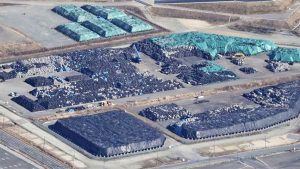
Some of the 14 million tons of radioactive soil and debris bagged and stacked in thousands of places following the 2011 triple reactor meltdowns at Fukushima-Daiichi. Photo: Asia News

By John LaForge

Japan’s Prime Minister endorses public spread of Fukushima radioactive waste

Japan’s new Prime Minister Takaichi Sanae visited Fukushima Prefecture December 2. One stop on her tour was at a temporary storage site holding some of the roughly fourteen-million tons of radioactive soil and debris that was collected in heavy bags and stacked in thousands of places following the March 2011 triple meltdowns. The PM said she wants to expand government plans to use some of the bagged-up radioactive waste in road building and construction projects, the national broadcaster NHK reported. Federal agencies have decided that the radioactive soil can be declared “recyclable” if it emits 8,000 becquerels per kilogram or less. (A becquerel is one measure of radioactive decay among many.) The collecting, transporting, dumping, and spreading of this material will endanger the workers involved, and will increase chances of public radiation exposures, as high winds and rainfall runoff can spread the material. The Japan Times reported on June 20, 2023 that a 5-year estimate of the cost of the program was then about $12.7 billion.

China reimposes Japanese seafood import suspension

On November 8, China’s government partially lifted its ban which was imposed in August 2023 after Japan began pumping radioactive wastewater into the Pacific Ocean in the face of worldwide criticism. China’s partial easing of restrictions left in place its ban on seafood from 10 of Japan’s 47 prefectures, all of which were heavily hit with radioactive fallout from the 2011 reactor explosions and meltdowns.

Then, on November 19, following hostile statements by Japan’s right-wing PM Takaichi regarding the military defense of Taiwan, China re-imposed its blanket ban on seafood imports. In a related tit-for-tat, Taiwan on November 24 lifted its blanket ban on Japanese seafood imports and its Food and Drug Administration justified the move after it checked over 270,000 batches of Japanese food for radiation, without finding “problems.”

Waste discharge to Pacific ongoing

On October 31, 2025, the International Atomic Energy Agency (IAEA) said it had conducted analysis of the 16th series of radioactive wastewater discharges from the destroyed Fukushima-1 site, and that “about 117,700 cubic meters of water have been released through the first 15 batches.” The IAEA reported that each batch met its “standards” and that “monitoring data remained consistent with negligible environmental impact.” Fukushima’s owner/operator Tepco says it will take the next 30 years to filter and pump all 1.3 million tons of radioactive wastewater into the Pacific, but routine earthquakes nearby threaten to destroy the 1,000 giant steel tanks that now store the cooling water near the shore. About 880 tons of highly radioactive molten nuclear reactor fuel remain inside the three wrecked reactors. The rubbished fuel is composed of enriched uranium, plutonium (in fuel that was being used in Unit 3), and hundreds of highly radioactive materials created by the reactors’ operational fissioning of uranium. The melted fuel and surrounding wreckage inside the exploded reactors’ cores is so radioactive that it can only be approached and examined robotically using machines that must be controlled at a distance.

Filed Under: Environment, Fukushima, Newsletter Archives, Nuclear Power, Quarterly Newsletter, Radiation Exposure, Radioactive Waste

February 4, 2026 by Nukewatch Leave a Comment

Bomb-Grade Plutonium Offered to Private Utilities for Reactor Fuel

Russia hasn't disposed of 34 tons of plutonium. It's our fault.
Photo: Politico

By John LaForge

White House appointees have offered excess plutonium from retired nuclear warheads, now stored in Texas to private industry at no cost for potential use as fuel in commercial power reactors.

“A July 31, 2025 memo seen by Politico from the Department of Energy (DOE), prepared by Deputy Secretary James Danly, recommends delivering 25 metric tons of plutonium from U.S. government-held stockpiles to the nuclear power industry,” Politico reported September 29.

“More than 20% of the material would come from plutonium pits — the highly radioactive spheres manufactured for the cores of nuclear weapons,” Politico said.

Due to cost and availability, uranium for reactor fuel is increasingly hard to secure. The plutonium scheme is essentially a bail-out for a failing industry. Hans Kristensen, with the Federation of American Scientists, told Politico that the plan represents “collusion, essentially, with the nuclear power industry. Some of the people that are involved in these recommendations are people that have very close ties to the nuclear power industry.” It would take companies at least several years to convert the plutonium into fuel. In 2018, a similar effort attempted at Savannah River plant in South Carolina failed and was cancelled by the first Trump White House because of a $50 billion price tag.

“It would be incredibly dangerous, complicated, and expensive to convert these impure plutonium materials into fuel that is safe enough for use in reactors,” said Edwin Lyman, a physicist at the Union of Concerned Scientists.

The government’s former plutonium production reactors and weapons fashioning facilities all across the country are burdened with thousands of tons of highly radioactive military wastes that must be contained and kept out of the environment for eons. (The long-term containment of 90,000 tons of civilian high-level radioactive waste from commercial power reactors are a separate, unsolved problem being mulled over by federal regulators.)

Military cesium-137 left from plutonium production at the Hanford Reservation in Washington state has been collected there for 75 years. There are reportedly 1,335 highly radioactive capsules of cesium-137 at Hanford. Approximately 700,000 tons of waste uranium-238, or “depleted uranium,” is stored in huge tanks in Paducah, Kentucky and Portsmouth, Ohio.

Roughly 50 tons of excess plutonium from weapons is stored at the Pantex Plant in Texas. As of 2021, a total of 61.2 tons of plutonium was called “excess to the needs of the U.S. government,” of which 53.4 tons is designated for nuclear weapons,” according to Robert Alvarez in the March 8, 2021 Bulletin of the Atomic Scientists. “The Energy Department faces the daunting task of geologically disposing of this huge cache of weapons-grade plutonium…,” he said.

The cost of keeping these deadly, cancer-causing radioactive wastes contained over thousands of years is so enormous, that at various times the government has proposed civilian “re-use” of the hot waste.

Cesium-137 is offered to “irradiation” operators for the irradiation of medical equipment in need of sterilization and for “food irradiation” conducted on spices, tea, and some fruits and vegetables. Uranium-238 is given away free to weapons producers who make armor-piercing, so-called “depleted uranium” munitions.

Filed Under: Environment, Newsletter Archives, Nuclear Power, Nuclear Weapons, Quarterly Newsletter, Radioactive Waste

  • « Previous Page
  • 1
  • …
  • 10
  • 11
  • 12
  • 13
  • 14
  • …
  • 266
  • Next Page »

Stay Connected

  • Facebook
  • Twitter

Subscribe

Donate

Categories

  • B61 Bombs in Europe
  • Chernobyl
  • Counterfeit Reactor Parts
  • Depleted Uranium
  • Direct Action
  • Environment
  • Environmental Justice
  • Fukushima
  • Lake Superior Barrels
  • Military Spending
  • Newsletter Archives
  • North Korea
  • Nuclear Power
  • Nuclear Weapons
  • Office News
  • On The Bright Side
  • Photo Gallery
  • Protect the Water Close Xcel's Monticello Reactor
  • Quarterly Newsletter
  • Radiation Exposure
  • Radioactive Waste
  • Renewable Energy
  • Social Issues
  • Sulfide Mining
  • Through the Prism of Nonviolence
  • Uncategorized
  • Uranium Mining
  • US Bombs Out of Germany
  • War
  • Weekly Column

Contact Us

(715) 472-4185
nukewatch1@lakeland.ws

Address:
740A Round Lake Road
Luck, Wisconsin 54853
USA

Donate To Nukewatch

News & Information on Nuclear Weapons,
Power, Waste & Nonviolent Resistance

Stay Connected

  • Facebook
  • Twitter

© 2026 · Nukewatch