By Leona Morgan
For more than 80 years, the Navajo Nation has endured excessive exploitation by uranium enterprises — at first, to fuel nuclear weapons and later, nuclear energy — with inadequate cleanup or no cleanup at all. Due to unquantifiable deaths, health consequences, and environmental contamination, the Navajo Nation enacted laws to protect its People and Mother Earth from new uranium mining in 2005 and transport of radioactive materials in 2012.
In November 2023 at the United Nations Climate Change Conference (known as “COP” or Conference of the Parties), the United States and 21 other countries committed to triple nuclear power development by 2050 as an empty gesture toward real solutions for climate change. COP 28 was held in the United Arab Emirates, and the President was an oil and gas executive.
In December 2023, Congress passed the National Defense Authorization Act with two major blows to uranium-impacted communities: the removal of a crucial amendment that would have expanded and extended the Radiation Exposure Compensation Act beyond the two-year band-aid fix that ends in June; and the Nuclear Fuel Security Act.
In January 2024, the price of uranium reached over $100 per pound. One of the requirements for uranium production is commodification of Mother Earth and a profitable market.
On Aug. 8, 2023, the Baaj Nwaavjo I’tah Kukveni National Monument was created around the Grand Canyon which prohibits uranium mining in nearly one million acres forever. However, due to the 1872 Mining Law, a few mines have what’s called “valid existing rights” and are grandfathered in to allow new mining within the national monument.
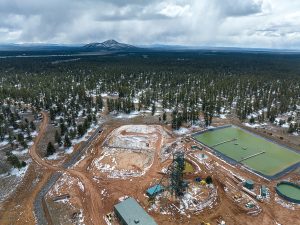
About half are already “mined out” and should be cleaned up. Of the remaining, two or three mines may be able to move forward with new mining.
Energy Fuels, a Canadian company, owns the Pinyon Plain uranium mine which was permitted in 1986, also known as Canyon Mine. Pinyon Plain is located a few miles from the south rim of the Grand Canyon in northern Arizona on stolen Forest Service (USFS) lands and within this new monument. Energy Fuels also owns other uranium mines and “projects,” as well as the White Mesa Mill in southeast Utah, the only operating conventional uranium mill in the country. Energy Fuels’ plan is to extract the uranium from Pinyon Plain and transport it to the mill with the majority of the route going through the Navajo Nation.
Haul No! is an Indigenous-led volunteer initiative that is working toward protection of communities around the mine, along the route, and near the mill, by working to shut down the mine. Haul No! was established in 2016 and continues to monitor the mine and spread awareness about Pinyon Plain/Canyon Mine and possible transport.
Despite decades of resistance by the Havasupai Nation, local Indigenous Nations, Coconino County Board of Supervisors, environmental groups, and others, Energy Fuels started new uranium mining at Pinyon Plain on Jan. 8, 2024. As of print, Energy Fuels has not yet started transport. The company is not obligated to inform the public or the Navajo Nation, but communicates with USFS, which has a trust responsibility to all federally recognized tribes. And because the ore is less than 1% uranium, the company does not have to label their transport trucks with radioactive placards.
Energy Fuels has not reached what is considered economically viable or “high-grade uranium ore.” With the price of uranium dropping, it is unknown when or if the company will ever have enough high-grade uranium to start transport. The route to White Mesa Mill is over 300 miles long going through several municipalities and Indigenous homelands.
-
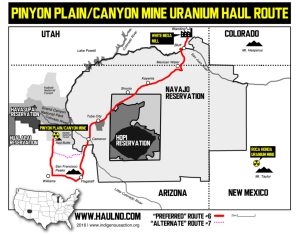
haulno!.com, indigenousaction.org, 2016. The Navajo Nation has a law against uranium mining and transport of radioactive materials, but the Nation’s sovereignty is limited. Because the mine is not on Navajo jurisdiction and the route is mostly on U.S. Highways, the Navajo Nation cannot stop the uranium transport. Less than a mile of the route is on City of Flagstaff streets, but even Flagstaff cannot stop transport.
Because Energy Fuels is not required to share information with the general public, and due to the lack of oversight by the USFS and Arizona Department of Environmental Quality (ADEQ), Haul No! visits the mine weekly and is working to inform as many communities as possible in Northern Arizona, reporting to Indigenous communities in person. On multiple occasions, Haul No! has photographed violations by Energy Fuels at the mine and on the route with no repercussions to the company. Haul No! cannot trust the USFS, ADEQ, the colonial governments, or even the Navajo Nation government to regulate or hold the company accountable at the site, along the transport route, and at the mill.
Currently, Haul No! is working to encourage local governments, such as Navajo Nation chapters and Arizona municipalities, to pass resolutions opposing the mine and demanding immediate closure by Arizona governor Katie Hobbs. As of print, there are at least five new resolutions from Navajo Nation entities and the Coconino County Board of Supervisors. These resolutions are new, but opposition to the mine has been strong since the permitting process in the 80s.
As a global treasure and natural wonder of the world, the Grand Canyon has a complex hydrogeological structure and a myriad of places held sacred to at least 13 regional Indigenous Nations. The Grand Canyon national monument is a federal failure. Anyone who has appreciation for the Canyon, for water, and for life altogether can help to put pressure on Governor Hobbs, U.S. Secretary of Agriculture Tom Vilsack, and President Biden by informing them and demanding that this 1872 loophole be closed.
Due to circumstances of climate, uranium pricing, and geopolitics, the current political and economical landscapes lend themselves to a possible new wave of uranium extraction and processing, a 21st century uranium boom. Haul No! intends to stop the pin prick that is Pinyon Plain. Haul No! did not support the national monument, but stands strong in its support for the Havasupai Nation’s continued fight against the mine and the Ute Mountain Ute Nation’s fight against the mill. Haul No! will continue monitoring, spreading awareness, and working toward an end to nuclear colonialism.
For more information visit haulno.com or follow Haul No!’s social media.
— Leona Morgan (she/her) is a Diné organizer and graduate student based in Albuquerque, New Mexico.
Nukewatch at UN Nuclear Ban Treaty Meetings
By Nukewatch Staff
Three years have passed since the United Nations Treaty on the Prohibition of Nuclear Weapons (TPNW) received its 50th ratification, triggering its entry into force. In online meeting after online meeting, Nukewatch has collaborated with comrades to rally support for the nuclear ban treaty in the United States. Last summer, Nukewatch’s John LaForge met with nuclear abolitionists in Vienna for the first Meeting of States Parties. This November, Nukewatch gathered in person with even more friends from over a hundred civil society organizations and at least 30 countries for the second Meeting of States Parties that took place in New York City. Nukewatch staff Kelly Lundeen and John LaForge organized and participated in events inside and outside of the United Nations.

(L-R) Hinamoeura Cross, Petuuche Gilbert, Elizabeth Minor, Nukewatch’s Kelly Lundeen, and Mari Inoue spoke at a United Nations civil society event highlighting voices from nuclear-impacted communities Nov. 28 in New York. Photo by Tony Sahara. Inside the UN headquarters, the Affected Communities and Allies Working Group, along with Nukewatch, Manhattan Project for a Nuclear-Free World, International Campaign to Abolish Nuclear Weapons (ICAN), and Article 36 co-hosted a side event titled “Perspectives on Ongoing Harm to Affected Communities and Next Steps with the TPNW,” which highlighted the impacts of nuclear imperialism by three nuclear powers, the U.S., France, and the U.K.
Tina Cordova of the Tularosa Basin Downwinders Consortium spoke about the health consequences of the Trinity Test as a member of the fourth generation in her family to be diagnosed with cancer. The U.S. government has denied Trinity’s impacts, which are partially at fault for New Mexico’s status as the U.S. state most dependent on Medicaid. Hinamoeura Cross, mother and French Polynesian parliamentarian, lives with leukemia and is also among the fourth generation in her family to have cancer. She shared the experiences of young French Polynesian women who have deliberately chosen not to have children to avoid the fate of French nuclear test survivors who have endured raising children with malformations, diseases, or losing their babies. Both Cordova and Cross were recipients of the Nuclear Free Futures Award given by Beyond Nuclear and International Physicians for the Prevention of Nuclear War.
Petuuche Gilbert, of Multicultural Alliance for a Safe Environment, reminded those present that uranium mining and milling are necessary for weapons production and have left irreparable environmental and intergenerational health consequences. However, mining and abandoned uranium mining communities, like the Grants district of New Mexico in his home of Acoma Pueblo, have been neglected by the TPNW. Mere Tuilau of Youngsolwara Pacific in Fiji brought to light the struggle of Fijian veterans, some as young as 15 when they were deployed to Kiribati, also known as Christmas Island. There they were exposed to U.K. nuclear testing in the 1950s and are now in dire need of access to health care and compensation.
Mari Inoue of Manhattan Project for a Nuclear-Free World and Affected Communities and Allies Working Group spoke about the importance of a victim-centered approach, adopting stricter radiation protection standards, and affected communities’ disagreement with language in the TPNW that supports nuclear energy.
Nukewatch also attended the UN meetings of 90 nations. More than 65 civil society events took place in New York, and there were dozens of solidarity actions worldwide for the Global Day of Action against Nuclear Weapons. During the week, a delegation of 23 parliamentarians, from 14 countries not yet party to the TPNW, met calling for governments to sign and ratify the treaty. The UN meetings concluded with a declaration reaffirming commitments to getting more countries to join the ban, denouncing nuclear deterrence as policy, and unfortunately restating nations’ so-called “inalienable” right to nuclear energy. The Third Meeting of States Parties to the treaty will take place March 3-7, 2025 in New York.
Outside of the United Nations, Nukewatch brought the message of hope of the nuclear ban treaty to the nuclear-armed states that boycotted the meetings. At the Rally and March to Abolish Nuclear Weapons, Nukewatch’s Kelly Lundeen read a letter urging the U.S. and Russia to join the TPNW and work toward the elimination of nuclear weapons. When she tried to deliver the letter to the U.S. Mission to the United Nations it was rejected by security at the door, despite several prior attempts to alert them of the visit.
Kelly and John returned to the U.S. Mission two days later on November 30 with Catholic Workers, New York War Resisters League, and Raging Grannies to make sure their message was heard inside. Kelly was part of a blockade of all three entrances that shut down the Mission offices for two hours resulting in the arrest of 18 people. She said, “Nuclear weapons have been banned. The world has spoken. As a U.S. citizen ashamed of what my country has done, I’m here to stand in solidarity.” All 18 were released from jail later that afternoon with a ticket for a court appearance.
Resources and further reading:
- Nuclear Ban Daily
- Tularosa Basin Downwinders Consortium
- Laguna-Acoma Coalition for a Safe Environment
- Manhattan Project for a Nuclear-free World
- Revised draft declaration of the second Meeting of States
Parties to the Treaty on the Prohibition of Nuclear
Weapons
Documentary on Radioactive Waste Wins Prize
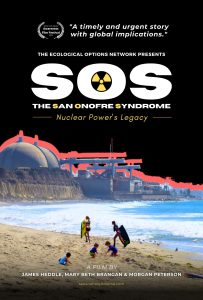
Photo:sanonofresyndrome.com/press-kit
By John LaForge
The new documentary film from producer/director Mary Beth Brangan, “SOS – The San Onofre Syndrome: Nuclear Power’s Legacy” [https://sanonofresyndrome.com/], has won the Awareness Film Festival’s Documentary Feature Grand Jury Award — beating the festival’s 100 other documentary entries. Brangan says that the film “chronicles a community’s victory over leaking reactors, only to confront a chilling reality — deadly radioactive waste stranded next to a rising sea. As temporary containers decay, a nationwide crisis emerges, and the race to avert catastrophe becomes a stark countdown against time.” Haled as “a timely and urgent story with global implications,” the film was recently accepted into the next International Uranium Festival to be screened in Rio de Janeiro, Berlin, and eighteen U.S. cities in 2024.
— SOS: info@sanonofresyndrome.com; https://sanonofresyndrome.com
U.S. Disregards Marshall Islands, Senate Approves RECA Expansion

Photo Credit: KRWG By Lindsay Potter
The U.S. senate approved legislation on July 27 expanding the Radiation Exposure Compensation Act to provide benefits to more radiation-affected Americans, the New Mexico Downwinders, uranium miners and workers since 1971, and residents of Montana, Idaho, Colorado, Guam, and previously excluded areas in Nevada, Arizona, and Utah. This legislation still awaits a decision in the House. In contrast, the U.S. government claims the pool of funding for medical compensation has run dry for the Marshallese people, displaced and poisoned by nuclear weapons the U.S. detonated over their homelands. Marshallese parliament speaker Kenneth Kedi told the Marshall Islands Journal, “the fact that U.S. authorities can tell the Marshall Islands there is ‘no more money’ for nuclear test exposure for people who lived through 67 of the largest U.S. nuclear weapons tests ever conducted while at the same time preparing to expand compensation coverage for Americans is astounding.”
The U.S. and the Marshall Islands are renegotiating the Compact of Free Association to address the egregious crimes against the Marshallese people by providing compensation, benefits, and access to immigration, though in amounts far below what was requested by the Marshall Islands. Still, Kedi says, “As nuclear test victims ourselves we support compensation for American victims of nuclear tests, whether they are Downwinders or worked at nuclear test sites or worked in uranium mines.”
—AP and KRWG July 27; Marianas Variety, Aug. 21, 2023; trinitydownwinders.com
Navy Contamination “Lower than Zero”

Photo Credit: San Francisco Chronicle By Lindsay Potter
The U.S. Navy has been accused of covering up dangerous radioactivity, including high levels of strontium-90, which displaces calcium in bones and causes cancer, on a 40-acre parcel of its Hunter’s Point Shipyard in San Francisco. When the EPA flagged the 23 tests from 2021 showing elevated strontium levels, the Navy simply responded with a new set of data, showing levels “lower than zero.” The EPA said “the new testing reads as if the Navy is suppressing data results it doesn’t like.” Declared a Superfund site in 1989 and closed in 1994, the shipyard was home to the Naval Radiological Defense Laboratory, the military’s biggest applied nuclear research facility, and later became a site for decontaminating ships from 1946 nuclear weapons detonations at Bikini Atoll. In 2016, the EPA stopped transfer of the land to real estate developers because the Navy was discarding “anomalous” soil samples and obscuring the true level of toxicity. Though the Navy agreed to remediate the area to a level acceptable for residential property, they repeatedly shirked this agreement — downgrading several parcels to “industrial use” with lower standards for toxicity, and installing covers in the soil to suppress contamination rather than removing the soil. On one already developed parcel, residents report cancers and health problems linked to radioactivity. There are currently 12 lawsuits related to the site.
— The Guardian June 25, 2023; NBC Dec 2, 2022
- « Previous Page
- 1
- …
- 6
- 7
- 8
- 9
- 10
- …
- 24
- Next Page »