Nukewatch

Working for a nuclear-free future since 1979

  • Issues
    • Direct Action
    • Environmental Justice
    • Nuclear Power
      • Chernobyl
      • Fukushima
    • Nuclear Weapons
    • On The Bright Side
    • Radiation Exposure
    • Radioactive Waste
    • Renewable Energy
    • Uranium Mining
    • US Bombs Out of Germany
  • Quarterly Newsletter
    • Quarterly Newsletter
    • Newsletter Archives
  • Resources
    • Nuclear Heartland Book
    • Fact Sheets
    • Reports, Studies & Publications
      • The New Nuclear Weapons: $1.74 Trillion for H-bomb Profiteers and Fake Cleanups
      • Nuclear Power: Dead In the Water It Poisoned
      • Thorium Fuel’s Advantages as Mythical as Thor
      • Greenpeace on Fukushima 2016
      • Drinking Water at Risk: Toxic Military Wastes Haunt Lake Superior
    • Nukewatch in the News
    • Links
    • Videos
  • About
    • About Nukewatch
    • Contact Us
  • Get Involved
    • Action Alerts!
    • Calendar
  • Donate

July 22, 2024 by Nukewatch Leave a Comment

Radiation-Exposed Communities Vow to Fight On

By Kelly Lundeen

The federal program compensating radiation-exposed community members since 1990 expired June 10. Although the Radiation Exposure Compensation Act (RECA) assisted many people, it always excluded several communities, including uranium workers after 1971, New Mexico downwinders of the Trinity nuclear test, and other communities in Guam, Arizona, Colorado, Idaho, Missouri, Montana, and Utah.

For years these communities led the struggle for RECA’s expansion to include them. For now, hopes for both the extension of the timeline and the expansion of the program’s eligible recipients have been dashed.

After receiving unprecedented support in the Senate, the extension and expansion failed in the House when Speaker Mike Johnson refused to bring it to the floor for a vote, which if taken, was expected to pass. Republican opposition to expand RECA has focused on the cost to the federal government.

Dark blue: cost of U.S. nuclear weapons programs 1942-2022 ($9.55 trillion). Light blue: 2023-2033 projected U.S. nuclear weapons spending ($791.5 billion). Red: RECA costs to date ($2.67 billion). Graphic: NuclearWatch NM.

Tina Cordova is one of the Trinity downwinders and co-founder of Tularosa Basin Downwinders Consortium (TBDC). She told KOB4 News, “I’m the fourth generation in my family to have cancer since 1945. And unfortunately, now I have a 24-year-old niece who’s diagnosed with thyroid cancer.” In response to issues of cost, Cordova wrote on the TBDC website,“ See the pie chart that shows how the cost of RECA [so far $2.67 billion] compares to the cost of the U.S. nuclear programs [$791.5 billion for 2023-2033]. RECA has been a pittance in comparison.” She said, “While they play politics, we’re gathering up our resources for someone to have cancer treatment. We’re having bake sales and car washes and selling cattle so we can meet our health care needs.”

Despite the end of RECA, there are other legislative opportunities to extend and expand the program. Grassroots advocates and allied legislators are committed in the struggle for recognition and compensation for the communities that were never included in RECA in the first place. Cordova said, “We will continue to fight for everyone who has been harmed by nuclear tests, mining, and waste, and we will leave no one behind.”

— KOB4 News and Source NM, June 7; Nuclear Watch New Mexico, March 20, 2024

Filed Under: Environmental Justice, Newsletter Archives, Nuclear Weapons, Quarterly Newsletter, Radiation Exposure

April 18, 2024 by Nukewatch Leave a Comment

Is Leaked, Radioactive Tritium in Mississippi River Drinking Water?

By John LaForge

Xcel Energy’s Monticello nuclear reactor on the Mississippi River has leaked some 829,000 gallons of wastewater contaminated with radioactive tritium into the groundwater on site,1 more than double the 400,000 gallons Xcel first estimated. The company has since replaced two leaking pipes, built an underground retaining wall, and is cleaning up after a second spill and its temporary reactor shutdown. Yet according to WCCO TV, for July 20, 2023, Xcel said a “small amount of leaked water may have reached the Mississippi River.”2

On March 18, 2023, the Associated Press (AP) reported that a representative of the U.S. Nuclear Regulatory Commission (NRC) told them that the tritium-contaminated wastewater from the reactor couldn’t contaminate the water people drink. The AP reporters quoted NRC spokesperson Victoria Mitlyng, writing: “Mitlyng said there is no pathway for the tritium to get into drinking water.”3

In fact, there are two pathways for the tritium leak to get into drinking water. First, the tritium in the 829,000-gallon leak is now in a groundwater plume that can move beyond Xcel’s Monticello site and reach private or public drinking water wells.

Second, the groundwater plume, which moves toward the Mississippi,4 will contaminate the river which supplies drinking water to one million-plus people in the Twin Cities and their suburbs and 38 million people downstream.

Legend – The Nuclear Regulatory Commission defines two emergency planning zones around nuclear reactors: a “plume exposure pathway zone” with a radius of 10 miles (dark yellow circle at center), concerned primarily with exposure to, and inhalation of, airborne radioactive contamination; and an “ingestion pathway zone” of about 50 miles (pale yellow circle), concerned primarily with ingestion of food and liquid contaminated by radioactivity. Numbers and red circles indicate approximate county population at risk. Arrows indicate wind direction.
Map Fine Print – Zone definitions: U.S. Nuclear Regulatory Commission. Population data: U.S. Census 2020 block groups with centers inside respective exposure zones. Wind data: National Weather Service 2023 daily summaries. Map by Carl Sack, 2024.

Perhaps Mitlyng was misquoted, since the NRC and the AP have both reported that the plume of tritium-contaminated groundwater can move outside Xcel’s boundary. In fact, both agencies have reported that Xcel’s stated purpose in hastily building an underground steel wall between the reactor and the Mississippi is to prevent the radioactive groundwater from entering the river.5

The AP reported March 24, 2023 that Chris Clark, the president of Xcel Energy,
acknowledged that the radioactive pollution can reach the Mississippi. The AP reported: “Even if the tritium reached the river, which Clark assured wouldn’t happen, it would dissipate within a few yards.”6 Clark’s assurance is either a mistake or a deliberate fib, because “dissipate” means to disappear or vanish. However, tritium contamination in water lasts 123 years.

Further, there is no way to remove tritium from water once it’s contaminated — as the 1.5 million tons of tritiated wastewater being pumped into the Pacific Ocean from the three-reactor earthquake/tsunami/meltdown site at Fukushima proves.

Why is Xcel’s tritium in the groundwater and the Great River such a threat to the people and animals that rely on it? As the NRC says, “This is because tritium travels as a form of water through the soil faster than other radionuclides.”7 The city of Minneapolis proudly declares, “Our water comes from the Mississippi River. Roughly 21 billion gallons of water are pumped from the river each year, and 57 million gallons of drinking water delivered every day.”8

We can’t say, “There’s nothing we can do.”

Everyone can comment to the government regarding the risks posed by Monticello’s operations, when Xcel issues (this spring) its draft supplemental environmental impact statement (DSEIS) regarding the firm’s request to extend its license and run the 54-year-old reactor until 2050, when it will turn 80.

The comment period will last four to six weeks and open after the DSEIS is released. Check Nukewatch’s website to learn when the period has opened. Use one of Nukewatch’s sample comments or your own. Plan to make your voice heard in person once the NRC schedules a public hearing on the license extension. nukewatchinfo.org/monticello.

Notes:

[1] Xcel Energy, “Subsequent License Renewal Application Response to Request for Additional Information and Request
for Confirmation of Information – Set 1 Part 2,” p. 6, Dec. 18, 2023, https://adamswebsearch2.nrc.gov/webSearch2/main.jsp?AccessionNumber=ML23352A081

and The Monticello Times, “Xcel groundwater recovery enters final phase,” Dec. 21, 2023, https://www.hometownsource.com/monticello_times/xcel-groundwater-recovery-enters-final-phase/article_7e834ce8-9ea3-11ee-8e03-9f36a6b5d962.html

[2] CBS Minnesota, WCCO Staff, “Xcel Energy: Small amount of leaked water may have reached the Mississippi River,”
July 20, 2023, https://www.cbsnews.com/minnesota/news/xcel-energy-small-amount-of-leaked-water-may-have-reached-
the-mississippi-river/

[3] Associated Press, “Regulators: Nuclear plant leak didn’t require public notice,” by Michael Phillis and Amancia Biraben, March 18, 2023, https://apnews.com/article/xcel-energy-nuclear-leak-tritium-6e522afbb12ad26925c40d833853088d

[4] Doug Wetzstein of the Minn. Pollution Control Agency told WCCO television last March, “The groundwater beneath
the facility … moves in the direction of the Mississippi River.” https://www.youtube.com/watch?v=r5c6j7UZZA0&ab_channel=WCCO-CBSMinnesota

[5] Nuclear Engineering International, “Xcel Energy to build underground barrier to contain radioactive water leak at Monticello NPP, August 22, 2023, https://www.neimagazine.com/news/newsxcel-energy-to-build-underground-barrier-to-contain-radioactive-water-leak-at-monticello-npp-11090330; Xcel illustration of its wall is at https://www.ci.monticello.mn.us/Blog.aspx?IID=59; WCCO Staff, CBS Minnesota, “Xcel Energy to begin construction on underground barrier at Monticello nuclear plant,” August 18, 2023, https://www.cbsnews.com/minnesota/news/xcel-energy-to-begin-construction-on-underground-barrier-at-monticello-nuclear-plant/

[6]Associated Press, “Minnesota nuclear plant shuts down for leak; residents worry,” by Trisha Ahmed and Matthew Daly, March 24, 2023, www.apnews.com/article/minnesota-nuclear-plant-leak-6b72b6f9cd2a1141aadd985b68654e04

[7] “NRC List of Leaks and Spills at Operating U.S. Commercial Nuclear Power Plants,” https://adamswebsearch2.nrc.gov/webSearch2/main.jsp?AccessionNumber=ML23284A16

[8] www.minneapolismn.gov, Treatment and Delivery Process, “Our water comes from the Mississippi River,” https://www2.minneapolismn.gov/government/departments/public-works/water-treatment-distribution/treat-deliver/

Filed Under: Environment, Environmental Justice, Newsletter Archives, Nuclear Power, Protect the Water Close Xcel's Monticello Reactor, Quarterly Newsletter, Radiation Exposure

April 18, 2024 by Nukewatch Leave a Comment

Nuclear Justice in Maohi Nui

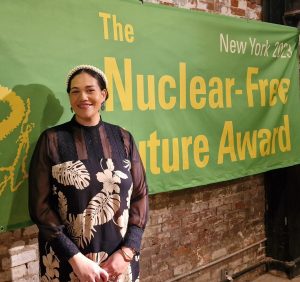
Hinamoeura Morgant-Cross receives the Nuclear -Free Future Award in New York, November 2023. Photo: Jean-Marie Collin.

Hinamoeura Morgant-Cross is a young French Polynesian whose realization that her own leukemia was a legacy of the French atomic tests in the South Pacific led her into activism. She works to ensure that the stories and experiences of the victims and their families will not be forgotten and to pressure the French government to both acknowledge responsibility and provide medical and financial support.

She was elected to the Polynesian Assembly of Representatives in May 2023 and shepherded a unanimous Assembly vote supporting the Treaty on the Prohibition of Nuclear Weapons. Morgant-Cross received the Nuclear-Free Futures Award in 2023 during the 2nd Meeting of the States Parties to the TPNW in New York. Nukewatch will feature the second part of her story in the summer 2024 Quarterly.

By Hinamoeura Morgant-Cross

TAHITI, MAOHI NUI — I was born in 1988 in Tahiti, the main island of French Polynesia. Until I was seven, France continued to explode nuclear bombs on my islands. Growing up, I never learned about the consequences of nuclear bombs at school. I didn’t even know there had been so many bombs, but what I did learn was that “thanks to nuclear power” we are a developed country.

Maohi Nui, known to the Western colonial world as French Polynesia, is a former French colony comprising more than 118 islands spanning almost one million square miles in the South Pacific Ocean. Maohi Nui belongs to France as a French collectivity with shared autonomy between the French government and the collectivity, a status that compromises our sovereignty on nuclear and other issues. France carried out dozens of atmospheric and underground tests in Algeria. But when Algeria gained independence in 1962, France turned to Maohi Nui to continue its nuclear experiments. Between 1966 and 1996 France detonated 193 nuclear bombs — 46 atmospheric and 147 underground — on the islands of Moruroa and Fangataufa and in our lagoons.

The French nuclear experimentation center is located 750 miles from Tahiti, but the nearest populated island to the testing zone, the island of Tureia, is only 75 miles away.

Evacuation occurred only once in the entire 30 years of experimentation. The sole island of Tureia was temporarily evacuated a few weeks before August 24, 1968 when the first French H-bomb test Canopus was dropped, 150 times more powerful than those which destroyed Hiroshima and Nagasaki. The French army instructed inhabitants of the island of Mangareva, 250 miles from ground zero, only to shelter from rain. No recommendations were made regarding water or food.

The fight for nuclear justice in Maohi Nui consists of properly educating the population about our nuclear history, which has been concealed by France for too long and downplayed for too long. Internationally, the anti-nuclear movement is denouncing the environmental and health consequences of France’s 193 nuclear bombs.

I’ve been a member of the Assembly of French Polynesia since May 2023, and I’m a fervent anti-nuclear campaigner. In September 2023, I presented a motion for a resolution in support of the United Nations Treaty on the Prohibition of Nuclear Weapons (TPNW) which was supported unanimously by members of the Assembly.

An extract of the resolution: “Today, it is very regrettable for French Polynesia, its population and its environment, that the French State is not a signatory to this Treaty and does not take part in the meetings of the States Parties to the TPNW. This is why, through this motion for a resolution, it is imperative that, as the territory that hosted the French nuclear testing center (Centre d’expérimentation du Pacifique – CEP), and as the population that was and still is a victim of nuclear fallout, we support the TPNW and solemnly ask the Head of State to: as a first step, encourage France to attend the next meetings of the States Parties to the TPNW as an observer state; secondly, work towards France’s accession to this new international standard.”

Through this resolution, my wish was to send a powerful message to France, but also to the international community and in particular to the countries taking part in the TPNW meetings: as a French collectivity, Maohi Nui has not the ability to sign onto the TPNW, but wants to be part of the meetings and discussions. Thanks to ICAN, representatives of the community of Maohi Nui were able to take part in the two meetings of the TPNW.

Filed Under: Environment, Environmental Justice, Newsletter Archives, Nuclear Power, Nuclear Weapons, Quarterly Newsletter, Radiation Exposure

April 18, 2024 by Nukewatch Leave a Comment

Trouble on the Water

By John LaForge

Xcel Energy owns the Monticello nuclear reactor on the Mississippi River, 40 miles upstream of Minneapolis. This 54-year-old General Electric reactor, one of the three oldest in the country, was originally designed and built to last 40 years. It should have been decommissioned in 2010.

On Nov. 22, 2022, Xcel reported to the Nuclear Regulatory Commission (NRC) that radioactivity was found in groundwater from an onsite monitoring well. Xcel’s notice said nothing about the leak’s volume, its source, or its level of radioactivity, but it did claim without evidence that, “There was no impact on the health and safety of the public or plant personnel.” The public was not informed of this “harmless” radioactive pollution until March 2023, four months later. Xcel then said that 400,000 gallons contaminated with radioactive tritium had leaked from underground pipes into the groundwater.

Placement of steel underground “groundwater barrier” built at Xcel’s Monticello nuclear reactor on the Mississippi River. Graphic: Xcel Energy 9/28/23.

The company said the concentration of tritium in its leakage was “five million picocuries-per-liter,” a very high concentration at the level of primary reactor coolant. Very few tritium leaks from U.S. nuclear reactors had more tritium per liter.

At 400,000 gallons (1,761,953 liters), with five million picocuries of tritium per liter, the leak contained roughly eight curies of radioactivity. This is no small matter. The partial reactor meltdown at Three Mile Island, one of the worst in U.S. history, released 14 curies of radioactive iodine-131. As noted below, 14 curies of tritium is now Xcel’s latest radioactive pollution estimate.

This tritium is a direct threat to the Mississippi River and the people and animals that rely on it, because, as the NRC says: “After a radioactive leak or spill … tritium travels as a form of water through the soil faster than other radionuclides.”

Leak Estimate Doubled

On Dec. 18, 2023, Xcel reported to the NRC that its first leak estimate was grossly in error. Xcel now estimates that 829,000 gallons of radioactive water has leaked into the ground — not 400,000. Xcel also reported the leaking started earlier than originally thought. Xcel noted that its estimate of radioactivity leaked into the groundwater is now 14 curies.

In a May 10, 2023 letter to the NRC, Xcel also confirmed that more radioactive materials than tritium were in the 829,000-gallon leak. Xcel wrote that samples from Monticello’s laboratory “detected iodine-131, iodine-133, iodine-135, xenon-133, and xenon-135 in [monitoring well-9a].”

Uninspected 54-year-old, Corroded Pipes Leak

The wastewater leaked from two old underground pipes between the reactor building and the turbine building, which were later replaced. The company announced in March 2023 that the leak had been stopped. Later, it admitted that the fix failed when a collection system overflowed, dumping tritium-contaminated water into the ground again.

In a Nov. 9, 2023 letter to the NRC, Xcel reported that “The visual examination of the removed [carbon steel] piping sections showed that both of the CRD [control rod drive] pipes experienced severe corrosion of the external surfaces in the regions exposed to the ground water present between the buildings” and “[b]oth CRD pipes … were replaced with uncoated stainless-steel piping.” The same letter reports on Xcel’s plans for inspecting thousands of Monticello’s other underground pipes. Xcel says it “will inspect the underground stainless-steel piping … once every 10 years.”

In January 2023, two months after the original leak, Xcel applied to the NRC for an operating license extension to run Monticello until it is 80, even though the company would wait another two months before notifying the public of this pollution catastrophe and 12 months before reporting the true volume of the spill. This GE Mark I reactor is identical to the three melted and exploded Fukushima units in Japan. With Xcel’s stellar record of never endangering anyone’s health and safety, the NRC ought to rubber stamp the application, right?

— Originally published online on Feb. 2, 2024 at Counterpunch.org.

Filed Under: Environment, Environmental Justice, Newsletter Archives, Nuclear Power, Protect the Water Close Xcel's Monticello Reactor, Quarterly Newsletter, Radiation Exposure

April 18, 2024 by Nukewatch 2 Comments

Fukushima After Meltdowns: 13 Years of Accidents, Quakes, Insults

By John LaForge

The catastrophic earthquake, tsunami, and triple reactor meltdowns that struck northeast Japan at Fukushima in March 2011 began a pollution disaster that keeps growing and surprising. The following updates show the worst-ever reactor incident is still a present tense event. Even without going into the 20 million tons of radioactive debris piled in mounds of bags at 100,000 Japanese sites, failing plastic containers holding corrosive nuclear sludge produced by the wastewater filter system, or airborne dispersal of hot particles from incinerators all across Japan burning Fukushima debris, this issue’s update is still over-long. China and Russia have banned all Japanese seafood imports after Japan began disposing of contaminated wastewater in the Pacific. Between the deliberate dispersal of radioactive wastes and accidental spills and leaks, all in the most earthquake-prone country on Earth, the dreams of clean, cheap nuclear power turn to nightmares immediately upon waking.

Students in Seoul, South Korea shaving their heads to protest the wastewater dump. Indonesian activists sued the Japanese government. Photo: CNBC 2021.
Still Finding Broad Contamination of Wild Foods

Edible mushrooms found in Narusawa village in Yamahashi prefecture, 227 miles from the Fukushima meltdowns, were found with high levels of radioactive cesium, according to Japan’s Ministry of Health, Labor, and Welfare. The ministry also reported higher-than-permitted contamination of edible plants in three other prefectures between 86 and 292 miles from Fukushima. The mushrooms in Narusawa had 50% more cesium-137 than permitted by regulations. The United States is more at ease with people eating cesium-137 than Japan, allowing twelve times as much in food, and doesn’t make an exception for baby food. Radioactive cesium was released in large amounts during the three reactor meltdowns at Fukushima.— Japan Ministry of Health, Labor and Welfare, Dec. 2023; The (Malaysia) STAR, China.org, and Xinhua news, Nov. 7, 2023

January Earthquake Overstressed Reactors

The severe magnitude 7.6 earthquake that struck western Japan January 1, killing 82 and leaving 31,000 homeless, shook and “inflicted stress” on parts of two nuclear reactors that “exceeded the limit” of their design capacity, Japan’s Nuclear Regulation Authority said in a report. Both reactors at Shika in Ishikawa Prefecture on the west coast were offline when the quake struck, but Shinsuke Yamanaka, chief of the NRA, told reporters that jolts from undersea seismic faults which triggered the quake “must be factored in as new knowledge” when updating safety standards. Yamanaka urged operator Hokuriku Electric Power Co. to find out why the Shika reactors’ electric transformers have both broken down and have “partially prevented the [reactors] from receiving power.” The earthquake and tsunami-caused loss of offsite power at Fukushima-Daiichi in March 2011 resulted in the collapse of cooling systems and the catastrophic meltdown of three large reactors there. Japan’s 54 reactors are all on its coastline and vulnerable to earthquakes which strike its islands nearly every day. — The Guardian, Jan. 1; Kyodo News, Feb. 21, 2024; World Data Info.

‘Cleanups’ See Radiation Leaks and Spills

According to Tokyo Electric Power Company (Tepco) which still operates the Fukushima site, ten of 16 valves mistakenly left open by workers spewed some 5.5 metric tons of highly radioactive wastewater onto the site in early February. The leak sprang from machinery used to remove radioactive cesium and strontium from wastewater severely contaminated after it passes through hundreds of tons of melted reactor fuel called “corium” amassed deep within the three destroyed Fukushima reactors. Tepco, the only source reporting on the incident, later claimed that only 1.5 tons had spilled. An accident in October contaminated four workers who were sprayed with radioactive wastewater when a hose broke.

These wastewater accidents were international scandals and forced Japan’s industry minister Ken Saito to make a face-saving spectacle out of publicly shaming Tepco president Tomoaki Kobayakawa. On Feb. 21, the minister demanded more “safety awareness and preventive measures.” Minister Saito even told Kobayakawa to investigate the accidents. The Tepco exec. dutifully apologized to the minister, as reporters took notes on the theatrical scolding. — Associated Press, Feb. 21; China Global Television Network, Feb. 16; NHK, Japan Public TV, Feb. 14; Reuters and China Daily, Feb. 7; New York Times and Reuters, Feb. 1, 2024

Preparation work to release radioactive water at Fukushima January 19, 2023. /CFP. news.cgtn.com.
Japan’s Illegal Radioactive Dumping

Writing for Counterpunch last September, Robert Hunsiker noted two ways that Japan’s disposal of radioactive wastewater in the Pacific violates the law. First, the long-time president of the Institute for Energy and Environmental Research Arjun Makhijani is quoted regarding the failure of the International Atomic Energy Agency (IAEA) to enforce its global regulations. Makhijani writes, “[The IAEA’s] outright refusal to apply its own guidance documents … [and] Its constricted view of the dumping plan has allowed it to evade its responsibilities to many countries. Its eagerness to assure the public that harm will be ‘negligible’ has been carried to the point of grossly overstating well-known facts about tritium.”

Second, Hunziker cited an article by Victoria Cruz-De Jesus in the American University International Law Review, quoting: “Japan’s policy to release wastewater into the Pacific Ocean constitutes a violation of Japan’s obligations under UNCLOS Article 192, which requires state parties to ‘protect and preserve the marine environment.’ Additionally, Japan’s pollution of the marine environment from land-based sources violates UNCLOS Article 207.” Hunziker concluded Japan could have pursued options which complied with “some of its treaty obligations … but ultimately settled for the cheapest, easiest, most convenient, yet most harmful, policy.” — Robert Hunsiker, Counterpunch, Sep. 8, 2023

Warnings About Failed Water Treatment

Tatsujiro Suzuki is the vice director of the Research Center for Nuclear Weapons Abolition at Nagasaki University and one of Japan’s premier experts on nuclear power. He spoke to South Korea’s Hankyoreh English daily on Feb. 20, and said in part: “… in August 2018, Japanese media reported that around 70% of the [“treated”] water stored in tanks at Fukushima contained higher-than-permitted levels of cesium, strontium, and iodine, which are extremely harmful to the body. I was genuinely shocked. Tepco had persistently claimed that they had reduced the level of radionuclides … it’s essential that we treat the water in those storage tanks a second time.” Suzuki also pointed out that “there was no study done on the potential environmental impact,” and despite an “IAEA report that declared that the ‘treated water would have a negligible radiological impact to people and the environment,’” the IAEA did not “recommend or support” the Japanese dump plan in “any way.”

Ken Buesseler of Woods Hole Oceanographic Institution wrote: “[I]n 2018, Tepco … announced for the first time that the tanks also contain concerning levels of other, more harmful radioactive materials such as cobalt-60 and strontium-90, which are much more likely to end up on the seafloor or be taken up by sea life … [the] data we have … come from a fraction of the tanks — about 200 — and don’t include other potential contaminants, such as plutonium.” — Hankyoreh English, South Korea, Feb. 21, 2024; Ken Buesseler, Woods Hole Oceanographic Institution, Knowable Magazine, March 11, 2021

Japanese Court to Hear Lawsuit Vs Dumping

The case Citizens v. Tepco and the State of Japan was filed in Fukushima District Court in September last year. In it, 151 citizens appeal for an injunction to halt the release. Last November, more citizens including people from the fishing industry joined the suit. Among the claims of the plaintiffs is that the massive releases violate Article 4 of the “Protocol to the London Convention on the Prevention of Marine Pollution by Dumping of Wastes.” Article 4 prohibits the “dumping” of wastewater into the sea, and the plaintiffs argue that the law applies to disposing of any and all radioactive waste in the oceans, including from pipelines. The legal dilemma is that pipelines pump radioactive wastes into the sea, but Article 4 prohibits “dumping” as it was practiced during the Cold War by rolling barrels from ships. — Grace Nishikawa and Dr. Marlies Hesselman, Blog of the European Journal of International Law, Jan. 16, 2024

“The Pacific Sub-Regional Polynesia Leaders Group meeting, 52nd Pacific Islands Forum. From Left: Secretary General – Henry Puna, Niue Premier – Dalton Tagelagi, Cook Islands Associate Minister Foreign Affairs – Tingika Elikana, Samoa Prime Minister – Fiamē Naomi Mataʻafa, President of French Polynesia – Moetai Brotherson, American Samoa Governor – Lemanu Maunga, Wallis and Futuna President – Munipoese Muli’aka’ak, Tuvalu Prime Minister – Kausea Natano, Tonga Prime Minister – Hu’akavemeiliku Siaosi Sovaleni. MELINA ETCHES.” Nov. 7, 2023, Cook Islands News.
Pacific Island States Condemn Disposal

The Polynesian bloc called for a pause in Japan’s dumping of radioactive wastewater during the 52nd Pacific Islands Forum Leaders Meeting in Cook Islands last November. The bloc includes Niue, Cook Islands, Samoa, American Samoa, French Polynesia, Wallis and Futuna, Tuvalu, and Tonga. The Pacific Islands Forum has consistently objected to Japan’s ocean dumping. The Forum also includes Australia, Federated States of Micronesia, Fiji, Kiribati, Nauru, New Caledonia, New Zealand, Palau, Papua New Guinea, Republic of Marshall Islands, Solomon Islands, and Vanuatu. In June 2023 the Forum declared Japan’s sanctioned pollution of the Pacific “is not merely a nuclear safety issue. It is rather a nuclear legacy issue, an ocean, fisheries, environment, biodiversity, climate change, and health issue with the future of our children and future generations at stake.” — Cook Islands News, Nov. 7; China Global Television Network Jun. 27, 2023.

Filed Under: Environment, Environmental Justice, Fukushima, Newsletter Archives, Nuclear Power, Quarterly Newsletter, Radioactive Waste

  • « Previous Page
  • 1
  • …
  • 5
  • 6
  • 7
  • 8
  • 9
  • …
  • 24
  • Next Page »

Stay Connected

  • Facebook
  • Twitter

Subscribe

Donate

Categories

  • B61 Bombs in Europe
  • Chernobyl
  • Counterfeit Reactor Parts
  • Depleted Uranium
  • Direct Action
  • Environment
  • Environmental Justice
  • Fukushima
  • Lake Superior Barrels
  • Military Spending
  • Newsletter Archives
  • North Korea
  • Nuclear Power
  • Nuclear Weapons
  • Office News
  • On The Bright Side
  • Photo Gallery
  • Protect the Water Close Xcel's Monticello Reactor
  • Quarterly Newsletter
  • Radiation Exposure
  • Radioactive Waste
  • Renewable Energy
  • Social Issues
  • Sulfide Mining
  • Through the Prism of Nonviolence
  • Uncategorized
  • Uranium Mining
  • US Bombs Out of Germany
  • War
  • Weekly Column

Contact Us

(715) 472-4185
nukewatch1@lakeland.ws

Address:
740A Round Lake Road
Luck, Wisconsin 54853
USA

Donate To Nukewatch

News & Information on Nuclear Weapons,
Power, Waste & Nonviolent Resistance

Stay Connected

  • Facebook
  • Twitter

© 2026 · Nukewatch