Nukewatch

Working for a nuclear-free future since 1979

  • Issues
    • Direct Action
    • Environmental Justice
    • Nuclear Power
      • Chernobyl
      • Fukushima
    • Nuclear Weapons
    • On The Bright Side
    • Radiation Exposure
    • Radioactive Waste
    • Renewable Energy
    • Uranium Mining
    • US Bombs Out of Germany
  • Quarterly Newsletter
    • Quarterly Newsletter
    • Newsletter Archives
  • Resources
    • Nuclear Heartland Book
    • Fact Sheets
    • Reports, Studies & Publications
      • The New Nuclear Weapons: $1.74 Trillion for H-bomb Profiteers and Fake Cleanups
      • Nuclear Power: Dead In the Water It Poisoned
      • Thorium Fuel’s Advantages as Mythical as Thor
      • Greenpeace on Fukushima 2016
      • Drinking Water at Risk: Toxic Military Wastes Haunt Lake Superior
    • Nukewatch in the News
    • Links
    • Videos
  • About
    • About Nukewatch
    • Contact Us
  • Get Involved
    • Action Alerts!
    • Calendar
  • Donate

April 18, 2024 by Nukewatch Leave a Comment

What Can the Courts Offer Gaza?

By Lindsay Potter

As billions of people witness the horrors unfolding in Gaza, the recent interim ruling by the International Court of Justice (ICJ), in the genocide case against Israel brought by South Africa, feels inadequate. If the International Court is capable of naming genocide but incapable of stopping it, what is the usefulness of the court ruling and how can it offer justice or consolation to any population under daily attack? The answer is that it cannot. The world seems suspended in speculative debate, unable to reign in the beast of Israeli aggression and the shameful support of its U.S. handlers.

The ICJ’s determination invokes all 153 states parties to the Genocide Convention’s obligation to prevent the genocide in Gaza and criminalizes complicity. The Biden administration is also in violation of the Genocide Convention Implementation Act under U.S. law. Yet, the UN Security Council and international courts are largely instruments of Western and nuclear-armed nations who hold overwhelming sway through vetoes and military blackmail. Codepink’s Marcy Winograd recently compiled a thorough list of avenues to effectively sanction Israel. Winograd writes: “If the nations of the world wanted to stop Israel’s slaughter, torture, and ethnic cleansing in Gaza, they could do so tomorrow with suspension of oil, arms, and technology imports and exports to Israel.”

Gaza by Palestinian artist Malak Mattar, 24, who arrived in London to study on Oct.6, 2023. thetricontinental.org.
Puppet Courts Fail Global Community

Ilan Pappé, Israeli historian and professor at the University of Exeter, wrote “Palestinians, and whoever supports any struggle against crimes committed by countries of the global north, ceased a long time ago to be impressed by symbolic actions … Ever since its final institutionalization after the Second World War, international law failed to deal properly with colonialism as a crime and was never able to challenge settler colonial projects like Israel. It also became clear that imperialist policies pursued by the U.S. and Britain, in clear violation of international law, are totally exempt from international law’s jurisdiction. It did not stop the killing of one single Palestinian … nor did it prevent the ethnic cleansing of Palestine. Indeed, the list of its failures is too long to be detailed here.”

Francis Boyle, professor of international law at the University of Illinois College of Law, confirms the racism and cronyism of the international justice system is also embodied in the International Criminal Court, which tries individuals on criminal charges of human rights violations and distinct from the ICJ: “I regret to report that the ICC has not done one darn thing to help the Palestinians … [it] has all the blood of the Palestinian people on its hands. The ICC basically operates at the behest of its funders and founders and masters: the U.S., NATO states, European states. Until their expedited indictment of Putin as U.S.-NATO lawfare against Russia, the ICC had not indicted one American, one European, one Brit, one NATO citizen, one Israeli, one white person.”

The court’s ineptitude is not news to countries like Nicaragua, who took the U.S. to the ICJ in 1984. The U.S. was found in violation of international law and ordered to cease its actions and pay reparations to Nicaragua, to no avail. The ICJ called outright for a ceasefire in Ukraine and yet the war rages on.

Painting: Fathi Ghaben (1947-2024), internationally recognized Gazan painter and educator who died from lack of medical care under Israel’s war.
Justice Must Lie in the Court of Global Action

Israel has shown that it intends to expand rather than end its killing and destruction in Gaza. Since January 26, thousands more Palestinians have been killed and Israel is threatening a ground invasion of Rafah, once deemed a safe zone and now hosting over a million displaced Gazans. Hospitals, refugee camps, and food convoys continue to be targeted. Aid is still denied and Israel’s Western allies pulled funding for UNRWA, the primary UN aid agency in Palestine. The World Food Programme has stopped issuing food to the starving population of northern Gaza and the Israeli government continues to refuse any deal for a Palestinian state.

The UN Security Council can vote on pushing for Israeli compliance through sanctions, arms embargoes, travel bans, and ultimately it has the power to intervene with force. However, the U.S. has consistently vetoed Security Council action on Israel’s behalf. Israel shows as much recognition to the ICJ as the U.S. has before it. The U.S. seems to have trained the Israeli state in everything from intelligence-gathering, to weapons of war, to disdain for human rights and accountability to the international community.

Some Nations Will Not Stand By Idly

The case before the ICJ offers another venue for speaking truth. While the consequences of such a hearing may feel ineffective, it is a necessary tool for naming crimes against humanity and those who perpetrate them. It is crucial to establish these facts to set the record, in hope that doing so can begin to reorder the global power structure.

Haidar Eid, associate professor at Al-Aqsa University in Gaza, wrote in Al-Jazeera: “With this case, South Africa has put not only Israel, but the entirety of the global justice system on trial. This case is a major turning point for humanity, because it marks the first time in history when a Global South country bravely crossed a red line drawn by the colonial West and demanded its favourite settler colony, Israel, be held to account for the crimes it has long been committing against an Indigenous people. Today, thanks to South Africa, the entire colonial West, and its centuries-long history of theft, dispossession, and injustice is on trial at the World Court. Yes, a new world order is in the making.”

As voices in the streets grow louder, holes are appearing in the U.S. and Europe’s steadfast denial. Belgium denounced U.S. arms sales to Israel, a court in the Netherlands ordered to block the export of F-35 fighter jet parts to Israel, the French foreign minister called for an immediate ceasefire, and Ireland’s senate unanimously approved sanctioning Israel, calling for an international arms embargo against Israel, and barring U.S. weapons shipments to Israel through Irish airspace. France, Jordan, and Canada are now air-dropping humanitarian aid off Gaza’s coast, with the U.S. now hypocritically joining this token offering to slow the cascading death toll.

The U.S. vetoed a third ceasefire resolution at the UN Security Council. But Biden’s administration is batting an eye as he enters this election year haunted by criticism of his handling of the war. President Biden signed an executive order in February sanctioning Israeli settlers; the U.S. promised its own weak, six-week ceasefire resolution; Secretary of State Blinken condemned Israeli plans for thousands of new settlements in the occupied West Bank as “counterproductive to a lasting peace and inconsistent with international law” (a humanitarian standard he selectively acknowledges). It is paltry and insulting, but it is a glimmer of possibility that U.S. blank-check justifications for the Israeli government’s actions are wavering, if only to save political face.

Chile, Slovenia, Mexico, Bangladesh, Bolivia, the Comoros, and Djibouti have all backed cases against Israel at the ICJ or ICC. The U.S. and Fiji are alone in support of Israel in a separate six-day hearing before the ICJ on Israel’s decades-long occupation of Palestinian territories. More than 50 countries are arguing on behalf of Palestine — the largest-ever participation in the court’s history. It will take time to balance the scales against undemocratic U.S. and nuclear-armed veto power and to build coalitions that demand a new world order, but these countries demonstrate they will speak out, they are ready to stand up amidst the rubble of the crumbling U.S. empire and to topple the pillars of Israeli impunity.

Sources:

Law for Palestine Database, reliefweb, Jan. 8, 2024.

“ICJ Israel decision: A new world order in the making” by Haidar Eid, Al Jazeera, Jan. 26, 2024.

“Will the U.S. Block the ICJ on Gaza? It’s Thwarted the Court Before,” Jon Schwarz, The Intercept, Jan. 30 2024. 

Francis Boyle on Democracy Now!, Feb. 2, 2024.

Al Jazeera, Feb. 2, 2024.

Al Jazeera, Jan. 19, 2024.

“ICJ Ruling is Not Good Enough, and This is the Way Forward,” ILAN PAPPE, The Palestine Chronicle, January 29, 2024. 


Filed Under: Newsletter Archives, Quarterly Newsletter, War

April 18, 2024 by Nukewatch 2 Comments

Fukushima After Meltdowns: 13 Years of Accidents, Quakes, Insults

By John LaForge

The catastrophic earthquake, tsunami, and triple reactor meltdowns that struck northeast Japan at Fukushima in March 2011 began a pollution disaster that keeps growing and surprising. The following updates show the worst-ever reactor incident is still a present tense event. Even without going into the 20 million tons of radioactive debris piled in mounds of bags at 100,000 Japanese sites, failing plastic containers holding corrosive nuclear sludge produced by the wastewater filter system, or airborne dispersal of hot particles from incinerators all across Japan burning Fukushima debris, this issue’s update is still over-long. China and Russia have banned all Japanese seafood imports after Japan began disposing of contaminated wastewater in the Pacific. Between the deliberate dispersal of radioactive wastes and accidental spills and leaks, all in the most earthquake-prone country on Earth, the dreams of clean, cheap nuclear power turn to nightmares immediately upon waking.

Students in Seoul, South Korea shaving their heads to protest the wastewater dump. Indonesian activists sued the Japanese government. Photo: CNBC 2021.
Still Finding Broad Contamination of Wild Foods

Edible mushrooms found in Narusawa village in Yamahashi prefecture, 227 miles from the Fukushima meltdowns, were found with high levels of radioactive cesium, according to Japan’s Ministry of Health, Labor, and Welfare. The ministry also reported higher-than-permitted contamination of edible plants in three other prefectures between 86 and 292 miles from Fukushima. The mushrooms in Narusawa had 50% more cesium-137 than permitted by regulations. The United States is more at ease with people eating cesium-137 than Japan, allowing twelve times as much in food, and doesn’t make an exception for baby food. Radioactive cesium was released in large amounts during the three reactor meltdowns at Fukushima.— Japan Ministry of Health, Labor and Welfare, Dec. 2023; The (Malaysia) STAR, China.org, and Xinhua news, Nov. 7, 2023

January Earthquake Overstressed Reactors

The severe magnitude 7.6 earthquake that struck western Japan January 1, killing 82 and leaving 31,000 homeless, shook and “inflicted stress” on parts of two nuclear reactors that “exceeded the limit” of their design capacity, Japan’s Nuclear Regulation Authority said in a report. Both reactors at Shika in Ishikawa Prefecture on the west coast were offline when the quake struck, but Shinsuke Yamanaka, chief of the NRA, told reporters that jolts from undersea seismic faults which triggered the quake “must be factored in as new knowledge” when updating safety standards. Yamanaka urged operator Hokuriku Electric Power Co. to find out why the Shika reactors’ electric transformers have both broken down and have “partially prevented the [reactors] from receiving power.” The earthquake and tsunami-caused loss of offsite power at Fukushima-Daiichi in March 2011 resulted in the collapse of cooling systems and the catastrophic meltdown of three large reactors there. Japan’s 54 reactors are all on its coastline and vulnerable to earthquakes which strike its islands nearly every day. — The Guardian, Jan. 1; Kyodo News, Feb. 21, 2024; World Data Info.

‘Cleanups’ See Radiation Leaks and Spills

According to Tokyo Electric Power Company (Tepco) which still operates the Fukushima site, ten of 16 valves mistakenly left open by workers spewed some 5.5 metric tons of highly radioactive wastewater onto the site in early February. The leak sprang from machinery used to remove radioactive cesium and strontium from wastewater severely contaminated after it passes through hundreds of tons of melted reactor fuel called “corium” amassed deep within the three destroyed Fukushima reactors. Tepco, the only source reporting on the incident, later claimed that only 1.5 tons had spilled. An accident in October contaminated four workers who were sprayed with radioactive wastewater when a hose broke.

These wastewater accidents were international scandals and forced Japan’s industry minister Ken Saito to make a face-saving spectacle out of publicly shaming Tepco president Tomoaki Kobayakawa. On Feb. 21, the minister demanded more “safety awareness and preventive measures.” Minister Saito even told Kobayakawa to investigate the accidents. The Tepco exec. dutifully apologized to the minister, as reporters took notes on the theatrical scolding. — Associated Press, Feb. 21; China Global Television Network, Feb. 16; NHK, Japan Public TV, Feb. 14; Reuters and China Daily, Feb. 7; New York Times and Reuters, Feb. 1, 2024

Preparation work to release radioactive water at Fukushima January 19, 2023. /CFP. news.cgtn.com.
Japan’s Illegal Radioactive Dumping

Writing for Counterpunch last September, Robert Hunsiker noted two ways that Japan’s disposal of radioactive wastewater in the Pacific violates the law. First, the long-time president of the Institute for Energy and Environmental Research Arjun Makhijani is quoted regarding the failure of the International Atomic Energy Agency (IAEA) to enforce its global regulations. Makhijani writes, “[The IAEA’s] outright refusal to apply its own guidance documents … [and] Its constricted view of the dumping plan has allowed it to evade its responsibilities to many countries. Its eagerness to assure the public that harm will be ‘negligible’ has been carried to the point of grossly overstating well-known facts about tritium.”

Second, Hunziker cited an article by Victoria Cruz-De Jesus in the American University International Law Review, quoting: “Japan’s policy to release wastewater into the Pacific Ocean constitutes a violation of Japan’s obligations under UNCLOS Article 192, which requires state parties to ‘protect and preserve the marine environment.’ Additionally, Japan’s pollution of the marine environment from land-based sources violates UNCLOS Article 207.” Hunziker concluded Japan could have pursued options which complied with “some of its treaty obligations … but ultimately settled for the cheapest, easiest, most convenient, yet most harmful, policy.” — Robert Hunsiker, Counterpunch, Sep. 8, 2023

Warnings About Failed Water Treatment

Tatsujiro Suzuki is the vice director of the Research Center for Nuclear Weapons Abolition at Nagasaki University and one of Japan’s premier experts on nuclear power. He spoke to South Korea’s Hankyoreh English daily on Feb. 20, and said in part: “… in August 2018, Japanese media reported that around 70% of the [“treated”] water stored in tanks at Fukushima contained higher-than-permitted levels of cesium, strontium, and iodine, which are extremely harmful to the body. I was genuinely shocked. Tepco had persistently claimed that they had reduced the level of radionuclides … it’s essential that we treat the water in those storage tanks a second time.” Suzuki also pointed out that “there was no study done on the potential environmental impact,” and despite an “IAEA report that declared that the ‘treated water would have a negligible radiological impact to people and the environment,’” the IAEA did not “recommend or support” the Japanese dump plan in “any way.”

Ken Buesseler of Woods Hole Oceanographic Institution wrote: “[I]n 2018, Tepco … announced for the first time that the tanks also contain concerning levels of other, more harmful radioactive materials such as cobalt-60 and strontium-90, which are much more likely to end up on the seafloor or be taken up by sea life … [the] data we have … come from a fraction of the tanks — about 200 — and don’t include other potential contaminants, such as plutonium.” — Hankyoreh English, South Korea, Feb. 21, 2024; Ken Buesseler, Woods Hole Oceanographic Institution, Knowable Magazine, March 11, 2021

Japanese Court to Hear Lawsuit Vs Dumping

The case Citizens v. Tepco and the State of Japan was filed in Fukushima District Court in September last year. In it, 151 citizens appeal for an injunction to halt the release. Last November, more citizens including people from the fishing industry joined the suit. Among the claims of the plaintiffs is that the massive releases violate Article 4 of the “Protocol to the London Convention on the Prevention of Marine Pollution by Dumping of Wastes.” Article 4 prohibits the “dumping” of wastewater into the sea, and the plaintiffs argue that the law applies to disposing of any and all radioactive waste in the oceans, including from pipelines. The legal dilemma is that pipelines pump radioactive wastes into the sea, but Article 4 prohibits “dumping” as it was practiced during the Cold War by rolling barrels from ships. — Grace Nishikawa and Dr. Marlies Hesselman, Blog of the European Journal of International Law, Jan. 16, 2024

“The Pacific Sub-Regional Polynesia Leaders Group meeting, 52nd Pacific Islands Forum. From Left: Secretary General – Henry Puna, Niue Premier – Dalton Tagelagi, Cook Islands Associate Minister Foreign Affairs – Tingika Elikana, Samoa Prime Minister – Fiamē Naomi Mataʻafa, President of French Polynesia – Moetai Brotherson, American Samoa Governor – Lemanu Maunga, Wallis and Futuna President – Munipoese Muli’aka’ak, Tuvalu Prime Minister – Kausea Natano, Tonga Prime Minister – Hu’akavemeiliku Siaosi Sovaleni. MELINA ETCHES.” Nov. 7, 2023, Cook Islands News.
Pacific Island States Condemn Disposal

The Polynesian bloc called for a pause in Japan’s dumping of radioactive wastewater during the 52nd Pacific Islands Forum Leaders Meeting in Cook Islands last November. The bloc includes Niue, Cook Islands, Samoa, American Samoa, French Polynesia, Wallis and Futuna, Tuvalu, and Tonga. The Pacific Islands Forum has consistently objected to Japan’s ocean dumping. The Forum also includes Australia, Federated States of Micronesia, Fiji, Kiribati, Nauru, New Caledonia, New Zealand, Palau, Papua New Guinea, Republic of Marshall Islands, Solomon Islands, and Vanuatu. In June 2023 the Forum declared Japan’s sanctioned pollution of the Pacific “is not merely a nuclear safety issue. It is rather a nuclear legacy issue, an ocean, fisheries, environment, biodiversity, climate change, and health issue with the future of our children and future generations at stake.” — Cook Islands News, Nov. 7; China Global Television Network Jun. 27, 2023.

Filed Under: Environment, Environmental Justice, Fukushima, Newsletter Archives, Nuclear Power, Quarterly Newsletter, Radioactive Waste

April 18, 2024 by Nukewatch Leave a Comment

Uranium Mining [re]Starts at Grand Canyon

By Leona Morgan

For more than 80 years, the Navajo Nation has endured excessive exploitation by uranium enterprises — at first, to fuel nuclear weapons and later, nuclear energy — with inadequate cleanup or no cleanup at all. Due to unquantifiable deaths, health consequences, and environmental contamination, the Navajo Nation enacted laws to protect its People and Mother Earth from new uranium mining in 2005 and transport of radioactive materials in 2012.

In November 2023 at the United Nations Climate Change Conference (known as “COP” or Conference of the Parties), the United States and 21 other countries committed to triple nuclear power development by 2050 as an empty gesture toward real solutions for climate change. COP 28 was held in the United Arab Emirates, and the President was an oil and gas executive.

In December 2023, Congress passed the National Defense Authorization Act with two major blows to uranium-impacted communities: the removal of a crucial amendment that would have expanded and extended the Radiation Exposure Compensation Act beyond the two-year band-aid fix that ends in June; and the Nuclear Fuel Security Act.

In January 2024, the price of uranium reached over $100 per pound. One of the requirements for uranium production is commodification of Mother Earth and a profitable market.

On Aug. 8, 2023, the Baaj Nwaavjo I’tah Kukveni National Monument was created around the Grand Canyon which prohibits uranium mining in nearly one million acres forever. However, due to the 1872 Mining Law, a few mines have what’s called “valid existing rights” and are grandfathered in to allow new mining within the national monument.

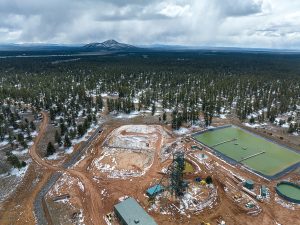
Photo courtesy of Natives Outdoors and Trout Unlimited.

About half are already “mined out” and should be cleaned up. Of the remaining, two or three mines may be able to move forward with new mining.

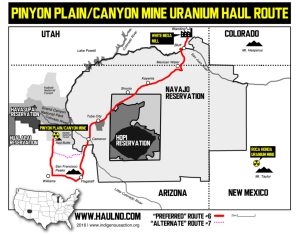
Energy Fuels, a Canadian company, owns the Pinyon Plain uranium mine which was permitted in 1986, also known as Canyon Mine. Pinyon Plain is located a few miles from the south rim of the Grand Canyon in northern Arizona on stolen Forest Service (USFS) lands and within this new monument. Energy Fuels also owns other uranium mines and “projects,” as well as the White Mesa Mill in southeast Utah, the only operating conventional uranium mill in the country. Energy Fuels’ plan is to extract the uranium from Pinyon Plain and transport it to the mill with the majority of the route going through the Navajo Nation.

Haul No! is an Indigenous-led volunteer initiative that is working toward protection of communities around the mine, along the route, and near the mill, by working to shut down the mine. Haul No! was established in 2016 and continues to monitor the mine and spread awareness about Pinyon Plain/Canyon Mine and possible transport.

Despite decades of resistance by the Havasupai Nation, local Indigenous Nations, Coconino County Board of Supervisors, environmental groups, and others, Energy Fuels started new uranium mining at Pinyon Plain on Jan. 8, 2024. As of print, Energy Fuels has not yet started transport. The company is not obligated to inform the public or the Navajo Nation, but communicates with USFS, which has a trust responsibility to all federally recognized tribes. And because the ore is less than 1% uranium, the company does not have to label their transport trucks with radioactive placards.

Energy Fuels has not reached what is considered economically viable or “high-grade uranium ore.” With the price of uranium dropping, it is unknown when or if the company will ever have enough high-grade uranium to start transport. The route to White Mesa Mill is over 300 miles long going through several municipalities and Indigenous homelands.

haulno!.com, indigenousaction.org, 2016.

The Navajo Nation has a law against uranium mining and transport of radioactive materials, but the Nation’s sovereignty is limited. Because the mine is not on Navajo jurisdiction and the route is mostly on U.S. Highways, the Navajo Nation cannot stop the uranium transport. Less than a mile of the route is on City of Flagstaff streets, but even Flagstaff cannot stop transport.

Because Energy Fuels is not required to share information with the general public, and due to the lack of oversight by the USFS and Arizona Department of Environmental Quality (ADEQ), Haul No! visits the mine weekly and is working to inform as many communities as possible in Northern Arizona, reporting to Indigenous communities in person. On multiple occasions, Haul No! has photographed violations by Energy Fuels at the mine and on the route with no repercussions to the company. Haul No! cannot trust the USFS, ADEQ, the colonial governments, or even the Navajo Nation government to regulate or hold the company accountable at the site, along the transport route, and at the mill.

Currently, Haul No! is working to encourage local governments, such as Navajo Nation chapters and Arizona municipalities, to pass resolutions opposing the mine and demanding immediate closure by Arizona governor Katie Hobbs. As of print, there are at least five new resolutions from Navajo Nation entities and the Coconino County Board of Supervisors. These resolutions are new, but opposition to the mine has been strong since the permitting process in the 80s.

As a global treasure and natural wonder of the world, the Grand Canyon has a complex hydrogeological structure and a myriad of places held sacred to at least 13 regional Indigenous Nations. The Grand Canyon national monument is a federal failure. Anyone who has appreciation for the Canyon, for water, and for life altogether can help to put pressure on Governor Hobbs, U.S. Secretary of Agriculture Tom Vilsack, and President Biden by informing them and demanding that this 1872 loophole be closed.

Due to circumstances of climate, uranium pricing, and geopolitics, the current political and economical landscapes lend themselves to a possible new wave of uranium extraction and processing, a 21st century uranium boom. Haul No! intends to stop the pin prick that is Pinyon Plain. Haul No! did not support the national monument, but stands strong in its support for the Havasupai Nation’s continued fight against the mine and the Ute Mountain Ute Nation’s fight against the mill. Haul No! will continue monitoring, spreading awareness, and working toward an end to nuclear colonialism.

For more information visit haulno.com or follow Haul No!’s social media.

— Leona Morgan (she/her) is a Diné organizer and graduate student based in Albuquerque, New Mexico.

Filed Under: Environment, Environmental Justice, Newsletter Archives, Quarterly Newsletter, Uranium Mining

January 18, 2024 by Nukewatch Leave a Comment

Nukewatch Quarterly Winter 2023/2024

Click the links below to access articles from the Winter 2023/2024 Quarterly Newsletter. Page numbers take you to the pdf of each page as they appear in the print version. Individual articles are also tagged by issue category.

Page 1

Tritium Leaks at Monticello Nuclear Reactor: It Ain’t Just Hydrogen

B61-13: Biden Orders Yet Another New H-bomb

Page 2

European Court of Human Rights May Hear Appeals of Nuclear Weapons Protest Convictions

Lawsuit Filed in Rome Against Stationing of U.S. Nuclear Weapons in Italy

Nukewatch at UN Nuclear Ban Treaty Meetings

Page 3

The Weapons Connection

Biden Returns from Israel Empty-Handed

Page 4 

Study Finds Low- Level Radiation Deadlier than Previously Thought Nuclear Industry Pushes Deregulation

Fukushima: Contamination in Spades

Page 5

Renowned Economist on Nuclear Power: “From a business perspective, it’s over. We don’t have the water.”

Nuclear Power’s Magical Thinking Debunked

Page 6

If You Love Nuclear Energy, You’re in Bed with Nuclear Weapons

First Attempt to Build Small Reactors in U.S. Nixed over Cost

Nuclear Power: Uninsurable, Dangerous, Slow, too Expensive

Page 7

Call to Action to Oppose New Nuclear Weapons

Documentary on Radioactive Waste Wins Prize

Nearly Everyone Breathing Polluted Air

Page 8

Owners Want Monticello Reactor to Run 80 Years

Filed Under: Newsletter Archives, Quarterly Newsletter

January 18, 2024 by Nukewatch 1 Comment

Tritium Leaks at Monticello Nuclear Reactor: It Ain’t Just Hydrogen

Concentrations 1, 2, 3, and 4 according to Xcel website. Concentration 5 according to Minn. Public Radio, Apr. 24. Concentrations 6, 7 according to USGS.
By Kelly Lundeen

The word ‘tritium’ dotted regional headlines this year, accompanied by misleading information about the radioactive substance. The March 17, 2023 weekly edition of Monticello Times announced, “400,000 gallons of water contaminated with radioactive tritium leaked from Monticello nuclear power plant.” Again on March 23, the Times followed up, “Xcel, regulators knew of tritium leak four months before notice.” On March 16, the St. Paul Pioneer Press assured the public that “Regulators monitor tritium leak at Xcel Energy’s Monticello nuclear plant.”

The large radioactive water leak at a concentration of 5 million picocuries-per-liter (pCi/L) of tritium was discovered one year ago by the Monticello reactor’s operator, Northern States Power. Four months later a second leak appeared when the fix failed. This forced the reactor to be shut down for a week, prompting regulators to finally release information about the leak to the public.

Xcel claims to have fixed the leak and continues pumping and collecting the radioactive groundwater to store onsite for reuse. The firm is also building a 600-foot underground wall 20 feet from the Mississippi River to prevent the radioactive groundwater from entering the River, even though, on July 20, Minnesota Public Radio warned, “Xcel: Leaked groundwater containing tritium may have reached Mississippi River in Monticello.”

Xcel has dodged questions about how far the radioactive water could have spread. The company claims that no tritium has been detected beyond the reactor facility boundaries, nor entered the Mississippi River, yet it has never specified where its testing is being done. Groundwater moves between 1 foot-per-day and 1 foot-per-decade, but the Mississippi River in Minnesota flows about 12,000 cubic feet-per-second, which could quickly disperse the tritiated water. Groundwater typically provides about 40-50 percent of the surface water to rivers, meaning the contaminated groundwater could have entered the Mississippi without being detected depending on where water is tested.

What is tritium?

What is this radioactive isotope that made headlines in mainstream newspapers? Tritium is a radioactive isotope of hydrogen. Much of the news coverage about the tritium leak at the Monticello reactor is deceptively reassuring. Mainstream media parrot misleading myths about tritium peddled by industry and the Nuclear Regulatory Commission (NRC).

Myth # 1

“Tritium is safe because it is ‘naturally occurring’ in the environment,” Pioneer Press, March 16

While it is true that tritium occurs in nature, its only natural source is in the upper atmosphere. In the chart below you can see that estimated naturally occurring tritium in groundwater — deposited from the upper atmosphere — ranges from 6 to 26 pCi/L. Additional tritium has been dispersed due to atmospheric nuclear weapons tests and routine or accidental nuclear reactor discharges.

Myth #2

“Tritium emits a weak form of radiation, a low-energy beta particle,” NRC

Radiation from tritium is not low-energy, but rather low-range, and its emissions are concentrated in a small space. It can be eight times more biologically damaging than other types of radiation if ingested or inhaled, and can even incorporate into DNA molecules affecting chromosomes.

Myth #3

“Tritium is a mildly radioactive form of hydrogen that occurs naturally,” Minnesota Public Radio, August 17

Tritium atoms replace hydrogen atoms in water molecules making the water itself radioactive. It is not simply water with tritium, it is tritiated water. Once it is part of water it follows the water cycle, traveling through groundwater, absorbed by roots of plants and into our food, or evaporated into the atmosphere and returned to the Earth through precipitation.

The body cannot distinguish clean water from tritiated water, making it more dangerous than other radionuclides. Its capacity to be exchanged with hydrogen gives it the special ability to bind with organic materials in plants, food, humans, and other animals.

Hydrogen is one of the building blocks of the human body and of all life. Humans are about 60 percent water. Tritium, disguised as hydrogen, is therefore more dangerous due to its similarity to hydrogen, not less dangerous. When a fetus is growing, its tissue collects tritium at twice the concentration of maternal tissue.

Around nuclear power facilities, children are the ones who suffer the most. They are about one and a half times more likely to be born with embryonal cancer and have over double the likelihood of childhood leukemia, caused by standard operation alone. That doesn’t include the accidents.

Myth #4

“The tritium radiation does not travel very far in air and cannot penetrate the skin,” NRC

Soil, plants, and food grown near nuclear reactors have been found to be contaminated up to 60 miles from the reactor site. In the case of Monticello, this includes the entire Minneapolis/St. Paul metro area, a population of 4 million people.

Tritium is created as a byproduct in the coolant inside the reactor core. While it may not be able to penetrate skin, there are other points of exposure that make a protective layer of skin irrelevant. Tritium is released legally by regular operation of all nuclear reactors in the form of radioactive water vapor. As long as people living around the reactor breath, the tritium will be inhaled, easily bypassing the skin. It can also be ingested through consumption of food grown around the reactor.

This article would not have been possible without information collected from radiation classes offered by the Gender & Radiation Information Project and Beyond Nuclear. (genderandradiation.org/classes)

— Sources include: Xcel Energy Monticello Groundwater Status and Background, Nov. 21, 2022; Minn. Public Radio, April 24, 2023; United States Geological Society (USGS) National Ground-Water Monitoring Network 2008, 1998; “Treatise on Geochemistry,” Volume 5, 2003, Pages 319-364, published by USGS, 2003

Filed Under: Environment, Newsletter Archives, Nuclear Power, Protect the Water Close Xcel's Monticello Reactor, Quarterly Newsletter, Radiation Exposure

  • « Previous Page
  • 1
  • …
  • 40
  • 41
  • 42
  • 43
  • 44
  • …
  • 222
  • Next Page »

Stay Connected

  • Facebook
  • Twitter

Subscribe

Donate

Categories

  • B61 Bombs in Europe
  • Chernobyl
  • Counterfeit Reactor Parts
  • Depleted Uranium
  • Direct Action
  • Environment
  • Environmental Justice
  • Fukushima
  • Lake Superior Barrels
  • Military Spending
  • Newsletter Archives
  • North Korea
  • Nuclear Power
  • Nuclear Weapons
  • Office News
  • On The Bright Side
  • Photo Gallery
  • Protect the Water Close Xcel's Monticello Reactor
  • Quarterly Newsletter
  • Radiation Exposure
  • Radioactive Waste
  • Renewable Energy
  • Social Issues
  • Sulfide Mining
  • Through the Prism of Nonviolence
  • Uncategorized
  • Uranium Mining
  • US Bombs Out of Germany
  • War
  • Weekly Column

Contact Us

(715) 472-4185
nukewatch1@lakeland.ws

Address:
740A Round Lake Road
Luck, Wisconsin 54853
USA

Donate To Nukewatch

News & Information on Nuclear Weapons,
Power, Waste & Nonviolent Resistance

Stay Connected

  • Facebook
  • Twitter

© 2026 · Nukewatch