Nukewatch

Working for a nuclear-free future since 1979

  • Issues
    • Direct Action
    • Environmental Justice
    • Nuclear Power
      • Chernobyl
      • Fukushima
    • Nuclear Weapons
    • On The Bright Side
    • Radiation Exposure
    • Radioactive Waste
    • Renewable Energy
    • Uranium Mining
    • US Bombs Out of Germany
  • Quarterly Newsletter
    • Quarterly Newsletter
    • Newsletter Archives
  • Resources
    • Nuclear Heartland Book
    • Fact Sheets
    • Reports, Studies & Publications
      • The New Nuclear Weapons: $1.74 Trillion for H-bomb Profiteers and Fake Cleanups
      • Nuclear Power: Dead In the Water It Poisoned
      • Thorium Fuel’s Advantages as Mythical as Thor
      • Greenpeace on Fukushima 2016
      • Drinking Water at Risk: Toxic Military Wastes Haunt Lake Superior
    • Nukewatch in the News
    • Links
    • Videos
  • About
    • About Nukewatch
    • Contact Us
  • Get Involved
    • Action Alerts!
    • Calendar
  • Donate

January 18, 2024 by Nukewatch Leave a Comment

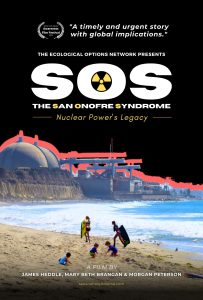
Documentary on Radioactive Waste Wins Prize


Photo:sanonofresyndrome.com/press-kit


By John LaForge

The new documentary film from producer/director Mary Beth Brangan, “SOS – The San Onofre Syndrome: Nuclear Power’s Legacy” [https://sanonofresyndrome.com/], has won the Awareness Film Festival’s Documentary Feature Grand Jury Award — beating the festival’s 100 other documentary entries. Brangan says that the film “chronicles a community’s victory over leaking reactors, only to confront a chilling reality — deadly radioactive waste stranded next to a rising sea. As temporary containers decay, a nationwide crisis emerges, and the race to avert catastrophe becomes a stark countdown against time.” Haled as “a timely and urgent story with global implications,” the film was recently accepted into the next International Uranium Festival to be screened in Rio de Janeiro, Berlin, and eighteen U.S. cities in 2024.

— SOS: info@sanonofresyndrome.com; https://sanonofresyndrome.com

Filed Under: Environment, Environmental Justice, Newsletter Archives, Nuclear Power, Quarterly Newsletter, Radiation Exposure, Radioactive Waste

January 18, 2024 by Nukewatch Leave a Comment

Nearly Everyone Breathing Polluted Air

By John LaForge

New York Times: “According to a pre-pandemic study from the World Health Organization, 98 percent of the world’s population lives in places that do not meet its guidelines for healthy air quality, with emissions from vehicles and heavy industry polluting the air year-round.”

The Guardian Weekly: “Analysis of data gathered using cutting-edge methodology — including detailed satellite images and measurements from more than 1,400 ground monitoring stations — reveals a dire picture of dirty air, with 98% of people living in areas with highly damaging fine particulate pollution that exceeds World Health Organization (WHO) guidelines.

“The WHO says the annual average concentrations of PM2.5 (tiny airborne particles mostly produced by burning fossil fuels and some of which can pass through the lungs and into the bloodstream and affect almost every organ) should not exceed 5 micrograms a cubic meter. The new analysis found only 2% of the population of Europe live in areas within this limit.”

Said Roel Vermeulen, a prof of environmental epidemiology at Utrecht University who led the team of researchers across the continent that compiled the data, “What we see quite clearly is that nearly everyone in Europe is breathing unhealthy air.”

Photo: theguardian.com

— New York Times, June 10, 2023; Guardian Weekly, Sept. 29, 2023

Filed Under: Environment, Newsletter Archives, Quarterly Newsletter

January 18, 2024 by Nukewatch Leave a Comment

Owners Want Monticello Reactor to Run 80 Years

By John LaForge

The 52-year-old Monticello nuclear reactor on the Mississippi River in Minnesota, 38 miles northwest of Minneapolis, is owned by Xcel Energy and operated by Northern States Power.

Fired up in 1971, the General Electric Mark I boiling water reactor is identical to the three Fukushima-Daiichi reactors in Japan that suffered complete core meltdowns and four hydrogen explosions in March 2011, leading to the worst accidental radiation releases in history. (Fukushima is often called the second worst nuclear reactor disaster after Chernobyl, but releases of cesium-137 to the ocean from Fukushima far surpass those of Chernobyl.)

In January 2023, Xcel applied to the U.S. Nuclear Regulatory Commission (NRC) for a second extension to its operating license which, if granted, would allow the unit to run for 80 years. The first extension was granted in 2006, allowing the jalopy to generate radioactive waste until 2030, when it will be 60. Monticello’s second request, called a Subsequent License Renewal Application, or SLRA, is now in progress, and the NRC, like a rubber stamp, has granted nearly every license extension request it has ever entertained.

The process is complex. After the application is submitted, a License Renewal Process and Environmental Scoping meeting is held; then the NRC conducts an Environmental Review, followed by a Site Environmental Audit which was completed in August 2023. Then a Draft Supplemental Environmental Impact Statement is issued (scheduled for Feb. 24, 2024), at which point interested parties and the public have 90 days to submit comments on the relicensing proposal. A public meeting is then held to discuss the Draft SEIS, and then a Final SEIS is issued. Lastly, the NRC issues a decision. The over-worked citizenry can be excused for not keeping up with this voluminous bureaucratic charade, something the industry desperately counts on.

The risks of operating large power reactors long past their designed retirement date is illustrated by what’s called the “bathtub curve.” The curve is a schematic description of when, and how likely, major accidents with machinery can be expected due to long-lasting wear-and-tear. (See diagram)

The “bathtub curve” is a schematic description of when major accidents with complicated machinery can be expected. Most occur early on in a machine’s life, and then toward the end of it after years of wear-and-tear.

The curve shows that in the life of complicated machines like nuclear reactors, accidents often occur early on — due to extreme heat, heavy vibrations, untested electronics, valves, welds, and associated equipment. After the early mishaps and mistakes there is often a period of time when the number of unplanned events decreases, followed by a steady state of proper operation. Then, in later years, the effects of aging damage the reliability of parts and equipment, especially those subject to decades of intense heat, vibration, corrosion, and — in the case of nuclear reactors — neutron bombardment and its “embrittlement” of metal parts and structures.

Because of the recent leak of contaminated wastewater from corroded and failed underground piping, the “effects of aging” are given a lot of attention in Xcel’s license extension application. An October 23 letter by the NRC says its staff participated in a “hybrid audit” of Monticello August 1-3, 2023, and a “virtual audit” August 15-17, 2023. The two audits were required as part of the license renewal application.

Venting is not always good for you

Following the audits, the NRC sent an October 23, 2023 memo to Xcel titled “Requests for Confirmation of Information.” The18-page memo notes that Monticello, “is currently constructing a groundwater remediation storage pond to store the tritiated groundwater that is being collected in response to the tritium leak. The water will either be reused in plant systems or be evaporated from the pond. If pond evaporation is implemented, it will be the third gaseous point for tritium at the plant.”

The public may not realize that radioactive waste gases are routinely released from the reactor to the environment, and that the new holding pond will constitute the third venting point, albeit by evaporation.

Page 6 of the NRC memo says the reactor “currently has two locations of gaseous radioactive effluent discharge: 1. the off-gas stack; and 2. the reactor building ventilation exhaust, both of which are also monitored…. It is an unfortunate fact of nuclear power reactors, that to moderate the operational temperature, pressure, and performance of essential mechanisms, the venting and discharge of radioactive materials to the environment is required. So much for “clean power.”

The October 23 memo also instructed Xcel to provide the NRC with a long list of reports including: “The source, volume, and activity of tritium and other radionuclides (if applicable) released, including how these values were estimated;” “Data that confirm the extent or absence of other radionuclides in groundwater following the November 2022 release;” and “A map showing the location of the holding tank that spilled on May 21, 2023, and estimates of the volume spilled and the tritium activity concentration of the holding tank at the time of the spill.”

How much radiation was released?

The Monticello reactor was forced to make an unplanned shut down in March this year, after Xcel admitted that one or two underground pipes had been corroded and gone un-inspected long enough to leak 400,000 gallons of radioactively contaminated wastewater into the ground. (See Fall 2023 Quarterly.)

The company said last summer that the leaked coolant contained 5 million picocuries-per-liter of radioactive tritium, the radioactive form of hydrogen. A picocurie is a small amount of radioactivity, but 5 million picocuries-per-liter is a very high concentration of tritium.

The 400,000 gallons is equal to 1,514,000 liters. If these 1.5 million liters of radioactive wastewater contained (as Xcel said) 5 million picocuries of tritium-per-liter (5,000,000 X 1,500,000 liters), then approximately 7.57 trillion picocuries of tritium were leaked to groundwater near the Mississippi River. This is equal to 7.57 curies of tritium, and a curie is a very large amount of radioactivity. (The partial meltdown at Three Mile Island in 1979 is officially reported to have vented 15 curies of radioactivity and is considered one of the worst radiation accidents in U.S. history.)

Dr. Arjun Makhijani, president of the Institute for Energy and Environmental Research, says in his new book Exploring Tritium’s Dangers, “one teaspoon of tritiated water would contaminate about 100 billion gallons of water to the U.S. drinking water limit….” We are left to wonder about the vast volume of groundwater that’s been contaminated with Monticello’s 400,000 gallons of tritiated water.

Repaired pipes same as the leaking pipes

Answering questions from the NRC about its extended license application, Xcel wrote on October 13 that it must demonstrate to the NRC that it is “managing the effects of aging,” and in particular must investigate the function “of structures and components” that the NRC has said “require review.” Monticello’s leaking pipes fit this bill.

The company notes that “New and replacement coatings for underground components” must meet required standards, and Xcel reported that “Existing coatings for underground components at MNGP [Monticello] were installed per site design specifications.”

This claim is dashed by the sentence that follows it: “Site design specifications did not require coatings on underground components…” So, the replacement pipes were uncoated like the originals, and yet the company dares to ask permission to push the reactor’s operating life another 28 years, until 2050. What could go wrong?

Filed Under: Environment, Newsletter Archives, Nuclear Power, Protect the Water Close Xcel's Monticello Reactor, Quarterly Newsletter, Radioactive Waste

November 1, 2023 by Nukewatch Leave a Comment

Nukewatch Quarterly Fall 2023

Click the links below to access articles from the Fall 2023 Quarterly Newsletter. Page numbers take you to the pdf of each page as they appear in the print version. Individual articles are also tagged by issue category.

Page 1

Xcel’s 52-Year-old Monticello Reactor Leaking Radiation
No Accident: Japan’s Planned 40-Yr Dumping of Radioactive Wastewater

Page 2

White House Sending DU Weapons to Ukraine
How Weapons Makers Influence the Ukraine War Debate

Page 3

U.S. H-bombs May Return to Britain 
Nuclear Subs to Each Cost Over $15 Billion
Supreme Court Decision Forces Roll-Back of Wetlands Protections
Florida Gov. Approves Radioactive Mining Waste in Road Building
Atomic Veterans Dying, as VA and Supreme Court Deny Benefits
U.S. Disregards Marshall Islands, Senate Approves RECA Expansion

Navy Contamination “Lower than Zero”
Nuclear Fairytales

Page 4 

Organizations Increasingly Condemn Nuclear Weapons ‘Sharing’ in Europe

Page 5

Confronting “Nuclear Sharing”
“Wake Up Justice!” Protest Rallies Aimed at Court Inaction

Page 6

Senate Extends Reactor Insurance Handout With No Public Scrutiny
Cancer Spike Near Nuclear Fuel Services, Inc. in Tenn.

Page 7

Illinois Governor Vetoes Dangerous Nuclear Moratorium Repeal Bill
New National Monument May Protect Sacred Lands
Federal Appeals Court Strikes Down NRC License for Parking Lot Dump
Two Holtec Radioactive Waste Dumps Thwarted
Medical Journals Call for Disarmament
Nukewatch on Democracy Now!

Page 8

Before Hiroshima & Nagasaki there was Shinkolobwe
The Missing Link Event: A battle for justice and reparations of Shinkolobwe’s negative uranium legacy
Above and Below the Mushroom Cloud

Filed Under: Newsletter Archives, Quarterly Newsletter

November 1, 2023 by Nukewatch Leave a Comment

Xcel’s 52-Year-old Monticello Reactor Leaking Radiation

Monticello Nuclear Station on the Mississippi River. Photo: KSTP.com.
By John LaForge

A damaged and leaking three-inch pipe at Xcel Energy’s single reactor at Monticello, Minnesota on the Mississippi River, is causing a radioactive pollution problem.

Last November, radioactive tritium leaking from the 52-year-old unit was found in a company’s onsite monitoring well. Xcel waited until mid-March to report the month-long 400,000-gallon leak. Inspectors from the Nuclear Regulatory Commission (NRC) just winked at the company’s four-month delay in reporting the leak. Xcel soon claimed to have plugged the leak.

The Associated Press (AP) reported that in November the concentration of tritium “was about 5 million picocuries per-liter” in groundwater within the company’s boundaries, according to Xcel’s website. This is 250 times the amount (20,000 picocuries per liter) of tritium legally permitted in drinking water. After claiming the leak to be fixed, Xcel reported a second leak of several hundred gallons of tritium-contaminated water which the firm said had sprung from an overflow tank used to collect the first leaked wastewater.

Originally licensed in 1971 to operate 40 years, Monticello was designed to close in 2010. Yet the NRC issued Xcel a license extension in 2006, allowing it to run until September 2030.

Monticello’s aged pipes, like 23 other Fukushima-style, General Electric Mark I reactors operating in the United States, are worn out and corroded — a chronic, nationwide hazard. “Radioactive tritium leaks found at 48 U.S. nuke sites,” was a headline in a four-part AP investigative series titled “Aging Nukes,” written by Jeff Dunn in 2011. “You got pipes that have been buried underground for 30 or 40 years, and they’ve never been inspected, and the NRC is looking the other way,” engineer Paul Blanch (who had worked for the industry and later became a whistleblower), told Dunn. “They could have corrosion all over the place,” Blanch said.

The Star Tribune reported June 17 that, “Tritium leaks unfortunately have been relatively common in the nuclear industry, and the Monticello spill was among the nation’s 10 largest.”

NRC public affairs officer Prema Chandrathil replied August 10 to some questions from Nukewatch, writing, “The now-stopped leak was from a pipe that ran between two buildings on site where the water had already been processed, filtered, and demineralized.” Asked if there were other radioactive materials in the wastewater, Chandrathil wrote, “When the leak was going on there were low levels of xenon and iodine detected near the leak. They decay away and become non-radioactive quickly due to their short half-life. Therefore, tritium is the only type of radioactive material currently present in the groundwater.”

This answer is suspect. Iodine-125 has a 60-day half-life, and, because it takes ten half-lives to “decay away,” its gamma radiation spews for 600 days. Iodine-129 has a half-life of 16 million years. If the NRC official meant iodine-131 — Chandrathil didn’t specify — that isotope decays for 80 days. Neither does xenon-137 just “decay away” as the NRC public affairs officer said. It decays to cesium-137 which takes 300 years to “decay away.” Again Chandrathil didn’t report which isotope of xenon was leaking, Xe-133, Xe-137, or some other.

The Minn. Dept. of Health website report on this event notes, “A conservative assumption in radiation protection is that any radiation exposure could result in an increase in cancer occurrences in the population, with the risk increasing as exposure increases.” However Xcel has said there is “no” health risk to the public as the affected groundwater contains “very low levels” of tritium.

This reassurance is untrue. Even “very low levels” of radiation exposure create a risk as the Health Dept. noted. Radiobiologists all agree that we can no longer speak of a ‘safe’ radiation dose level. And every federal agency that regulates industrial releases and medical uses of ionizing radiation warns that exposure to radiation (external or internal), no matter how small, increases one’s risk of cancer and other illnesses. For example, the Environmental Protection Agency says, “There is no firm basis for setting a ‘safe’ level of exposure above background ….”, “Based on current scientific evidence, any exposure to radiation can be harmful (or can increase the risk of cancer). …. no radiation exposure is completely risk free.” And “[T]here is no level below which we can say an exposure poses no risk.”

Tritium emits ‘beta’ radiation in the form of fast- moving particles, and several sources misreported related facts. The Minn. Dept. of Health said July 21, that beta particles “are too weak to penetrate the skin,” and the AP reported last March 17 that tritium’s beta radiation “cannot penetrate human skin.”

The Environmental Protection Agency and many other authorities say beta particles are “more penetrating than alpha particles,” and “are capable of penetrating the skin and causing radiation damage.” Dr. Rosalie Bertell in her book No Immediate Danger says beta particles can cause serious burns and other skin anomalies, including skin cancer. If beta particles are inhaled or ingested, they can cause biological damage more severe than external exposure inflicts because they can penetrate cell membranes.

In an apparent admission that Xcel has lost control of the underground radioactive plume moving toward the Mississippi, the firm announced August 17 that it would build an “underground metal barrier” between the leaking pipe(s) and the river. Xcel said the steel wall — 40-feet deep and 600 feet long — will take four to eight weeks to install “along the edge of the plant’s boundary with the river,” and is intended to keep Monticello’s contaminated groundwater from reaching the Mississippi River. Authorities have not reported whether the groundwater plume is deeper than 40 feet.

One grim irony of Xcel’s underground wall is that at Japan’s Fukushima-Daiichi — where three identical GE reactors, were destroyed by earthquake damage and meltdowns — the owners tried to retard the flow of groundwater by constructing an underground wall. The Japanese effort failed even after a $250 million investment. In addition, like at Fukushima where huge steel tanks currently store 1.37 million tons of contaminated wastewater, Xcel said last March that it was “considering building above-ground storage tanks” for its radioactively tainted leaks.

— CBS News, Aug. 18; Utility Dive, Aug. 28, 2023

Filed Under: Environment, Newsletter Archives, Nuclear Power, Protect the Water Close Xcel's Monticello Reactor, Quarterly Newsletter

  • « Previous Page
  • 1
  • …
  • 44
  • 45
  • 46
  • 47
  • 48
  • …
  • 223
  • Next Page »

Stay Connected

  • Facebook
  • Twitter

Subscribe

Donate

Categories

  • B61 Bombs in Europe
  • Chernobyl
  • Counterfeit Reactor Parts
  • Depleted Uranium
  • Direct Action
  • Environment
  • Environmental Justice
  • Fukushima
  • Lake Superior Barrels
  • Military Spending
  • Newsletter Archives
  • North Korea
  • Nuclear Power
  • Nuclear Weapons
  • Office News
  • On The Bright Side
  • Photo Gallery
  • Protect the Water Close Xcel's Monticello Reactor
  • Quarterly Newsletter
  • Radiation Exposure
  • Radioactive Waste
  • Renewable Energy
  • Social Issues
  • Sulfide Mining
  • Through the Prism of Nonviolence
  • Uncategorized
  • Uranium Mining
  • US Bombs Out of Germany
  • War
  • Weekly Column

Contact Us

(715) 472-4185
nukewatch1@lakeland.ws

Address:
740A Round Lake Road
Luck, Wisconsin 54853
USA

Donate To Nukewatch

News & Information on Nuclear Weapons,
Power, Waste & Nonviolent Resistance

Stay Connected

  • Facebook
  • Twitter

© 2026 · Nukewatch