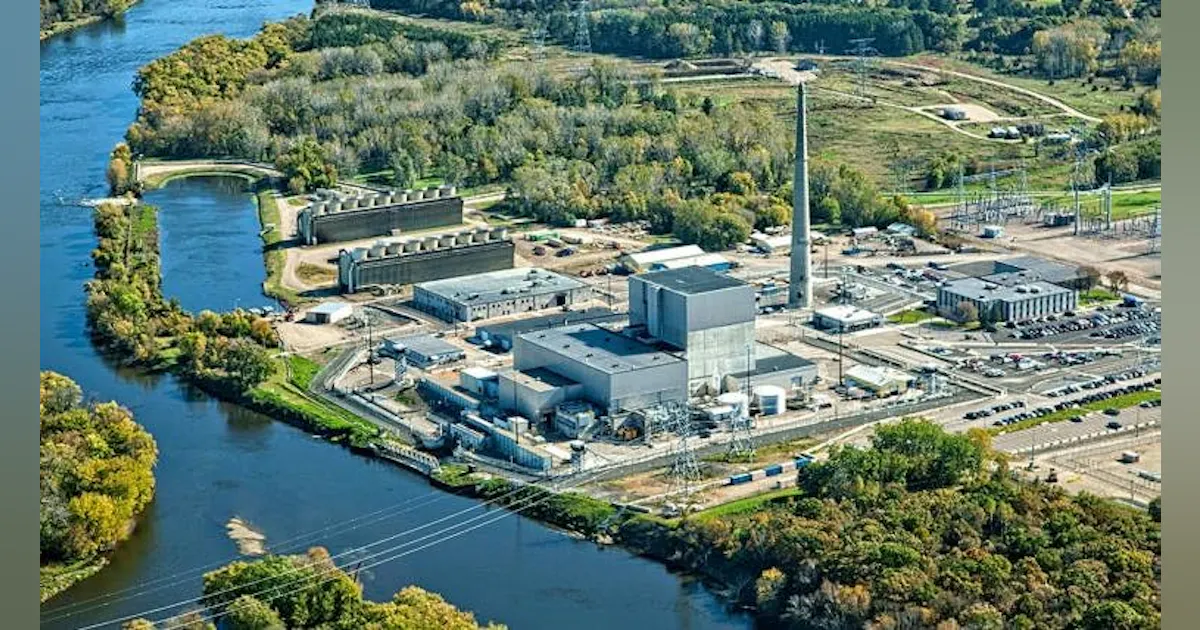
Editor’s note: A look into archives of Minneapolis papers from the 1970s shows that the Monticello reactor has poisoned the Mississippi River in the past, and one of its spills was so radioactive that Minneapolis shut down its drinking water intake from the river. Verbatim transcripts from the papers follow.
NSP to delay atom discharges
The Minneapolis Star, Wed., Nov. 24, 1971, p.23
Northern States Power Co. [now Xcel] has tentatively agreed to hold up on any future unexpected discharge of radioactive water from its Monticello nuclear power plant until state agencies can analyze the water, a Minnesota Health Department official said today.
Russell Frazier, chief of the laboratory analytical services of the department, said the agreement with NSP on future procedures was made after what he termed “the high drama which accompanied the release of a minor amount of radioactivity from the Monticello reactor.”
Frazier said NSP has tentatively agreed to notify the state health department and the Minnesota Pollution Control Agency.
He said that there was confusion and a lack of data last weekend when NSP decided to drain about 50,000 gallons of low-level radioactive water from the Monticello plant into the Mississippi to permit the repair of a loose baffle.
Fraizer said a “purely precautionary decision” was made by health officials and the Minneapolis Water Department to shut down the city water intake pump, which supplies drinking water to the city at a point about 30 miles downstream from Monticello.
“The action is no way a measure of the importance to be attached to the Monticello release,” he said.
Radioactive discharge fits state standards
The Minneapolis Star Tribune, Tue., Dec. 21, 1971, p.16
Northern States Power (NSP) Company’s Monticello nuclear plant Monday discharged 8,500 gallons of radioactive water that met state standards for the isotope cesium 137.
The 4 p.m. release, object of a week-long dispute between the firm and the Minnesota Pollution Control Agency (PCA), was analyzed twice by PCA and Minnesota Health Department scientists.
First it was found to contain 4.1 microcuries of cesium 137, and then 5.7 microcuries. But an average of the two tests, 4.9 microcuries, fell below the state’s weekly maximum limit of 5.3 microcuries for the isotope, said Grant Merritt, PCA director.
The discharge came after NSP exchanged the water within the plant to produce a “cleaner” release. Earlier, PCA measurement had shown the cesium 137 to be about twice the amount allowed by the disputed state standards, although well below limits set by the U.S. Atomic Energy Commission (AEC).
PCA technicians today hope to sample a second batch of about 6,500 gallons that NSP says also must be discharged as part of a maintenance procedure.
Since NSP earlier said it would not discharge within 48 hours after a sample is taken, PCA officials said the second batch isn’t expected to be released before Thursday.
An NSP spokesman confirmed yesterday’s release but would not answer questions about the sampling or timing of the second discharge.
Merritt maintains that NSP earlier committed itself to meeting state standards, even though federal courts thus far have held that only AEC regulations apply to nuclear plants. The state restrictions on cesium 137 are from 100,000 to 100 million times more stringent than those of the AEC.
A-water released by NSP
The Minneapolis Star, Wed., Dec. 29, 1971, p.29
Five thousand gallons of radioactive water were released from the Monticello nuclear power plant into the Mississippi River today, according to a spokesman for the Northern States Power Co.
A Minnesota Pollution Control Agency spokesman said tests of the water showed that the levels of radioactive cesium-137 were 45 percent below state standards.
The PCA spokesman said overall radiation in the water was even lower than that.
The water is the second of two discharges NSP said it needed to make because of modification and maintenance work being done at the nuclear plant.
PCA officials had managed to get the first discharge delayed while they investigated radiation levels.
By splitting the discharge into two batches and waiting a week before letting the second one go, NSP was able to keep radiation levels below rigid state weekly standards.
Today’s discharge began at 6 a.m. and an [NSP] spokesman said it normally would take five hours.