Nukewatch

Working for a nuclear-free future since 1979

  • Issues
    • Direct Action
    • Environmental Justice
    • Nuclear Power
      • Chernobyl
      • Fukushima
    • Nuclear Weapons
    • On The Bright Side
    • Radiation Exposure
    • Radioactive Waste
    • Renewable Energy
    • Uranium Mining
    • US Bombs Out of Germany
  • Quarterly Newsletter
    • Quarterly Newsletter
    • Newsletter Archives
  • Resources
    • Nuclear Heartland Book
    • Fact Sheets
    • Reports, Studies & Publications
      • The New Nuclear Weapons: $1.74 Trillion for H-bomb Profiteers and Fake Cleanups
      • Nuclear Power: Dead In the Water It Poisoned
      • Thorium Fuel’s Advantages as Mythical as Thor
      • Greenpeace on Fukushima 2016
      • Drinking Water at Risk: Toxic Military Wastes Haunt Lake Superior
    • Nukewatch in the News
    • Links
    • Videos
  • About
    • About Nukewatch
    • Contact Us
  • Get Involved
    • Action Alerts!
    • Calendar
  • Donate

April 18, 2024 by Nukewatch Leave a Comment

Latest Litany of Accidents at WIPP

By Lindsay Potter

The Waste Isolation Pilot Plant, the nation’s only permanent repository for radioactive waste from nuclear weapons production, is a network of 2,000-foot-deep caverns in a salt bed roughly 30 miles east of Carlsbad, New Mexico. In its 35 years of operation, WIPP has been plagued by accidents and mishandlings resulting in radioactive releases and contamination of the land, air, and workers, requiring temporary work stoppages. One radioactive catastrophe and explosion of improperly packed rad waste in 2014 caused a dangerous level of contamination causing work to be paused for several years. A new shaft, like four others already at WIPP, had to be designed to increase air flow and create access to additional cavern space. The $100 million new shaft, in tandem with a $470 million renovation of the ventilation system, plan to triple the “air capacity…allowing maintenance, mining, and waste operations to occur simultaneously,” according to the Carlsbad Current-Argus.

WIPP recently won a 10-year permit renewal, effective Nov. 3, 2023, nullifying its original 2024 closure. However, reports of three accidents during the new shaft construction within roughly one month last fall led to a temporary stop work order. In October, a swinging skid steer collided with the scaffolding platform of the shaft. In two incidents in November, a rigging cable snapped in the shaft, in one case causing the loading “basket” to sail 2,000 feet to the mine’s floor. Work began again on December 16. — Carlsbad Current-Argus, Jan. 26 and Jan. 3, 2024; Nuclear Newswire, Oct. 12, 2023


nuclearactive.org

Filed Under: Newsletter Archives, Quarterly Newsletter, Radioactive Waste

April 18, 2024 by Nukewatch 2 Comments

Fukushima After Meltdowns: 13 Years of Accidents, Quakes, Insults

By John LaForge

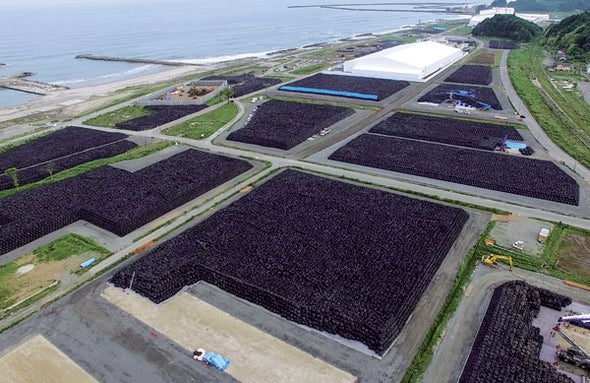
The catastrophic earthquake, tsunami, and triple reactor meltdowns that struck northeast Japan at Fukushima in March 2011 began a pollution disaster that keeps growing and surprising. The following updates show the worst-ever reactor incident is still a present tense event. Even without going into the 20 million tons of radioactive debris piled in mounds of bags at 100,000 Japanese sites, failing plastic containers holding corrosive nuclear sludge produced by the wastewater filter system, or airborne dispersal of hot particles from incinerators all across Japan burning Fukushima debris, this issue’s update is still over-long. China and Russia have banned all Japanese seafood imports after Japan began disposing of contaminated wastewater in the Pacific. Between the deliberate dispersal of radioactive wastes and accidental spills and leaks, all in the most earthquake-prone country on Earth, the dreams of clean, cheap nuclear power turn to nightmares immediately upon waking.

Students in Seoul, South Korea shaving their heads to protest the wastewater dump. Indonesian activists sued the Japanese government. Photo: CNBC 2021.
Still Finding Broad Contamination of Wild Foods

Edible mushrooms found in Narusawa village in Yamahashi prefecture, 227 miles from the Fukushima meltdowns, were found with high levels of radioactive cesium, according to Japan’s Ministry of Health, Labor, and Welfare. The ministry also reported higher-than-permitted contamination of edible plants in three other prefectures between 86 and 292 miles from Fukushima. The mushrooms in Narusawa had 50% more cesium-137 than permitted by regulations. The United States is more at ease with people eating cesium-137 than Japan, allowing twelve times as much in food, and doesn’t make an exception for baby food. Radioactive cesium was released in large amounts during the three reactor meltdowns at Fukushima.— Japan Ministry of Health, Labor and Welfare, Dec. 2023; The (Malaysia) STAR, China.org, and Xinhua news, Nov. 7, 2023

January Earthquake Overstressed Reactors

The severe magnitude 7.6 earthquake that struck western Japan January 1, killing 82 and leaving 31,000 homeless, shook and “inflicted stress” on parts of two nuclear reactors that “exceeded the limit” of their design capacity, Japan’s Nuclear Regulation Authority said in a report. Both reactors at Shika in Ishikawa Prefecture on the west coast were offline when the quake struck, but Shinsuke Yamanaka, chief of the NRA, told reporters that jolts from undersea seismic faults which triggered the quake “must be factored in as new knowledge” when updating safety standards. Yamanaka urged operator Hokuriku Electric Power Co. to find out why the Shika reactors’ electric transformers have both broken down and have “partially prevented the [reactors] from receiving power.” The earthquake and tsunami-caused loss of offsite power at Fukushima-Daiichi in March 2011 resulted in the collapse of cooling systems and the catastrophic meltdown of three large reactors there. Japan’s 54 reactors are all on its coastline and vulnerable to earthquakes which strike its islands nearly every day. — The Guardian, Jan. 1; Kyodo News, Feb. 21, 2024; World Data Info.

‘Cleanups’ See Radiation Leaks and Spills

According to Tokyo Electric Power Company (Tepco) which still operates the Fukushima site, ten of 16 valves mistakenly left open by workers spewed some 5.5 metric tons of highly radioactive wastewater onto the site in early February. The leak sprang from machinery used to remove radioactive cesium and strontium from wastewater severely contaminated after it passes through hundreds of tons of melted reactor fuel called “corium” amassed deep within the three destroyed Fukushima reactors. Tepco, the only source reporting on the incident, later claimed that only 1.5 tons had spilled. An accident in October contaminated four workers who were sprayed with radioactive wastewater when a hose broke.

These wastewater accidents were international scandals and forced Japan’s industry minister Ken Saito to make a face-saving spectacle out of publicly shaming Tepco president Tomoaki Kobayakawa. On Feb. 21, the minister demanded more “safety awareness and preventive measures.” Minister Saito even told Kobayakawa to investigate the accidents. The Tepco exec. dutifully apologized to the minister, as reporters took notes on the theatrical scolding. — Associated Press, Feb. 21; China Global Television Network, Feb. 16; NHK, Japan Public TV, Feb. 14; Reuters and China Daily, Feb. 7; New York Times and Reuters, Feb. 1, 2024

Preparation work to release radioactive water at Fukushima January 19, 2023. /CFP. news.cgtn.com.
Japan’s Illegal Radioactive Dumping

Writing for Counterpunch last September, Robert Hunsiker noted two ways that Japan’s disposal of radioactive wastewater in the Pacific violates the law. First, the long-time president of the Institute for Energy and Environmental Research Arjun Makhijani is quoted regarding the failure of the International Atomic Energy Agency (IAEA) to enforce its global regulations. Makhijani writes, “[The IAEA’s] outright refusal to apply its own guidance documents … [and] Its constricted view of the dumping plan has allowed it to evade its responsibilities to many countries. Its eagerness to assure the public that harm will be ‘negligible’ has been carried to the point of grossly overstating well-known facts about tritium.”

Second, Hunziker cited an article by Victoria Cruz-De Jesus in the American University International Law Review, quoting: “Japan’s policy to release wastewater into the Pacific Ocean constitutes a violation of Japan’s obligations under UNCLOS Article 192, which requires state parties to ‘protect and preserve the marine environment.’ Additionally, Japan’s pollution of the marine environment from land-based sources violates UNCLOS Article 207.” Hunziker concluded Japan could have pursued options which complied with “some of its treaty obligations … but ultimately settled for the cheapest, easiest, most convenient, yet most harmful, policy.” — Robert Hunsiker, Counterpunch, Sep. 8, 2023

Warnings About Failed Water Treatment

Tatsujiro Suzuki is the vice director of the Research Center for Nuclear Weapons Abolition at Nagasaki University and one of Japan’s premier experts on nuclear power. He spoke to South Korea’s Hankyoreh English daily on Feb. 20, and said in part: “… in August 2018, Japanese media reported that around 70% of the [“treated”] water stored in tanks at Fukushima contained higher-than-permitted levels of cesium, strontium, and iodine, which are extremely harmful to the body. I was genuinely shocked. Tepco had persistently claimed that they had reduced the level of radionuclides … it’s essential that we treat the water in those storage tanks a second time.” Suzuki also pointed out that “there was no study done on the potential environmental impact,” and despite an “IAEA report that declared that the ‘treated water would have a negligible radiological impact to people and the environment,’” the IAEA did not “recommend or support” the Japanese dump plan in “any way.”

Ken Buesseler of Woods Hole Oceanographic Institution wrote: “[I]n 2018, Tepco … announced for the first time that the tanks also contain concerning levels of other, more harmful radioactive materials such as cobalt-60 and strontium-90, which are much more likely to end up on the seafloor or be taken up by sea life … [the] data we have … come from a fraction of the tanks — about 200 — and don’t include other potential contaminants, such as plutonium.” — Hankyoreh English, South Korea, Feb. 21, 2024; Ken Buesseler, Woods Hole Oceanographic Institution, Knowable Magazine, March 11, 2021

Japanese Court to Hear Lawsuit Vs Dumping

The case Citizens v. Tepco and the State of Japan was filed in Fukushima District Court in September last year. In it, 151 citizens appeal for an injunction to halt the release. Last November, more citizens including people from the fishing industry joined the suit. Among the claims of the plaintiffs is that the massive releases violate Article 4 of the “Protocol to the London Convention on the Prevention of Marine Pollution by Dumping of Wastes.” Article 4 prohibits the “dumping” of wastewater into the sea, and the plaintiffs argue that the law applies to disposing of any and all radioactive waste in the oceans, including from pipelines. The legal dilemma is that pipelines pump radioactive wastes into the sea, but Article 4 prohibits “dumping” as it was practiced during the Cold War by rolling barrels from ships. — Grace Nishikawa and Dr. Marlies Hesselman, Blog of the European Journal of International Law, Jan. 16, 2024

“The Pacific Sub-Regional Polynesia Leaders Group meeting, 52nd Pacific Islands Forum. From Left: Secretary General – Henry Puna, Niue Premier – Dalton Tagelagi, Cook Islands Associate Minister Foreign Affairs – Tingika Elikana, Samoa Prime Minister – Fiamē Naomi Mataʻafa, President of French Polynesia – Moetai Brotherson, American Samoa Governor – Lemanu Maunga, Wallis and Futuna President – Munipoese Muli’aka’ak, Tuvalu Prime Minister – Kausea Natano, Tonga Prime Minister – Hu’akavemeiliku Siaosi Sovaleni. MELINA ETCHES.” Nov. 7, 2023, Cook Islands News.
Pacific Island States Condemn Disposal

The Polynesian bloc called for a pause in Japan’s dumping of radioactive wastewater during the 52nd Pacific Islands Forum Leaders Meeting in Cook Islands last November. The bloc includes Niue, Cook Islands, Samoa, American Samoa, French Polynesia, Wallis and Futuna, Tuvalu, and Tonga. The Pacific Islands Forum has consistently objected to Japan’s ocean dumping. The Forum also includes Australia, Federated States of Micronesia, Fiji, Kiribati, Nauru, New Caledonia, New Zealand, Palau, Papua New Guinea, Republic of Marshall Islands, Solomon Islands, and Vanuatu. In June 2023 the Forum declared Japan’s sanctioned pollution of the Pacific “is not merely a nuclear safety issue. It is rather a nuclear legacy issue, an ocean, fisheries, environment, biodiversity, climate change, and health issue with the future of our children and future generations at stake.” — Cook Islands News, Nov. 7; China Global Television Network Jun. 27, 2023.

Filed Under: Environment, Environmental Justice, Fukushima, Newsletter Archives, Nuclear Power, Quarterly Newsletter, Radioactive Waste

January 18, 2024 by Nukewatch Leave a Comment

Fukushima: Contamination in Spades

By John LaForge
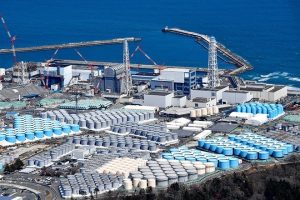
Over 1.3-million tons of wastewater contaminated with dozens of radioactive chemicals left from cooling three reactor core meltdowns stored in tanks at Fukushima Daiichi, in Japan.
Japan’s oceanic pollution launched to wide protest

In August, Tokyo Electric Power Co. (Tepco) began pumping some of its partially treated wastewater into the Pacific Ocean, raising loud international protests and prompting bans on importation of Japanese fish that may last the 30 or 40 years it will take to dump all the waste. China and four other Pacific Rim countries fully banned imports of fishery products from Japan from Aug. 24, when the wastewater discharge started.

Over 1 million tons of radioactive wastewater have accumulated in huge tanks at Fukushima. It is collected after groundwater and cooling water has poured over or run through the 900 tons of melted reactor fuel wreckage now lost somewhere under the three destroyed reactors.

Tepco said October 24 that its dumping of the second, 7,800-ton batch of radioactive wastewater was finished. According to Japan Today, Tepco plans to release 31,200 tons of the wastewater by the end of March 2024. This would drain merely ten of the 1,000 huge tanks of the waste that were built onsite since the earthquake/tsunami/meltdown catastrophe began in March 2011. Due to the need to continually cool the melted reactor cores, mass collection of radioactive wastewater will continue indefinitely.

Meltdown fallout and wastewater dumping prompt major seafood import bans

The operators of the destroyed Fukushima-Daiichi reactors intend to disperse over 1.34 million tons of the wastewater over the next 30 to 40 years, after convincing the government and international observers that the practice would have a “negligible” impact on sea life and human health. Fifteen countries have maintained import restrictions on Japanese fish and other seafood from heavily contaminated areas. According to Food Navigator online, five with the strictest bans are geographically close to Japan and fiercely opposed to the waste dumping. They are South Korea, Taiwan, China, Hong Kong, and Macau. Ten others — Indonesia, French Polynesia, the U.S., the European Union (27 states), Iceland, Switzerland, Norway, Liechtenstein, Russia, and Singapore — require certification, inspections, etc. before allowing imports. China’s ban has had a serious impact on Japan’s fishery.

According to the BBC, China imported over 100,000 tons of scallops from Japan last year. The South China Morning Post reports that China, had been the world’s biggest buyer of Japanese seafood, but “says its ban is due to food safety fears.”

Third round of wastewater dumping protested

In November, Tepco began its third deliberate discharge of radioactive wastewater into the Pacific Ocean. The group Korean Peoples’ Action Against Japan’s Ocean Dumping of Radioactive Wastewater said problems with the wastewater include clogged wastewater filters and an increase in the concentration of radioactive material in the third discharge compared to the second. Likewise, the Pacific Collective on Nuclear Issues, composed of civil society groups, NGOs, and others in the Pacific region, said in a statement, “If the Japanese government and Tepco believe the radioactive wastewater is safe, they should be prepared to safely dispose of it within terrestrial Japan.”

The Collective also reminded the November 8 meeting of Pacific Island Forum states that the panel of scientific experts commissioned by the Forum found that “data provided so far, to support Japan’s claim that the treated wastewater is safe, is inconsistent, unsound, and therefore far from reliable.”

One-ton bags of cesium-contaminated waste full of cesium-contaminated waste scraped from areas around the Fukushima complex are now stacked in thousands of places, some near the ocean where the waste is vulnerable to being dispersed by storm surges and tsunamis. Today there are over 19 million such bags stacked in tens of thousands of locations. AP photo.
Wastewater accident contaminates five workers

Tepco has reported that five workers “accidentally” came in contact with radioactive “fluid” while cleaning discharge systems pipelines, and two of them were contaminated enough to be kept under medical observation, China Daily reported November 6. According to Tepco, a doctor said there was a possibility the two men sustained burns due to radiation exposure, and that the radiation levels in the bodies of the two men were above the company’s allowable threshold. The paper, which has been highly critical of Japan’s wastewater discharging, demanded to know: “[S]ince four of the five workers ‘were wearing protective gear and full-face masks, which prevented ingestion of the fluid,’ how could the ‘fluid’ splash and burn the ‘lower body and both arms’ of one of them, and why the other worker, whose ‘entire body was found to be exposed,’ was allowed to do the dangerous work without wearing any protective gear?” The Daily’s editors said the “Accident proved Japan’s toxic water plan dubious.”

Faulty editors paste “safety” over risky wastewater discharge

“IAEA confirms safe tritium levels in latest ALPS treated water release at Fukushima,” was the November 7 headline Nuclear Engineering International magazine used in its report on Tepco’s wastewater dumping. Yet the article itself had no such confirmation. IAEA experts monitoring the discharge only said that the concentration of radioactive tritium in the waste was “far below Japan’s operational limit.” Nowhere did the word “safe” appear. The article itself is factually accurate since there is no safe level of radioactive contamination, regardless of how small the amount. It was the editors that have put words into the IAEA’s mouth and turned the reporter’s story into a lullaby.

Area forests are a re-contamination source

Jim Smith, a Professor of Environmental Science at the University of Portsmouth, wrote in The Conversation, October 23, that “Radiocaesium [cesium-137], which is the most important long-lived radioactive element emitted by the accident in terms of radiation dose, adheres to soil particles very strongly. Consequently, the decontamination of agricultural land primarily involved removing the top 5cm [about 2 inches] of topsoil. In urban areas, decontamination efforts entailed the removal of soil from sports fields”, school yards and other public areas.

As much as 71% of Fukushima Prefecture is covered by forest, and most of it remains contaminated. “Restrictions on the consumption of forest products have lasted for decades following the 1986 Chernobyl incident. And they are expected to persist in many forested areas of Fukushima too,” Prof. Smith wrote. Rainwater runoff from these forests creates routine downstream re-contamination of previously decontaminated areas. Additionally, forest fires can redistribute radioactivity still on trees and the forest floor creating inhalation risks.

Japanese minister under fire for calling wastewater ‘contaminated’

In an August 31 “slip of the tongue,” Japan’s Fisheries Minister Tetsuro Nomura publicly said Tepco was dumping “contaminated water” into the Pacific. As the waste is poisoned with four dozen radioactive chemicals due to the failure of Tepco’s filtration system known as ALPS, the minister was merely stating a fact. He was attacked in the press and by politicians for the “error” in not referring to “treated” water, and had to publicly apologize for the “gaffe” after being scolded by Prime Minister Fumio Kishida.

Filed Under: Environment, Fukushima, Newsletter Archives, Nuclear Power, Quarterly Newsletter, Radioactive Waste

January 18, 2024 by Nukewatch Leave a Comment

Renowned Economist on Nuclear Power: “From a business perspective, it’s over. We don’t have the water.”

Photo: Wall Street Journal, “Europe’s Key Rivers Fall to Critical Levels, Aggravating Energy Crunch.”

Jeremy Rifkin is the economic and social theorist, writer, activist, public speaker, political advisor to the European Union, and author of 23 books about the influence of scientific and technological changes on the economy, the workforce, society, and the environment.

At an annual investors’ meeting of Germany’s Wermuth Asset Management Group in October 2013, Rifkin was asked his opinion of nuclear power in view of climate change.

Rifkin said, “Frankly, I think from a business perspective it’s over. Let me explain why …

“No. 1: … There are only 400 nuclear power plants [436 in 2023]. These are old nuclear power plants, but our scientists tell us [that] to have a minimum impact on climate change — which is the whole rationale for bringing this technology back — nuclear would have to be 20 percent of the energy mix to have the minimum, minimum impact on climate change, not six percent of the mix [10% in 2023]. That means we’d have to replace the existing 400 nuclear plants and build 1,600 additional plants — three nuclear plants have to be built every 30 days for 40 years to get to 20 percent — and by that time climate change will have run its course for us. So I think, from a business point of view, I just don’t see that investment. I’d be surprised if we replace 100 of the 400 existing nuclear plants which would take us down to 1 or 2 percent of the energy [mix].

“No. 2: We still don’t know how to recycle the nuclear waste and we’re 70 years in. We have good engineers in the United States. We spent 18 years and $8 billion building an underground vault in Yucca Mountain to store the waste for 10,000 years, but we can’t use it. It’s already no good because there are cracks in the mountain. But any geologist could have told them we live on tectonic plates and you can’t keep underground vaults secure.

“No. 3: We run into uranium deficits according to the IAEA [International Atomic Energy Agency] between 2025 and 2035 with just the existing 400 plants. So that means the price goes up.

“No. 4: We could do what the French generation of new plants is doing and recycle the uranium to plutonium. But then we have plutonium all over the world in an age of uncertainty and terrorism.

“No. 5: And this is the big one that people don’t realize: We don’t have the water. Over 40 percent of all the fresh water consumed in France each year goes to cooling the nuclear reactors. It’s almost 50 percent now. When it comes back [when reactor cooling water is returned to the lakes and rivers] it’s heated and it’s dehydrating our ecosystems, and threatening our agriculture. We don’t have the water, and this is true all over the world. We have saltwater nuclear plants but then you have to put them on coastal regions and you risk a Fukushima because of tsunamis.

“The last thing: nuclear power is centralized power, like fossil fuels. It doesn’t fit a new generation that’s moving with the kind of technologies that are distributed, collaborative, and laterally scaled. It’s an old technology. So it’s no accident Siemens [Corporation] is out [of the reactor business], Germany is out, Italy is out, Japan is now out, and I think with [French] President Holland’s election — I met with him in the spring — they’re moving to a Third Industrial Revolution Model in France. I’d be surprised if nuclear has much of a life left. I don’t think it’s a good business deal.”

— Video of Jeremy Rifkin at the Annual Investors Event of Germany’s Wermuth Asset Management Group, Oct. 8, 2013.


Filed Under: Environment, Newsletter Archives, Nuclear Power, Quarterly Newsletter, Radioactive Waste, Renewable Energy

January 18, 2024 by Nukewatch Leave a Comment

Documentary on Radioactive Waste Wins Prize


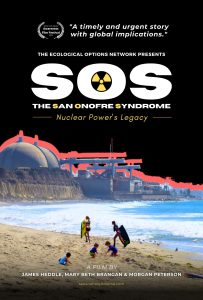
Photo:sanonofresyndrome.com/press-kit


By John LaForge

The new documentary film from producer/director Mary Beth Brangan, “SOS – The San Onofre Syndrome: Nuclear Power’s Legacy” [https://sanonofresyndrome.com/], has won the Awareness Film Festival’s Documentary Feature Grand Jury Award — beating the festival’s 100 other documentary entries. Brangan says that the film “chronicles a community’s victory over leaking reactors, only to confront a chilling reality — deadly radioactive waste stranded next to a rising sea. As temporary containers decay, a nationwide crisis emerges, and the race to avert catastrophe becomes a stark countdown against time.” Haled as “a timely and urgent story with global implications,” the film was recently accepted into the next International Uranium Festival to be screened in Rio de Janeiro, Berlin, and eighteen U.S. cities in 2024.

— SOS: info@sanonofresyndrome.com; https://sanonofresyndrome.com

Filed Under: Environment, Environmental Justice, Newsletter Archives, Nuclear Power, Quarterly Newsletter, Radiation Exposure, Radioactive Waste

  • « Previous Page
  • 1
  • …
  • 8
  • 9
  • 10
  • 11
  • 12
  • …
  • 69
  • Next Page »

Stay Connected

  • Facebook
  • Twitter

Subscribe

Donate

Categories

  • B61 Bombs in Europe
  • Chernobyl
  • Counterfeit Reactor Parts
  • Depleted Uranium
  • Direct Action
  • Environment
  • Environmental Justice
  • Fukushima
  • Lake Superior Barrels
  • Military Spending
  • Newsletter Archives
  • North Korea
  • Nuclear Power
  • Nuclear Weapons
  • Office News
  • On The Bright Side
  • Photo Gallery
  • Protect the Water Close Xcel's Monticello Reactor
  • Quarterly Newsletter
  • Radiation Exposure
  • Radioactive Waste
  • Renewable Energy
  • Social Issues
  • Sulfide Mining
  • Through the Prism of Nonviolence
  • Uncategorized
  • Uranium Mining
  • US Bombs Out of Germany
  • War
  • Weekly Column

Contact Us

(715) 472-4185
nukewatch1@lakeland.ws

Address:
740A Round Lake Road
Luck, Wisconsin 54853
USA

Donate To Nukewatch

News & Information on Nuclear Weapons,
Power, Waste & Nonviolent Resistance

Stay Connected

  • Facebook
  • Twitter

© 2026 · Nukewatch