Nukewatch

Working for a nuclear-free future since 1979

  • Issues
    • Direct Action
    • Environmental Justice
    • Nuclear Power
      • Chernobyl
      • Fukushima
    • Nuclear Weapons
    • On The Bright Side
    • Radiation Exposure
    • Radioactive Waste
    • Renewable Energy
    • Uranium Mining
    • US Bombs Out of Germany
  • Quarterly Newsletter
    • Quarterly Newsletter
    • Newsletter Archives
  • Resources
    • Nuclear Heartland Book
    • Fact Sheets
    • Reports, Studies & Publications
      • The New Nuclear Weapons: $1.74 Trillion for H-bomb Profiteers and Fake Cleanups
      • Nuclear Power: Dead In the Water It Poisoned
      • Thorium Fuel’s Advantages as Mythical as Thor
      • Greenpeace on Fukushima 2016
      • Drinking Water at Risk: Toxic Military Wastes Haunt Lake Superior
    • Nukewatch in the News
    • Links
    • Videos
  • About
    • About Nukewatch
    • Contact Us
  • Get Involved
    • Action Alerts!
    • Calendar
  • Donate

November 2, 2026 by Nukewatch Leave a Comment

Roll Up, Roll Up, Get Your Plutonium Here!

By Linda Pentz Gunter

Edited by Nukewatch Staff for space

In yet another alarming development coming from the White House, private corporations proposing risky, untested startup reactors are to be given access to plutonium, the most toxic material known to science and the fore trigger in nuclear bombs.

A May 27 exposé in The New York Times revealed that the Trump administration is proposing to allow private entities access to Cold War-era leftover plutonium in order to convert it into fuel for risky new reactor designs that have yet to pass any kind of rigorous safety analysis.

The move marks a dangerous commercialization of plutonium and would treat plutonium like a commodity with value, instead of as a long-lived lethal waste. One of the first companies to benefit is Oklo, on whose board the current Energy Secretary, Chris Wright, used to sit and whose stock rose on the announcement.

The other companies involved, according to reporting in The Times, are Standard Nuclear, Exodys Energy, SHINE Technologies, and Flibe Energy. The plutonium would come from a surplus stockpile of dismantled nuclear warheads. Previous efforts to use plutonium as reactor fuel [in South Carolina] collapsed due to extreme expense and technical challenges.

Oklo, and its European partner, Newcleo — a nuclear “innovation” company registered in France — claim they can produce reactor fuel from surplus plutonium faster than waiting for new fuel production to get up and running in the United States. This, argues Ed Lyman, a senior scientist in the Global Security Program of the Union of Concerned Scientists, is simply nonsense.

“The idea that plutonium could actually be used more quickly than uranium fuel is absurd because of the complexity, and the attention to safety and security that a plutonium fuel facility would require,” Lyman said, speaking during a recent Capitol Hill briefing on the risks and unaffordability of new nuclear projects.

Given its sole use as the key component of thermonuclear bombs, any use of plutonium, especially in the private sector, would require extreme security measures. Placing plutonium material in the hands of private multinational corporations not only sets a dangerous precedent but, “raises serious weapons proliferation concerns, makes little economic sense, and may adversely affect the nation’s defense posture,” wrote three Democratic members of Congress — Don Beyer of Virginia, John Garamendi of California, and Ed Markey of Massachusetts — in a letter last September to the Department of Energy.

“Taking plutonium, surplus plutonium, and handing it to industry for fuel,” said longtime nuclear nonproliferation policy expert Sharon Squassoni, represents an ominous crossover from the civil into the military nuclear sector. “In terms of the military-versus-civilian line blurring, why is that so important? Because if it’s not civilian, you don’t [get] Nuclear Regulatory Commission (NRC) regulation,” she said during remarks alongside Lyman and others during the Capitol Hill briefing. That is, the new startup reactors will be able to avoid all safety regulations imposed on today’s reactors by the U.S. NRC.

The plan to build a factory to fabricate a fuel blend known as mixed-oxide, or MOX, at the Savannah River Site in Aiken, South Carolina — using uranium and surplus plutonium — eventually collapsed, partially due to the ever-ballooning price tag, which reached $50 billion before the project was abandoned.

Part of the extreme costs were due to the myriad technical challenges and the fact that … no existing U.S. reactors at the time were designed to do so.

Reprocessing itself is a highly expensive and polluting procedure, resulting in greater volumes of radioactive waste — much of it released into the environment — even as it reduces the levels of radioactivity within the waste. As a result of reprocessing at the Sellafield site in the UK, the Irish Sea is now considered the most radioactive sea in the world, due to the site’s liquid radioactive discharges.

A MOX fuel fabrication facility was under construction at the Savannah River Site in South Carolina for years before being abandoned after wasting $50 billion.

“Trying to convert this material into reactor fuel is insanity. It would entail trying to repeat the disastrous MOX fuel program and hoping for a different result,” Edwin Lyman, told Reuters last August.

More than 20 years ago, the now closed Nuclear Control Institute (NCI), for which Lyman used to work, called out the dangers of using plutonium in the commercial sector.

The NCI warned then of what would become the intolerably high costs of making MOX, writing: “The MOX approach would take decades to complete, require billions of taxpayers dollars in subsidies to electrical utility companies, and promote plutonium fuel industries in other countries.”

“Converting warhead plutonium into fuel for generating electricity would stimulate commerce in this extremely toxic, weapons-usable material,” the institute said, adding, “Fifteen pounds of plutonium is enough for one atomic bomb. A few specks of it inhaled into the lungs cause cancer. Commerce in many tons of plutonium raises risks of theft by terrorists and outlaw states, and of aggravating the consequences of reactor accidents.”

— Linda Pentz Gunter is Executive Director of Beyond Nuclear, writes for Capitol Hill Citizen, edits Beyond Nuclear International, and is the author of No To Nuclear: Why Nuclear Power Destroys Lives, Derails Climate Progress, and Provokes War (Pluto Press 2026).
Filed Under: Environment, Newsletter Archives, Nuclear Power, Nuclear Weapons, Quarterly Newsletter, Radioactive Waste

November 2, 2026 by Nukewatch Leave a Comment

Japan’s Waste Dispersal from Triple Meltdown: Not Just Tritium

By John LaForge

Radioactive cooling water, contaminated after being used to cool melted uranium and plutonium fuel inside three destroyed reactors is being dispersed to the Pacific Ocean by Tepco, the owner of the world’s only triple meltdown disaster site: Fukushima-Daiichi in Japan. In addition, large amounts of groundwater and rainwater, that continuously pour into the wrecked reactors through earthquake-caused cracks in foundations, also become contaminated and require storage and treatment. After limited decontamination, the wastewater is allowed to add to oceanic pollution even in the face of international criticism, protest, and several national bans on the importation of Japanese seafood from the region.

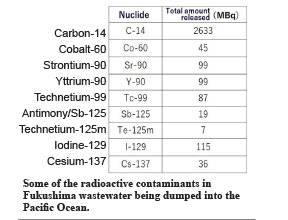
The Citizens Nuclear Information Center in Tokyo (CNIC) reported last summer, in its “Nuke Info Tokyo” #232, that many radioactive materials contaminate the wastewater being sent into the Pacific.

While Fukushima’s owner Tepco, Japan’s government, and the corporate media regularly claim that tritium is the only radioactive Fukushima waste that is in the wastewater being dispersed, the chart (at right) records other highly radioactive materials in the wastewater, and total amounts through the end of 2025.

The total amount of nuclides released other than tritium were calculated from their residual concentrations in the treated water and the total amount of the treated water released. By December 2025, a total of 133,321 cubic meters (639 barrels) of wastewater had been dumped, containing an estimated total of about 31.2 trillion becquerels of tritium.

What does “MBq” mean? “MBq” stands for mega-becquerel or one-million becquerels. A measure of ionizing radiation, one becquerel is one atomic disintegration per second.

Tepco has estimated that it has dumped 2,633 million (2.6 trillion) becquerels of radioactive carbon-14 into the Pacific Ocean, along with all the tritium and other radioactive elements.
Carbon-14 has a radioactive half-life of 5,730 years. After one half-life (5,730 years), 50% of the carbon-14 remains. Scientists say it takes ten half-lives for radioactive material to decay. So, all the carbon-14 being poured into the Pacific from Fukushima will remain there, contaminating sea life and the food web, for about 57,000 years.

Japan’s Radioactive Waste Discharge Makes Others Bear the Cost

By Chen Xiang

Japan has now completed 20 rounds of discharge, releasing roughly 157,000 tonnes of nuclear-contaminated water in total.

A simulation study by a research team at Tsinghua University [in Beijing] previously showed that after entering the ocean, contaminated water could spread across most of the North Pacific and reach the coast of North America in about 1,200 days, or roughly 3.3 years.

By the start of this latest discharge, nearly three years have passed since Japan began releasing the water, and trace amounts of radionuclides such as tritium and carbon-14 have been detected in many areas of the North Pacific.

The discharge poses long-term, latent, and cumulative risks, with potential ecological and health impacts that warrant close attention. It is not an acute health hazard with immediate effects; its negative impacts may continue to accumulate and spread imperceptibly over an extended period.

The Comprehensive Report on the Safety Review of the ALPS-Treated Water … released by the International Atomic Energy Agency on July 4, 2023, noted that the ALPS “does not remove all radioactive material. Small amounts of different radionuclides remain in the water (although they are well below regulatory limits) even after treatment, and tritium is not removed by the ALPS system at all.”

These residual radioactive substances could potentially accumulate through marine food chains, or food web, and eventually enter the human food supply, posing continuing risks to the health of people living along the North Pacific coast, or who consume seafood products from there, over the coming decades.

It is therefore clear that short-term monitoring results meeting safety standards do not guarantee absolute safety, nor can they justify Japan’s reckless discharge of nuclear-contaminated water…. People in Pacific coastal countries should not be forced to bear the health and ecological consequences of Japan’s nuclear accident.

Japan’s unilateral decision to discharge nuclear-contaminated water into the ocean constitutes a serious violation of international law…. Japan has seriously violated its obligations under the United Nations Convention on the Law of the Sea to protect and preserve the marine environment.

International rules lack binding corrective mechanisms and are unable to effectively halt Japan’s discharge of nuclear-contaminated water. As a result, Japan has been able to shift the costs of managing its nuclear accident and its ecological consequences onto the rest of the world.

— The author, an Associate Research Fellow at the Institute of Japanese Studies, Chinese Academy of Social Sciences, wrote this for People’s Daily.

Filed Under: Environment, Fukushima, Newsletter Archives, Nuclear Power, Quarterly Newsletter, Radiation Exposure, Radioactive Waste

June 21, 2026 by Nukewatch Leave a Comment

Spring/Summer 2026 Quarterly

Click the links below to access articles from the Spring/Summer 2026 Quarterly Newsletter. Page numbers take you to the pdf of each page as they appear in the print version. Individual articles are also tagged by issue category.

Page 1

European States, Vatican Reject U.S. War on Iran

Proximity to Nuclear Reactors Associated with Increased Cancer Deaths

Monticello Reactor Leaks Oil to Mississippi while Shut Down for Repairs

Page 2

What Ever Happened to My ‘World-Class’ Nuclear Regulator? U.S. Showcases Dangerous Nuclear Reactor Designs

Page 3

No More ‘New START’ Nuclear Weapons Numbers Treaty May Have Been Worse than Useless

Cesium Contamination of Some Imported Consumer Goods Brings Criminal Charges

Page 4 

Supreme Court Clears Path for “Mobile Chernobyls”

Canada’s Reactor Safety Commission Slammed for Ignoring Offsite Emissions

Radiation Rule Changes Would Increase Allowable Exposures

Page 5

Biggest Arms Dealers Break Sales Record

China Reaffirms Nuclear No-First-Use Policy

Russian Nuclear-capable Oreshnik Missiles in Belarus

Opposition to More Nuclear Waste in Utah

Executive Order and Global Hegemony

Nuclear Power Fails Another Year in the Global Marketplace

White House Offers Cash Bribes to States to Host High-level Rad Waste Dump

U.S. and Israel Strike Iran Nuclear Reactor

Page 6

Reviving nuclear power in Vermont — or anywhere — would be a health hazard

A History of Scientists’ Warnings About Radiation Exposures

Page 7

Fukushima Meltdowns 15 Years On

Page 8

Mississippi River Coalition Commemorates 15 Years Since Fukushima Reactor Meltdowns

From the archives: 1971 Monticello Reactor Releases Led to Mpls Water Shutoff


Filed Under: Newsletter Archives, Quarterly Newsletter

June 21, 2026 by Nukewatch Leave a Comment

European States, Vatican Reject U.S. War on Iran

By John LaForge

Advisory warns of 'heightened threat environment' in US after Iran ...

Spain and Austria have refused to allow their airspace to be used by U.S. warplanes in the bombardment of Iran. Additionally, Italians so overwhelmingly oppose the U.S. and Israeli war, that even their right-wing Prime Minister Giorgia Meloni has spoken out.

Meloni told Parliament March 14, “Threats are becoming more and more frightening. They’re multiplying, and the unilateral interventions carried outside the perimeter of international law — which is where we must place the American and Israeli intervention against the Iranian regime — interventions in which I say immediately, at the expense of any mistake, Italy will not take part and does not intend to take part.”

Spain’s Prime Minister Pedro Sánchez was more emphatic, calling the war “absurd, cruel and illegal,” and saying on March 25: “Of course we are going to put all the resources of the state at the service of the people, to protect them from a war, a war on Iran which is not endorsed by the government of Spain. And I say to the right, and the far-right, that they cannot be supporting those who set fire to the world and then complain about the smoke….”

Mark Botanga, a Belgian Member of European Parliament outraged by the killing of children, said in Parliament March 11: “Most of you don’t condemn and even support Trump’s & Netanyahu’s war on Iran, yet claim to stand with the Iranian people. Now I dare you to say that to the eyes of that 7-year-old girl … that was killed when a U.S. Tomahawk missile hit her elementary school. Dare to admit to the 167 other victims in that school that you are offering European bases to U.S. killing machines. Tell the families of Tehran, a city of 10 million people, that you support the chemical warfare of Israel as it poisons the air with toxic fires and black rain that will cause cancers for decades…. Afghanistan, Libya, Syria, Iraq: your bombs never brought democracy and never will. They bring chaos, death, destruction, and the unbearable silence of children who will never come home.”

And António Costa, President of the European Council, wrote on social media, “Any targeting of civilian infrastructure … is illegal and unacceptable.”

Pope Rebukes Hegseth’s War Prayer

During a March 29 Palm Sunday mass in St. Peter’s Square, Pope Leo denounced the U.S. and Israeli war on Iran as “atrocious” and indirectly rebuked U.S. Secretary of War Pete Hegseth for a war prayer delivered in Washington, D.C.

Quoting a passage from the Christian Bible, the Pope said: “‘Even though you make many prayers, I will not listen: your hands are full of blood.’”

Hegseth ⸺ a white supremacist and religious fundamentalist tattooed with the papal Crusader cross, who titled his book “American Crusade,” and who paid $50,000 to a woman who accused him of sexual assault in 2017 ⸺ used a March 25 “Christian” worship service for military and civilian workers in Washington to pray for merciless killing. Hegseth prayed: “Let every round find its mark against the enemies of righteousness and our great nation. Give [U.S. warriors] wisdom in every decision, endurance for the trial ahead, unbreakable unity, and overwhelming violence of action against those who deserve no mercy.”

In his apparent rebuttal four days later, Pope Leo told tens of thousands of worshippers, “This is our God: Jesus, king of peace, who rejects war, whom no one can use to justify war. He does not listen to the prayers of those who wage war, but rejects them.”

In March, when Trump demanded military help in forcing open the Strait of Hormuz, even Nigel Farange, the leader of Britain’s right-wing Reform UK party, said England shouldn’t participate in “another foreign war.” Italy’s Deputy Prime Minister Matteo Salvini bluntly refused saying, “Italy isn’t at war with anyone.” And when Trump asked allies for naval help, Boris Pistorious, Germany’s defense minister said “This is not our war; we have not started it.”

Elsewhere around the world, Oman declared the U.S. war a violation of international law and warned of regional destabilization. Algeria called it a “flagrant violation of sovereignty” and “American-Zionist aggression.” On April 2, over 100 U.S.-based international law experts signed an open letter calling the war “a clear violation of the UN Charter” involving possible violations of international humanitarian law, and “potential war crimes.” Detailing profound concerns about the war, the letter was signed by senior professors, leaders of prominent international law associations, non-governmental organizations, and legal clinics, former government legal advisors, and military law experts including former (U.S. military) Judge Advocates General.

Filed Under: Newsletter Archives, Quarterly Newsletter, War

June 21, 2026 by Nukewatch Leave a Comment

Proximity to Nuclear Reactors Associated with Increased Cancer Deaths

By Maya Brownstein

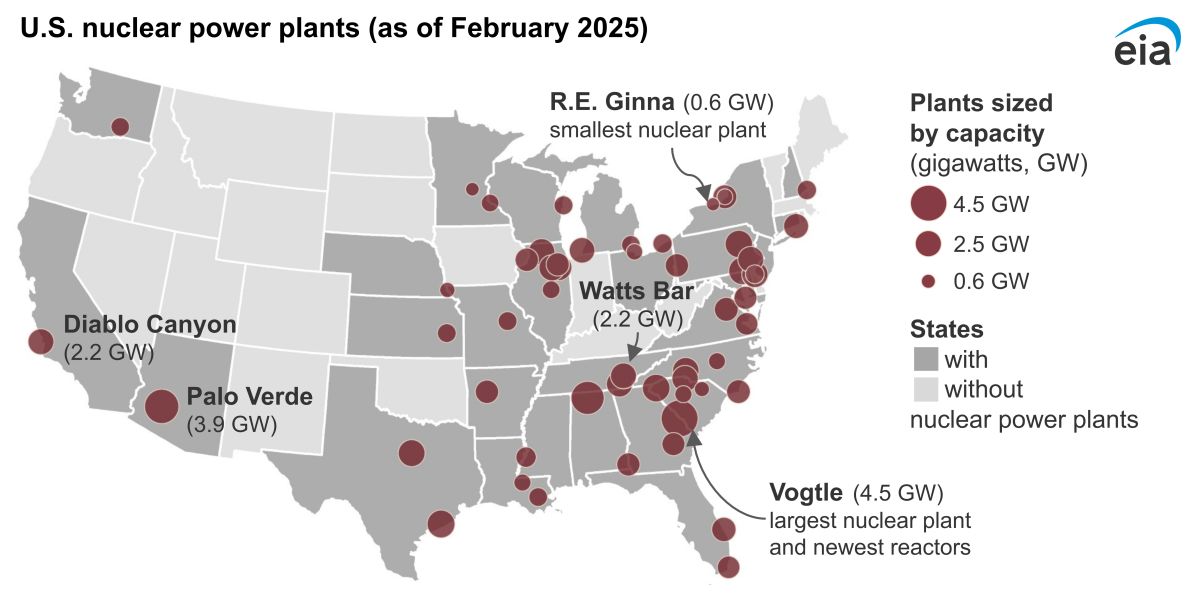
BOSTON, Mass. — U.S. counties located closer to operational nuclear power plants (NPPs) have higher rates of cancer mortality than those located farther away, according to a new study led by the Harvard T.H. Chan School of Public Health.

The study is the first of the 21st century to analyze proximity to NPPs and cancer mortality across all NPPs and every U.S. county. The researchers emphasized that the findings are not enough to establish causality but do highlight the need for further research into nuclear power’s health impacts.

The study was published Feb. 23, 2026, in the journal Nature Communications.Where Is the Largest Nuclear Power Plant in the U.S.? Top 20 for 2025 ...

Numerous studies on the potential link between NPPs and cancer have been conducted around the world, with conflicting results. In the U.S., these studies have been rare and limited in their scope, focused on a single NPP and its surrounding community.

To expand the evidence base, the researchers conducted a national assessment of NPPs and cancer mortality between 2000 and 2018 using “continuous proximity.” They used advanced statistical modeling that captured the cumulative impact of all nearby NPPs, rather than just one. The locations and dates of operation of U.S. NPPs — as well as some nearby in Canada — were obtained from the U.S. Energy Information Administration, and county-level data on cancer mortality was obtained from the Centers for Disease Control and Prevention. The researchers controlled for potential confounders [that might effect data] in each county, including educational attainment, median household income, racial composition, average temperature and relative humidity, smoking prevalence, BMI [body mass index], and proximity to the nearest hospital.

The study found that U.S. counties located closer to nuclear power plants experienced higher cancer mortality rates, even after accounting for socioeconomic, environmental, and health care factors. The researchers estimated that over the course of the study period, roughly 115,000 cancer deaths across the U.S. (or about 6,400 deaths per year) were attributable to proximity to NPPs. The association was strongest among older adults.

“Our study suggests that living near a NPP may carry a measurable cancer risk — one that lessens with distance,” said senior author Petros Koutrakis, Professor of Environmental Health and Human Habitation. “We recommend that more studies be done that address the issue of NPPs and health impacts, particularly at a time when nuclear power is being promoted as a clean solution to climate change.”

The researchers noted that the results are consistent with the results of a similar study they conducted in Massachusetts, which identified elevated cancer incidence among populations living closer to NPPs.

They also noted some limitations to the study, including that it did not incorporate direct radiation measurements and instead assumed equal impact by [emissions from] all NPPs.

— Maya Brownstein is the Media Relations Manager in the Office of Communications, Chan School of Public Health.

— Link to Harvard report is here: https://www.nature.com/articles/s41467-026-69285-4

Filed Under: Environment, Newsletter Archives, Nuclear Power, Quarterly Newsletter, Radiation Exposure

  • « Previous Page
  • 1
  • …
  • 3
  • 4
  • 5
  • 6
  • 7
  • …
  • 222
  • Next Page »

Stay Connected

  • Facebook
  • Twitter

Subscribe

Donate

Categories

  • B61 Bombs in Europe
  • Chernobyl
  • Counterfeit Reactor Parts
  • Depleted Uranium
  • Direct Action
  • Environment
  • Environmental Justice
  • Fukushima
  • Lake Superior Barrels
  • Military Spending
  • Newsletter Archives
  • North Korea
  • Nuclear Power
  • Nuclear Weapons
  • Office News
  • On The Bright Side
  • Photo Gallery
  • Protect the Water Close Xcel's Monticello Reactor
  • Quarterly Newsletter
  • Radiation Exposure
  • Radioactive Waste
  • Renewable Energy
  • Social Issues
  • Sulfide Mining
  • Through the Prism of Nonviolence
  • Uncategorized
  • Uranium Mining
  • US Bombs Out of Germany
  • War
  • Weekly Column

Contact Us

(715) 472-4185
nukewatch1@lakeland.ws

Address:
740A Round Lake Road
Luck, Wisconsin 54853
USA

Donate To Nukewatch

News & Information on Nuclear Weapons,
Power, Waste & Nonviolent Resistance

Stay Connected

  • Facebook
  • Twitter

© 2026 · Nukewatch